
Written by Kate Freney
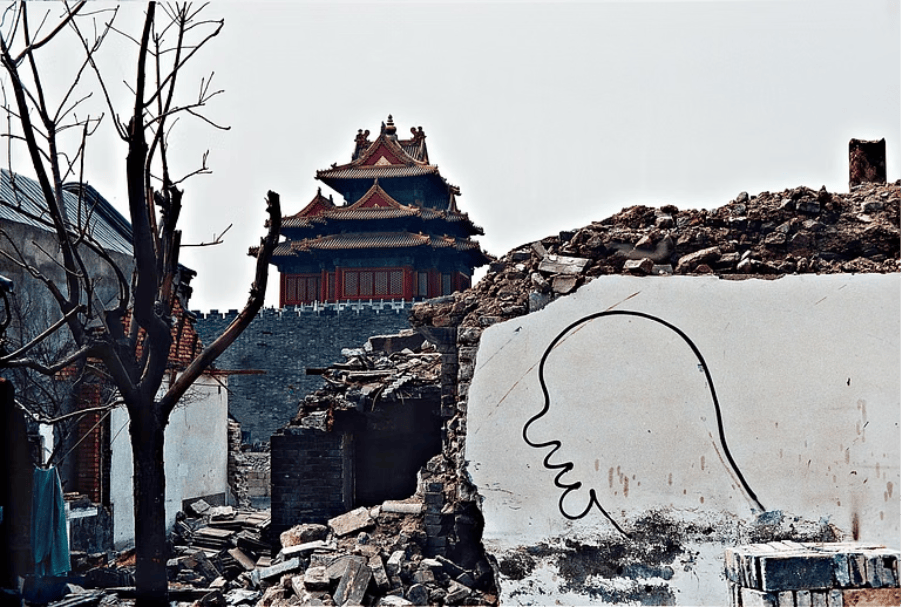
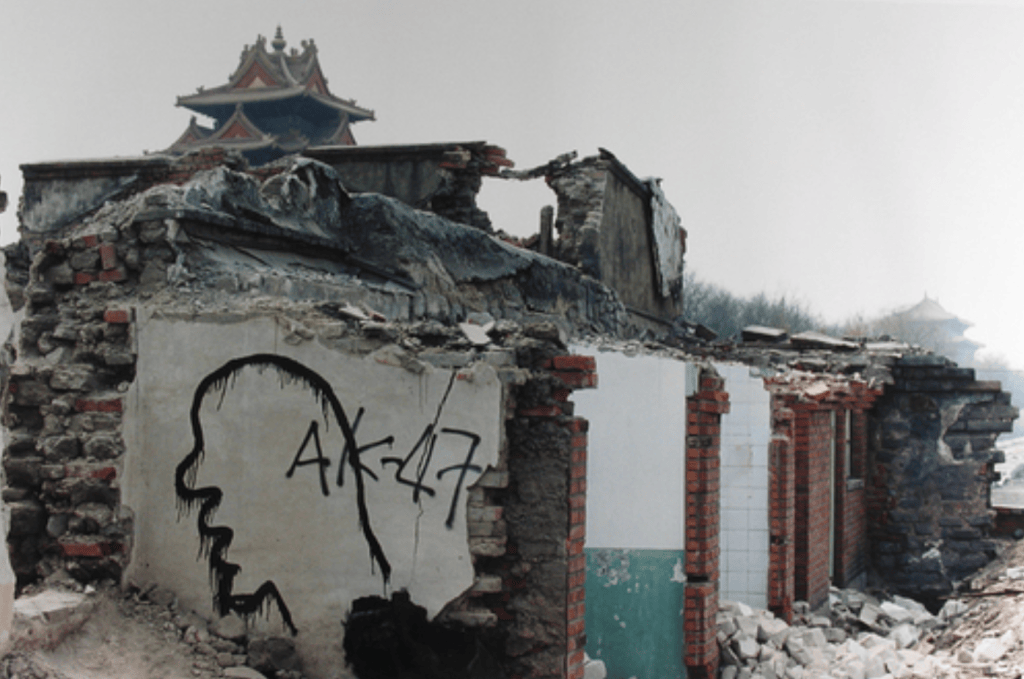
In early 1998, Beijing’s newspapers argued over a face. For months, a spray-painted profile of a bald head, sometimes reaching two meters tall, had been appearing on walls across the city, from the older inner neighbourhoods past the Third Ring Road. Residents and critics disagreed over whether the painter deserved punishment or praise, and in a city that – as the art historian Wu Hung notes – had never been exposed to Western graffiti, there was no settled answer. The debate brought a far larger question to the fore: what happens to an art form defined by transgression when it arrives in a state that controls public space?
Nothing to See Here
From the outside, that question may seem to have an obvious answer. To a Western ear, the idea of graffiti in China sounds like a contradiction. With a one-party state wielding a well-oiled censorship system, and a capital known for its surveillance, it may be natural to assume that unsanctioned writing on public property would be prohibited. Its appearance would surely be an act of defiance, swiftly painted over and harshly punished. In Orientalism (1978), Edward Said posits that the West has long understood – or rather misunderstood – “the East”; less through its actual reality than through what the West imagines itself not to be, the West casts itself in a flattering glow of freedom, reason, and modernity, with the East left in a shadow of despotism, stasis, and opacity. Said wrote mainly about the Middle East, but China is often pictured similarly: a place where the state controls everything, and individuals can only obey or resist.
The assumption is tempting and not baseless. The Democracy Wall of 1978-79, where young activists posted big-character posters (dàzìbào) calling for civil liberties, ended in suppression. All pro-democracy activity was banned in early 1981, and many activists received harsh prison sentences. Yet even this story is not straightforward. In November of 1978, Deng Xiaoping publicly stated that China’s constitution permitted big-character posters. The wall was initially tolerated, then moved to a remote park at the end of 1979, and only then shut down. Suppression came, but slowly, unevenly, and after considerable internal debate. What emerges is a pattern of tolerance, relocation, and limits, rather than instant erasure. To understand it, we must look further back to China’s long tradition of writing on walls.
The Writing was Always on the Walls
Long before spray paint, China had a well-established culture of writing in public. From the Tang dynasty on, poets routinely inscribed verses on the walls of temples, inns, courier stations, and government offices. These “poems written on walls” (tibishi) were not furtive scrawls. Before printing became widespread, a wall was one of the best ways to show your work to an audience. As the literary scholar Judith Zeitlin puts it, where graffiti is usually understood as “writing out of place”, tibishi were “writing in place”, a legitimate and admired practice. That is not to say the practice was uncontested. A Ming-dynasty essay entitled “How to Kill Scenery” listed inscribing poems at famous mountain sites alongside crimes such as using a pine grove as a toilet. Yet there was equally little patience for the opposite complaint: in anecdotes from this period, anyone who grumbled that a poem had spoiled a nice, clean wall was likely to be mocked as a philistine. Writing on walls, in other words, was neither forbidden nor free. It was governed by shared ideas of where, what, and by whom. The twentieth century changed who set those rules. After the founding of the People’s Republic of China in 1949, the state took over the wall as a medium, using political campaigns to fill public spaces with slogans. Big-character posters mostly spread official doctrine, but, as the art historian Minna Valjakka points out, they offered “an opportunity for political self-expression within certain limits”. Within certain limits aptly depicts the nature of writing on Chinese walls. From the Tang poet to the Maoist poster, public writing in China has rarely been either simply permitted or simply suppressed. It has been negotiated. When contemporary graffiti arrived in the 1990s, the name was new, but the questions it raised were centuries old.
Zhang Dali: Talking to a Wall
The painter was Zhang Dali, a Beijing-trained artist who had first painted the head while living in Bologna and brought it home in 1995. By 1998, he had sprayed more than 2,000 of them across Beijing, most on buildings marked with the character chai (拆), “demolish”. The city was in the middle of a building boom, and its old lanes and courtyard houses were being cleared at extraordinary speed. Zhang’s heads appeared exactly where the old city was disappearing. When the newspaper debate began, Zhang did not go into hiding. He came forward as the artist and was soon giving interviews to reporters and critics. Far from an outlaw, he was a graduate of one of Beijing’s leading art academies, with a carefully worked-out explanation for his project: the head was a self-portrait, a stand-in through which he hoped to engage the city in a “dialogue” with himself. The city’s response was less clear-cut. Neither celebration nor repression ensued. Wu Hung described residents’ reactions as ranging “from indifference to suspicion, fear, misunderstanding, and rejection”. Nobody quite knew what to do with the heads, and so, for the most part, they remained. Beijing, as Wu illustrates, had become a city that could tolerate this new iteration of this art form, “however unwillingly”. Foreign observers, meanwhile, had painted a picture of their own. Some journalists described Zhang’s work as a “declared graffiti war” on demolition and linked it, as the historian Maurizio Marinelli notes, “somewhat dubiously” to the Democracy Wall dissidents of 1979. A Chinese artist painting on condemned buildings had to be a dissident. The idea that he might be doing something more ambiguous – observing, questioning, starting a conversation – did not fit the lens through which the West views China.
The story sold well. Zhang’s photographs of his graffiti were soon on sale in a foreign-owned gallery in Beijing, and one appeared on the cover of Newsweek. Having failed, in Wu’s words, “to engage Beijing in a direct conversation”, Zhang’s work instead came to symbolise a new image of the city, largely for audiences abroad. The West, it seems, was happy to buy Chinese protest, even when the artist had not quite said that was what he was selling.
Now You See it
If Zhang Dali showed that graffiti could survive in Beijing, the decade that followed showed how. By the late 2000s, the city’s graffiti scene was concentrated in a handful of places, above all the 798-art district, a former factory complex turned gallery quarter. When Minna Valjakka carried out fieldwork there between 2006 and 2009, she found hundreds of pieces covering its walls, some of which had stayed untouched for more than a year. There was, she noted, no systematic programme to erase them. Officials appeared to treat the art districts differently from the rest of the city’s public spaces. The tolerance was real, but not static. Spring of 2008, as Beijing prepared for the Olympic Games, graffiti in 798 was no longer allowed as freely as before, and writers largely kept away. Then the Games ended, pressure eased, and by the following summer the graffiti had returned and exceeded its original vibrant state. Control, in other words, ebbed and flowed in tandem with political circumstance.
Simultaneously, officials discovered the utility of graffiti. Before the Olympics, writers were invited to paint large pieces on an official “cultural wall” near 798, which was still intact a year later. Valjakka argues that these officials were using graffiti to improve the image of the city, and in Beijing’s case, the whole nation, presenting themselves as more tolerant of youth culture and self-expression. What, then, keeps Chinese graffiti in line, if not the threat of the paint roller? Part of the answer lies with the writers themselves. Valjakka found that most accepted paid commissions, chose non-political imagery (if there is such a thing), and painted where they knew it would be tolerated. It would be easy to read this as proof that Chinese graffiti is tame. It could equally be read as a sign of how effective a quieter form of control can be. When everyone already knows where the line is, it rarely needs to be enforced.
This is precisely what the Western image of China tends to miss. It conceives of suppression as something visible: an arrest, a scrubbed-out slogan, a banned exhibition. In Beijing’s graffiti scene, the limits were mostly invisible. They were drawn by zoning, timing, patronage, and the writers’ own judgement of what was safe.
Tagged by the State
The Kwanyin Clan shows how far this process could go. Founded in Beijing in 2006 and based in the 798 district, the crew became known for what the scholar Adriana Iezzi calls “modern literati graffiti”: work that combines spray paint with the arts of China’s traditional scholar class, such as calligraphy, poetry, and ink painting. Their aim, Iezzi notes, was the enhancement and beautification of urban space, “not rebellion”. Their unauthorised work was mostly apolitical. In April 2008, they painted a long mural entitled Olympic Beijing for a campaign co-sponsored by the Beijing Olympic Committee. It was packed with symbols of national greatness: from calligraphy and pagodas to the Olympic torch, all in a sea of red. An art form born on American streets in the words of Valjakka became, a new tool of “visual propaganda in urban public spaces”.
This raises an uneasy question about the “Chinese style” many writers were searching for. Is a mural of pagodas and bamboo a comprehensively authentic expression of Chinese tradition, or is it window dressing for state and global audiences? The historian Arif Dirlik describes how Chinese elites have sometimes absorbed Western stereotypes of China and presented them back as their own, a process he calls self-orientalising. Iezzi herself links the crew’s government collaborations to China’s use of contemporary art as soft power. The answer is likely both. The crew had mixed Chinese characters into their work since their very first mural, long before any Olympic commission, so their interest in tradition was genuine; yet the images chosen for Olympic Beijing were the most recognisable, exportable signs of “China” available. Either way, the state did not need to suppress the Kwanyin Clan. It found a use for them.
Writing on the Wall
So, what does happen to an art form defined by transgression when it arrives in a state that controls public space? In Beijing, it was neither crushed nor set free. It found art districts where nobody painted over it, semi-legal walls where nobody asked, an Olympic summer when it vanished and an autumn when it came back. It was tolerated, relocated and, at times, recruited. None of this should surprise us as much as it does. Chinese poets were writing on walls within certain limits a thousand years before anyone in New York picked up a spray can. The surprise comes from the image we bring with us: a China in which the state either controls everything or is openly defied, with nothing in between.
Yet the grey zones are not uniquely Chinese. As Wu Hung points out, Western cities have long tried to confine street graffiti to designated areas. They commission murals, sell graffiti-style art in galleries, and hang a Keith Haring poster in the living room while demanding a stop to vandalism outside. What orientalism hides is not only how China works, but how similar the West’s own arrangements can be. The picture today, under a tighter political climate, may well look different, but the lesson holds. If we look at China’s walls expecting only repression or resistance, we will see neither clearly. The most revealing writing has always been in between.
Bibliography
Dirlik, A. (1996) ‘Chinese History and the Question of Orientalism’, History and Theory, 35(4), pp. 96–118.
Iezzi, A. (2019) ‘The Kwanyin Clan: Modern Literati Graffiti Writers’, Annali di Ca’ Foscari. Serie orientale, 55, pp. 395–448.
Marinelli, M. (2004) ‘Walls of Dialogue in the Chinese Space’, China Information, 18(3), pp. 429–462.
Opletal, H. (2021) ‘The 1978–1981 Democracy Wall Movement’, Journal of the European Association for Chinese Studies, 2, pp. 127–167.
Said, E. (1978) Orientalism. New York: Pantheon Books.
Valjakka, M. (2011) ‘Graffiti in China – Chinese Graffiti?’, The Copenhagen Journal of Asian Studies, 29(1), pp. 61–91.
Valjakka, M. (2015) ‘Negotiating Spatial Politics: Site-Responsive Urban Art Images in Mainland China’, China Information, 29(2), pp. 253–281.
Wu, H. (2000) ‘Zhang Dali’s Dialogue: Conversation with a City’, Public Culture, 12(3), pp. 749–768.
Zeitlin, J.T. (2003) ‘Disappearing Verses: Writing on Walls and Anxieties of Loss’, in Zeitlin, J.T. and Liu, L.H. (eds.) Writing and Materiality in China: Essays in Honor of Patrick Hanan. Cambridge, MA: Harvard University Asia Center, pp. 73–132.
Image Credits
Zhang Dali, “Dialogue and Demolition”, 1999. Image available at https://www.bukowskis.com/en/auctions/F836/lots/1688628-zhang-dali-dialogue-and-demolition-1999

