Written by Poppy Williams
12/10/2026
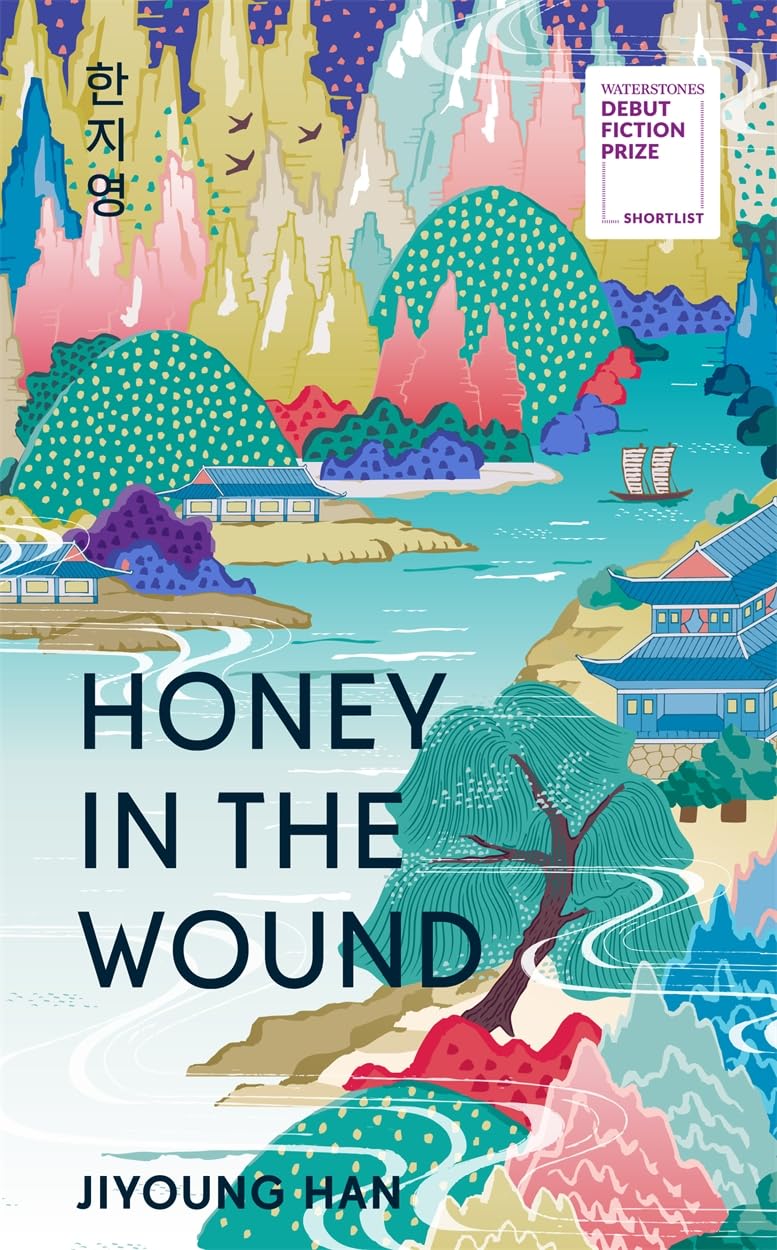
I, a blissfully ignorant English student, pulled Honey in the Wound off the shelf of the Princes Street Waterstones, entirely unaware that I would not be able to stop thinking about it for the next two months. That’s the beauty of reading I suppose. Jiyoung Han was an author I’d never encountered and, were it not for her publisher’s cover design, may have remained that way. The blurb only solidified my purchase. To quote it directly, Honey in the Wound “follows a mysteriously gifted lineage of Korean women as they are displaced across Asia by Japanese imperialism.” A historical fiction blended with fantasy; I was sold. Little did I know …
With limited words I must gloss over the gloriously crafted initial chapters to pay the heart of the novel the attention it deserves – though I shall divulge that they follow a young girl who, in seeking freedom, transforms into a tiger to protect her homeland; and a mother to whom nobody can tell a lie. Every character Han writes is exceptionally well crafted and illustrates the unwavering action of Korean women over the generations to resist colonial rule. We then move to follow the novel’s main protagonist, her daughter, Young-Ja, a girl whose cooking transfers her feelings to those who eat. Her family brutally murdered and her sister abducted by Japanese soldiers, Young-Ja manages to escape on the verge of death (with the help of the trusty tiger). This event shapes the remainder of her life.
Her grief from this brutality is the first pivotal moment of Young-Ja’s story. Han’s exploration of loss is masterfully expressed through Young-Ja’s longing for her home and her family, which forms the backdrop for her later interactions (particularly with other women). An especially poignant relationship for Young-Ja after her family’s murder is with an old Japanese woman, Seiko. Seiko nurses her back to health and soon they both share their grief (absorbed through Young-Ja’s cooking by Seiko), and form an intimate mother-daughter bond through which Han evokes a deep sense of feminine unity and dependence. These female relationships are portrayed as essential to Young-Ja’s survival, particularly after her heartbreaking parting from Seiko, who sends Young-Ja away to China after discovering her husband’s sexual exploitation. This moment particularly stuck with me; Young-Ja never learned the reason for having been sent away, believing it a fault of her own rather than for her protection.
Young-Ja is sent away with an (at this point unknown) Korean resistance fighter to work in teahouse under the brutality of Feng-nüshi, a woman known to cut off the fingers of girls who make any mistake. Though initially hard to stomach, Young-Ja’s seven years here see her become a server tasked with observing and reporting to her mistress what the Japanese soldiers discuss, hoping to aid resistance efforts in both China and Korea against the Japanese. Once again, these efforts are undertaken through female friendships and collaboration. Like Young-Ja, the reader learns to find a home in the teahouse after finding their footing. We also learn to admire Feng-nüshi in a way; despite her brutality, she is also a fierce protector of her girls.
A noticeable strength seen throughout Han’s writing is her skill of subversion; she has the deftness to simultaneously build up and crush the readers’ perceived line of events alongside their hope that this is finally the end of Young-Ja’s woes. Han subverts all expectations when Japanese soldiers set light to the teahouse, trapping many of the working women inside, driving some to suicide while Young-Ja is kidnapped.
The shock factor of where Young-Ja lands is most certainly emphasised by my ignorance of the Japanese occupation. This, I surmise, is what Han counted on. The reader shares Young-Ja’s sense of foreboding as she is taken away alongside other young women, unaware of what lays ahead. Just like these women, as was I. Honey in the Wound portrays the brutal reality of the ‘comfort women’; girls (often young) taken by force, or under the promise of a better life or job prospects, and forced to sexually satisfy Japanese soldiers to boost army morale. Han approaches this issue, not delicately, but truthfully. She exposes the brutal reality of the comfort houses and, through Young-Ja, evokes the trauma incurred by these women as the protagonist craves the relief of death but is forced to keep reliving this daily assault. As a result of my Western education, the Asian experience during the World Wars was not something I had learned of before. Han exposes these realities to the western eye, forcing us to confront these lived realities hidden from us.
As we reach the final section of Honey in the Wound, Young-Ja (and, at last, the reader) finds some relief but is permanently altered. Having escaped the comfort house, Han switches our perspective tothat of Young-Ja’s granddaughter (after conceiving from one of her assaulters), Rinako. The narrative shifts forward to the 1990s. Protests are erupting throughout China, Korea and Japan for the Japanese government to acknowledge their actions towards the Comfort Women. Rinako, after only meeting her grandmother in her late teens, provides pride and joy to Young-Ja’s life after decades of near solitude plagued by PTSD. Rinako becomes hugely politically active, pushing for Japanese acknowledgment of Young-Ja’s hardships. This sadly only occurred in the Kono Statement of 1993, almost 50 years after the end of World War II.
Han’s Honey in the Wound is not only a tale of these generations of Korean women but a well-needed lesson to the western world to learn about non-western histories. Her writing takes the reader on a journey of profound heartache with a core story of female connection which transcends history and can be found, and is certainly gripped onto, during times of brutality and hardship. For me, Honey in the Wound has ignited a desire to learn more about these women. Take more time browsing the bookshelves; you’ll likely find something you didn’t realise you needed, too.
Bibliography
Jiyoung Han, Honey in the Wound (London: Bonnier Books, 2026)