
Written by Harry Child
12/10/2026
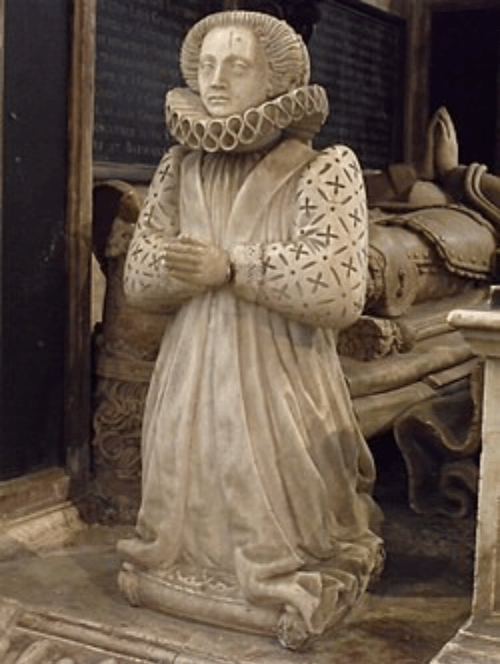
Monument to Elizabeth, 15th Baroness Roos, in Bottesford Church Lincolnshire. She is depicted here, in prayer at the feet of her mother and father, the 3rd Earl and Countess of Rutland.
Introduction
Before I start, I need to mention that a lot of my thoughts surrounding this topic have been greatly influenced by the guides at Burghley House, of which, I am privileged to say, I am a member. Following a talk I gave to them during the summer, the suggestions they put forward were invaluable and have helped me in penning this article, my thanks go to them.
This is the first of three articles I intend to publish with Retrospect this year, looking at extracts of research I completed over the summer months on two lesser-known members of William Cecil’s family, the Lord High Treasurer to Elizabeth I. My principal aim is for William, future 2nd Earl of Exeter (eldest grandson of the Treasurer), and David, future third Earl of Exeter (the Treasurer’s great grandson), to be better-known. Being chronologically the first of such material, with little scholarly attention thus far, makes these figures a good starting point. The marriage between Elizabeth, 15th Baroness Roos and William Cecil, future second Earl of Exeter, is a tragic tale: it epitomises the deeply flawed system of noble marriage in Tudor England and its consequences.
The Build up to the Marriage, 1587-89
In 1587 Edward Manners, the 3rd Earl of Rutland, died in his late thirties. He left behind him only a daughter named Elizabeth who could not inherit his earldom. Earldoms could not pass down the female line at this time, but what he could pass down to her was his lesser title, of which he was the 14th, and she was soon to be the 15th incumbent of. That was the Barony of de Roos (or Ros). She was very young to have lost her father, aged around eleven, but sadly for her, this was not the only instance she had to prematurely grow up; only two years later she was to be wed, no less than to the grandson of the Baron Burghley, the most powerful man in Elizabethan England.
So how did this come to happen? Edward Manners had been a ward of the crown, as the young 3rd Earl of Rutland, and the master of the court of wards at that time was the great Baron Burghley. Rutland was even educated in Burghley’s household. It is said that when he died, the Earl wished for his daughter to marry into Burghley’s family: a good and powerful family that he had established connections to.
In 1589, at age thirteen, Elizabeth married Mr William Cecil, Burghley’s eldest grandson. Yes, at this time, despite being the eldest grandson of the most powerful man in the kingdom, William was only a gentleman, ‘Mr’, not ‘Sir’ or ‘Lord’. The honour of Sir, remarkably enough, was not granted to him until 1603, following King James I’s accension. It’s perfectly plausible, though there is no direct proof, that he was not particularly well thought of by the Virgin Queen, especially as we hear that she had grown suspicious of William by 1600, with his second wife having to intercede to calm her suspicions. This had comeafter he decided a second trip to Italy would be worthwhile: he had already been once as a young man in the 1580s and was lavishly entertained by Cardinal Farnese (the illegitimate son of Pope Paul III) with five man-servants attending to him. James most likely issued this honour to William as a mark of respect to his father, Thomas, who had been one of the first Lords in England to recognise James’s right to be King, and indeed had hosted the new king for a couple of days in York during his progress down to London. This seems plausible, as it was in York that William received his knighthood.
The marriage started badly, an ominous sign of what was to come. This was not to do with the two having incompatible personalities; indeed, what is known of their relationship displays that they at least ‘got on’, but the bad start was rather a financial blow due to Elizabeth’s youth. Elizabeth, only 13 at the time of marriage, was still a ward of the crown. Wardship was a process in Early Modern England by which if a tenant in chief of the crown (which the 3rd Earl of Rutland certainly was) died, with an underage heir, then this heir would be looked after by the crown until they reached age of majority (14 for girls, 21 for boys). The crown would take the estate’s income until then, unless the wardship had been sold to another party (a common occurrence). Elizabeth, therefore, was still a royal ward, and what is more had married without a license from the Queen. The result of this was the new couple were fined £600 for breaking the law of the realm. To put this in perspective, the Bank of England estimates that this would be worth over £200,000 today – a major financial blow indeed. We do have to wonder why the Baron Burghley would have allowed this marriage to go ahead, given he would have been all too familiar with the risks. We can only speculate on this matter at present; it could have been that, upon meeting, Elizabeth and William, decided they wanted to get married and didn’t really consult Burghley, breaking the rules of their own accord and were subsequently punished. Another interpretation might have it that Burghley thought, given his influence, he could get away with marrying them when Elizabeth was still a ward, but ultimately this plan came unstuck. We simply do not know, but these two explanations seem most plausible to me at this time.
Married Life, 1589-1591
The biggest issue of William and Elizabeth’s married life was the birth of their son in 1590. The child was named William, after his great-grandfather, but as historian Stephen Alford suggests, even this was a contentious issue.
Alford tells us that following her pregnancy, Elizabeth and her mother, the dowager countess of Rutland, were keen to name the child Edward. After all, this was the name of Elizabeth’s beloved father. Lord Burghley heard of this and was not pleased. He was to be the child’s godfather, and the convention was that the godson took his godfather’s name, therefore it had to William. Burghley took direct action, writing to the countess in ‘plain’ terms according to Alford, no doubt also applying pressure on his grandson, so that he too affirmed to the great Lord that the child would be named William. An extract from a quote Alford includes in his book on the Baron Burghley highlights this pressure, as William tells his grandfather that he did not wish to make him ‘think we know not our duties’.
In early June 1590, the baby was born and subsequently baptised at Newark. Lord Burghley was seemingly overjoyed with his great grandson’s birth, exclaiming ‘God bless him to follow my purposes, but not my pains nor dangers’. We hear at this time that the baby was “well liking every day more” (in essence, that the baby was healthy), and that Elizabeth was herself seemingly recovering: “the mother gatherethstrength”, as Alford quotes.
But this “gathereth [of] strength” must only have been temporary, for only ten months later, in April of 1591, at the age of only fifteen and having been married less than two years, Elizabeth passed away inTower Street London at the home of her maternal grandfather, and was subsequently buried in St. Nicholas’ chapel in Westminster Abbey. Her cause of death is unknown: it could have been illness, or perhaps her body was not able to recover after childbirth at such a young age. What is known is that, at the age of twenty-five, William had become a widower and his son, only ten months old, would never know his mother.
Aftermath
Few aspects of this marriage ended well for William and his family, neither in the short or long term. In the short term, William was faced with an extensive litigation on Elizabeth’s death. Given she had passed so soon after the marriage, and at such a young age, Elizabeth’s family, amongst others, began challenging William on his right to keep lands and possessions he had obtained through the marriage. J.C.H and P.W Hasler on the History of Parliament Online draw our attention to this and highlight that the litigation was ‘costly’, possibly costing William his freedom, as we next find him in the Fleet Prison for debt, where it is only through contacts, namely with his nephew Robert Cecil, that he is able to be released.
In the long term, William’s son with Elizabeth would grow up to have a short and scandalous life. The Baron Roos, as he is often referred, was central to one of the largest scandals of Jacobean England, which the king himself personally investigated: an alleged affair between Roos and his step-grandmother, Frances Brydges. Whilst he would have political appointments, such as becoming the ambassador to Emperor Matthias of the Holy Roman Empire, his scandalous activity, including alleged Catholicism, would overshadow this. As a final blow to the sheer tragedy of this marriage, the Baron Roos predeceased his father by twenty-one years. At the age of only twenty-nine, travelling in Naples, Lord Roos died, rumoured to have been poisoned.
Conclusion
I hope that at the very least, this story will have introduced you to some lesser known characters of Elizabethan and Jacobean England and made a case for their greater importance in history. Besides telling an interesting but tragic tale, this story does have real resonance for its age: it is an interesting case study illustrating the flawed nature of marriage regulations in Early Modern England, and the damage that could be inflicted to everyone involved in marriages it allowed (albeit with consequences), that perhaps should not have gone ahead.
Bibliography
Sparham, Bob. ‘St Mary’s Bottesford Phase V.III, Monument to Edward Manners, 3rd Earl of Rutland’, Bottesford Living History, https://www.bottesfordhistory.org.uk/content/places/places-of-worship/st-marys-architecture-and-monuments/st-marys-bottesford-phase-v-iii-monument-to-edward-manners-3rd-earl-of-rutland, (2007), (last accessed: 02/10/2026).
Dennis, G. R. The Cecil Family, (Houghton Mifflin Company, 1914).
Charlton, William Henry. The Life of William Cecil, Lord Burghley, Lord High Treasurer of England Etc., (W. Langley, 1847).
Leatham, Victoria. Burghley: The Life of a Great House, (Herbert Press, 1992).
Hasler, J. C. H., & Hasler, P. W. ‘CECIL, William (1566-1640), of London, Newark Castle, Notts.; later of Burghley House, Lincs.’, History of Parliament Online, https://www.historyofparliamentonline.org/volume/1558-1603/member/cecil-william-1566-1640, (last accessed 01/10/2026).
Alford, Stephen. Burghley: William Cecil at the Court of Elizabeth I, (Yale University Press, 2008).
‘Court of Wards and Liveries 1540-1645: land inheritance and disputes’, The National Archives, https://www.nationalarchives.gov.uk/help-with-your-research/research-guides/land-inheritance-court-of-wards-liveries-1540-1645/, (last accessed: 01/10/2026).
‘Inflation Calculator’, Bank of England, https://www.bankofengland.co.uk/monetary-policy/inflation/inflation-calculator, (last accessed: 01/10/2026).
Featured Image Credits
Image taken by J. Hannan-Briggs, sourced from Wikimedia Commons: https://commons.wikimedia.org/wiki/File:Elizabeth,_daughter_of_3rd_Earl_of_Rutland_-_geograph.org.uk_-_2607369.jpg.

