
Written by Millie Oliver
The witch craze that took place in Europe during the early modern period has long been a subject of intense fascination, with endless academic works and media dedicated to the topic. However, the majority of scholarship focuses on western and central Europe, which is fair, but I think more interesting observations surrounding witchcraft beliefs can be made in Europe’s periphery, more specifically in Russia.
The very nature of witchcraft differed greatly in Russia, which in turn meant the nature of their trials and their subjects starkly differed to the typical witch trial we envision.
Unlike western Europe, our story begins much earlier in the year 1000, just after the Christianisation of the Rus. In the medieval period, witchcraft was practiced by magicians, who could be either male or female but in the thirteenth century this practice of magic was not considered a major problem. The concept of magic had been prevalent in Russian society since the medieval period. However, what we now identify as the ‘witch craze’ began in the late sixteenth and early seventeenth centuries. Throughout the country, there were around four hundred trials involving nine hundred individuals. This is not unusual as most areas outside western Europe had significantly lower rates of trial and executions. This is likely because the frenzy observed in western Europe can largely be attributed to the intense nature of the propaganda circulating at the time, whereas in Russia the orthodox church never portrayed the heretical image of witches who were engaged in sinister deals with the devil.
Further departures
The gap between Russia and western Europe becomes even more significant from here, from the accusers to the victims.
All charges of witchcraft were brought from people below (lower classes) who believed they were the victims of witchcraft, and these charges were brought to secular authorities. Petitions were then sent to the Tsar, and he would choose to intervene from the centre and send out orders of what was to be done. The most extreme punishment a supposed witch could have received in Russia was death by burning; however, this was rare and victims were more likely to be buried alive. In fact, the punishment for witchcraft was not automatically death if convicted like we see in the western world, as the normal punishment was flogging or a fine.
Gender dynamics
The most poignant factor of the witch trials is by far the nature of its victims. It’s in western Europe that seventy-five to eighty percent of the victims were women, a fact which compels most people now to believe that the prosecution of ‘witches’ was a disguise to punish women who broke the bounds of a restrictive early modern society. This has resonated with modern women, and the witch trials now function as a central part of contemporary feminist movements. However, the case of Russia completely turns this argument on its head as the opposite was true. In Russia, seventy-five to eighty percent of victims were men, which begs the question of whether the witch trials really were gender specific. Unusually, Russian witch lore remains aloof from western demonological conceptions and misogyny. This argument is fascinating, because for a country the West had long deemed as ‘backwards’ in this period, their attitudes towards witchcraft in comparison are surprisingly enlightened.
Men were more likely to be accused of witchcraft because of Russia’s unique hierarchical class system. In an empire where serfdom dominated the lower classes, men could be accused of witchcraft because they were more likely to be mobile as traders, hunters, travellers, and churchmen whereas women were not. Witch beliefs were also not confined to the lower classes, with these ideas being prevalent among the highest echelons of Russian society; this is evidenced by the fact that literate men were especially suspect of witchcraft as they could produce talismans and incantations.
Return of the witch
The western timeline of witchcraft shows us that after the late sixteenth and early seventeenth centuries, beliefs in witchcraft practically became extinct largely due to the popularity of the enlightenment period. However, the same cannot be said for our eastern counterparts as beliefs in witches carried on until 1900. For example, we begin to see a change in Russian witchcraft under Peter the Great who introduced the concept of satanism into the field (it must be noted this likely happened due to the monarch’s extended time in western Europe so this perspective was not organic to the Russian people.)
This changed again in the 1860s under the reign of Catherine the Great and her enlightenment beliefs. She still allowed the prosecution of witchcraft, but it was because she thought witch mania was an attempt to fool gullible people rather than because it was a crime. Pictorial representations of witchcraft are very hard to find in Russia unlike in western Europe where images were mass produced. The earliest image we have is of the Baba Yaga fighting a crocodile in 1728, and this image is also unrepresentative of typical with imagery which featured no lewd sexual or demonic elements. This image is also reflective of the type of magic that Russian witches practiced; mostly common magic using herbs, roots, and even sweat from clothing to enchant common objects. Hexes were also sent through the air to cause people hernias or swelling. Magic in this realm had a duplicitous function as it was believed to be both good and bad.
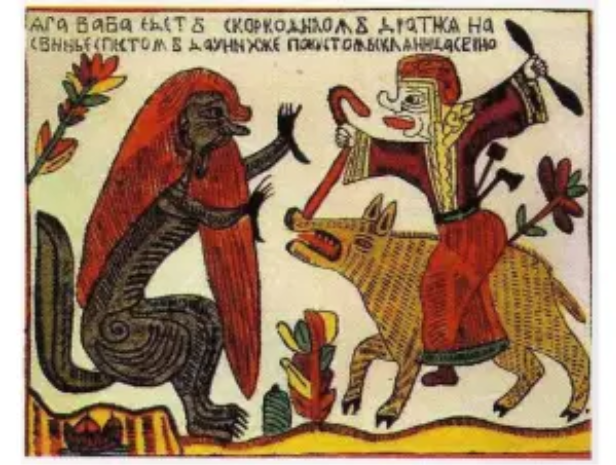
Lubok from the seventeenth century which depicts the Baba Yaga, riding a pig and battling a crocodile. The original text reads: “Ѧга Баба єдєтъ с коркодиломъ дратисѧ на свиньє с пєстомъ да у них же по кустомъ склѧница с вино” but a modern translation would be: Яга Баба едет с крокодилом драться на свинье с пестом, да у них же под кустом скляница с вином. “Yaga Baba rides off to fight the crocodile on a pig with a pestle, and under a bush they have a glass of wine.”
Twentieth and twenty-first century conclusions:
This particular case study should be of interest to people studying the twentieth century, as its legacy still resonates with a modern audience due to the persistence of superstition and the political discourse it awakens. Whilst examples of 1950s McCarthyism are generally used to explain this, Russia has its own similar continuing political legacy of witchcraft. There is a specific emphasis on roots in Russian early modern witchcraft which has substantial links to the 1930s terror under Stalin’s dictatorship. There is also reference to rasstavlyat koreshki or расставлять корешки among peasant classes which translates to ‘spreading roots’. This was used in the political context of supposed evil people thought to be connected to Trotsky who were placing their followers (roots) within peasant communities. This example clearly evidences how Russia’s unique magical beliefs never left the people, even centuries after the witch trials ceased.
It’s clear that Russian witchcraft differed starkly from that of western Europe. No malevolent pact with the devil were depicted for most of the period and magic itself was ubiquitous in this culture. This reminds us that western Europe, which is often portrayed as normative, is very unusual in this circumstance (Russia and Ukraine look a lot like other northern European countries). This study also illustrates the relationship between witchcraft and modernity more specifically. The role of witchcraft practices after 1917 aren’t well documented but this still alludes to the persistence of the craft in the lower classes and practices like slander or persecution which is very reminiscent of the Communist era. The story of witchcraft in Russia is a landmark one, because it shows us an early modern world where men could be just as threatening as women, with the idea of potential runaway serfs endangering the social order rather than wayward women who stepped out of historical boundaries.
Bibliography
https://www.thecollector.com/russian-witch-trials/
Featured Image Credit: https://www.flickr.com/photos/76635305@N03/34385854036
 Retrospect Journal