
written by Owen James
30/03/2026
The Prelude to World War Two
By the beginning of the 20th century, Spain was no longer in her glory days. The country’s empire had largely been lost, and it lagged behind advanced economies in northern Europe both in terms of the extent of industrialisation and modernisation. Its agricultural sector stagnated, whilst its economy faced the burden of low tax revenue, unfavourable loans and misdirected tariffs.
The period before the Second World War is of vital importance in modern Spanish history, but it is also highly complex. I will do my best to provide the necessary context.
During the 1930s, Spain was splintered into competing political camps, and polarisation between left and right was growing rapidly. In 1936, the country descended into a bloody civil war. Yet, civil conflict was not entirely new to Spain: The nineteenth century had already been shaped by Carlismo, a traditionalist and absolutist monarchist movement that frequently clashed with liberalism.
The outcome of the Civil War between 1936–39 has had an enormous and lasting impact on Spain. Its effects can still be felt today, and an estimated 500,000 people died in the conflict.
Ultimately, the conflict resulted in the defeat of the Second Spanish Republic by Nationalist forces led by Caudillo Francisco Franco. Franco pursued a political ideology of Falangismo (Falangism). As an ideology, Falangism combined anti-socialism, anti-communism and anti-liberalism with ultra-nationalism, Catholic traditionalism and authoritarianism.
Franco continued to govern Spain until his death in 1975, with the sole party in the country being the FET y de las JONS. His legacy today remains controversial and warrants its own attention in detail.
Francoist Spain and Nazi Germany
From Roman salutes to toothbrush moustaches, the similarities between Francoist Spain and Hitler’s Germany appear striking at first glance.
During the Spanish Civil War, the relationship between the Falangists and Nazis began to blossom. During the 1930s, Nazi Germany held considerable appeal for many Spaniards. From an outside lens, it seemed that the Nazis had revived its economy and put Germany centre stage in world affairs.
Although Spain and Germany did not share exactly the same ideology, and their relationship was sometimes strained, relations remained broadly cordial. The Spanish Civil War had a profound impact on Hispano-German ties. After all, Adolf Hitler had supported the Nationalist cause in the Spanish Civil War. Famously, the bombing of Guernica was carried out by the German Condor Legion.
Following the end of the Civil War, Nationalist leaders felt indebted to Germany, and the Nazis attempted to exploit this sentiment at every opportunity. Franco had awarded both Hitler, and Italy’s Benito Mussolini with the Great Imperial Order of the Red Arrows, a military order recently established by Franco himself. To Germany, and to the wider Axis coalition, Spanish entry into the war seemed almost guaranteed. However, as the title of the article suggests, it was not.
So, why did Spain stay out of the war? How close were they to joining?
Non-Belligerence and The Meeting at Hendaye
It is vital to understand that Franco did want to join the conflict in Europe. Paul Preston argues ‘the idea that Franco, with astute caution… hoodwinked Hitler and kept Spain out of the Second World War is a central myth of Francoist propaganda.’
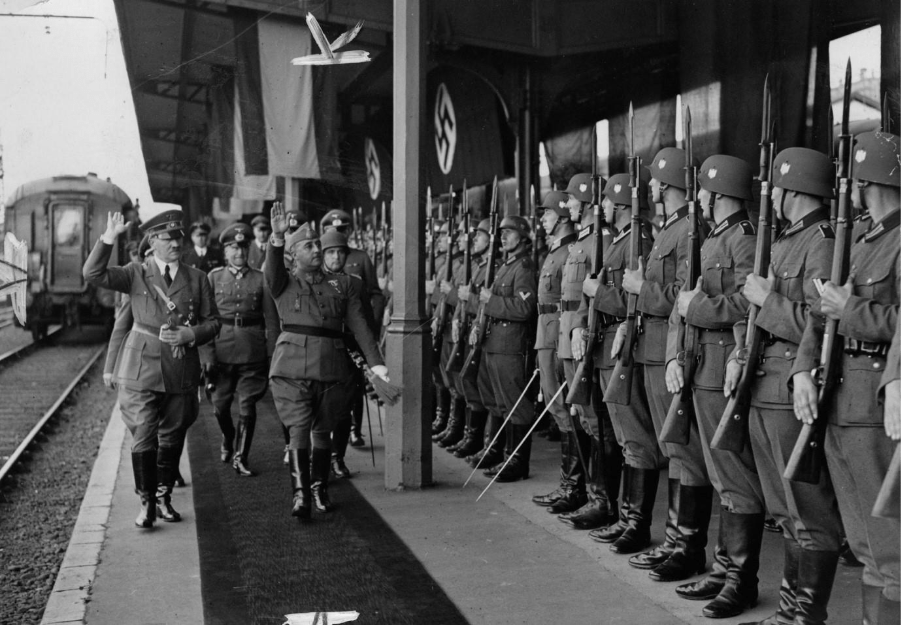
Although Franco admired Hitler, the relationship between the Führer and the Caudillo can certainly not be described as especially close. On the 23 October 1940, the two leaders met for the first and only time at the railway station in Hendaye, in Vichy France, to discuss possible Spanish entry into the war. France at this time, like the majority of western Europe, was under the control of the Nazi regime.
The meeting has acquired great symbolic importance, not least because it was the only time the two men met. Its outcome, however, was far from positive. Fundamentally, the two leaders disagreed about almost everything. Franco’s sweeping colonial demands – including French Morocco and the former German colony of Cameroon – convinced Hitler that he could not satisfy Spain’s price for entry. Franco also demanded huge economic assistance, and shipments for military equipment. Conversely, Hitler asked for Spanish belligerency, submarine bases, and permission to attack Gibraltar. Franco was further incensed when Hitler requested permission for a German base on one of the Canary Islands. Hitler did not, in the end, exert much pressure on Franco. Irritated with Spain’s colonial demands, he instead boasted that Spain could take Gibraltar single-handedly.
All told, the meeting lasted for some nine hours, although there were intermittent breaks. It would be fair to say the meeting was a failure. The following remarks by each leader offer some insight into their reactions to the meeting.
‘These people are intolerable. They want us to come into the war in exchange for nothing.’ –Francisco Franco to Spanish Minister of Foreign Affairs, Ramón Serrano Suñer, following the interview.
‘Rather than go through that again, I would prefer to have three or four teeth taken out’ – Adolf Hitler to Benito Mussolini following the meeting.
Franco’s parting comment to the Führer – promising unconditional support to Nazi Germany if Hitler really required it – suggests an emotional commitment to the Axis cause. Nevertheless, these words were never translated to German as the interpreter considered them to be merely a formal courtesy. Crucially, the meeting at Hendaye produced little result. Although Franco did re-iterate his intention to join the war at the necessary time, nothing was contractually agreed.
It would also be reductive to dismiss the economic state of Spain at this point, especially in light of the recent Civil War. Franco was certainly aware of the country’s economic and military weakness, coupled with Britain and America’s ability to control its food and fuel supplies.
Ultimately, Spanish non-belligerency did not stem from any principled desire to stay out of the war, but rather from Franco’s inability to secure the imperial gains he wanted.
In spite of all the external factors at play, there was some direct Spanish involvement in World War Two, albeit not through an official declaration of war. Franco permitted over 18,000 volunteers to join Operation Barbarossa, Nazi Germany’s monumental attempt to invade the Soviet Union.
The Blue Division, The Eastern Front and Krasny Bor
In June 1941, Franco approved the recruitment of Spanish volunteers to send to Russia in recognition of the help received from Germany during the Civil War. Official war collaboration between Spain and Germany would subsequently last 18 months. The volunteers recruited by the Falange and the Spanish army would form part of La División Azul (The Blue Division). Sources differ over the social composition of the division, particularly in terms of class background and political affiliation. What can be said some confidence, however, is that the contingent of young men that made up the division was certainly diverse. Falangist volunteers and ex-combatants seem to have made up the majority of the division, but they were also accompanied by those who simply desired to improve their position within society, or those that felt disenfranchised by Spanish post-war politics.
Given the brutal conditions on the Eastern Front during World War Two, volunteering might seem irrational at first glance. Yet, in context, the decision becomes more understandable. The Civil War in Spain had created a generation of veteran soldiers, many of whom would struggle to return to normality following the end of the conflict. Combined with an overwhelming sentiment of anti-communism in Spain, it is hardly surprising that many jumped at the opportunity to defeat the supposed global threat of Bolshevism. After all, the oath that Spanish fighters had to take did not include a specific threat against the Soviets, but rather communism in general.
As I just touched on, life on the Eastern Front was certainly not like staying in the Ritz. It was brutal. By the end of March 1942, over 7,000 Spaniards were ill, wounded, dead, or missing, many of whom also suffered from severe frostbite.
Despite these adversities, soldiers of the Blue Division fought well for the Axis cause. The most famous example of Spanish success comes from the Battle of Krasny Bor, in which a vastly outnumbered Blue Division successfully halted the Soviet advance in 1943. Nonetheless, victory was pyrrhic as the Spaniards suffered heavy casualties.
Crucially, Spanish actions on the Eastern front did not mimic those of the Nazis. For one, most Falangists did not pursue the extermination rhetoric that the Nazis employed towards the Soviets. For the Blue Division, it was not a war about race, but more about Catholicism reigning supreme over communism. Despite their overwhelmingly negative views of the Soviet Union, soldiers of the Blue Division did not generally treat Soviets as subhuman in the way that units of the Waffen SS and Wehrmacht often did. They danced, ate, and even shared shelter with the Russians.
However, by 1943, the tides had already changed. It was clear the Axis powers had only a slim chance of survival in the conflict. It was in this context that Franco demanded the repatriation of his troops and officially ended Hispano-German cooperation in the war.
Final Thoughts
On balance, Spain’s role within World War Two remains understudied and deserves far greater attention than history has traditionally afforded it. Spanish non-belligerency was not the result of some Francoist masterplan to keep the country out of the war. Rather, Franco was an opportunist constrained by the devastating legacy of the recent Civil War.
If you would like to explore this topic further, Paul Preston’s work provides an utterly fascinating account of modern Spanish history.
Bibliography
Balfour, Sebastian. ‘‘Spain from 1931 to the Present.’’ In Spain: A History, ed. Raymond Carr. Oxford University Press, 2000.
Bowen, Wayne H. Spaniards and Nazi Germany: Collaboration in the New Order. University of Missouri Press, 2000.
Carr, Raymond. ‘‘Liberalism and Reaction, 1833-1931.’’ In Spain: A History. ed. Raymond Carr. Oxford University Press, 2000.
Moreno Juliá, Xavier. ‘‘Spain.’’ In Joining Hitler’s Crusade: European Nations and the Invasion of the Soviet Union, 1941. ed. David Stahel. Cambridge University Press, 2018.
Núñez Seixas, Xosé M. ‘‘Russia and the Russians in the Eyes of the Spanish Blue Division Soldier.’’ Journal of Contemporary History 52, no.2 (2017): 352–374.
Preston, Paul. A People Betrayed: A History of Corruption, Political Incompetence and Social Division in Modern Spain. HarperCollins Publishers, 2020.
Preston, Paul. ‘‘Franco and Hitler: The Myths of Hendaye 1940.’’ Contemporary European History 1, no.1 (1992): 1–16.
featured image: Hitler and Franco during the Meeting at Hendaye (23 October 1940).
Heinrich Hoffmann/Krakow-Warsaw Press Publishing (Creator: Heinrich Hoffmann) https://upload.wikimedia.org/wikipedia/en/9/96/Meeting_at_Hendaye_%28en.wiki%29.jpg


