
Written By Elizabeth Hall
29/03/2026
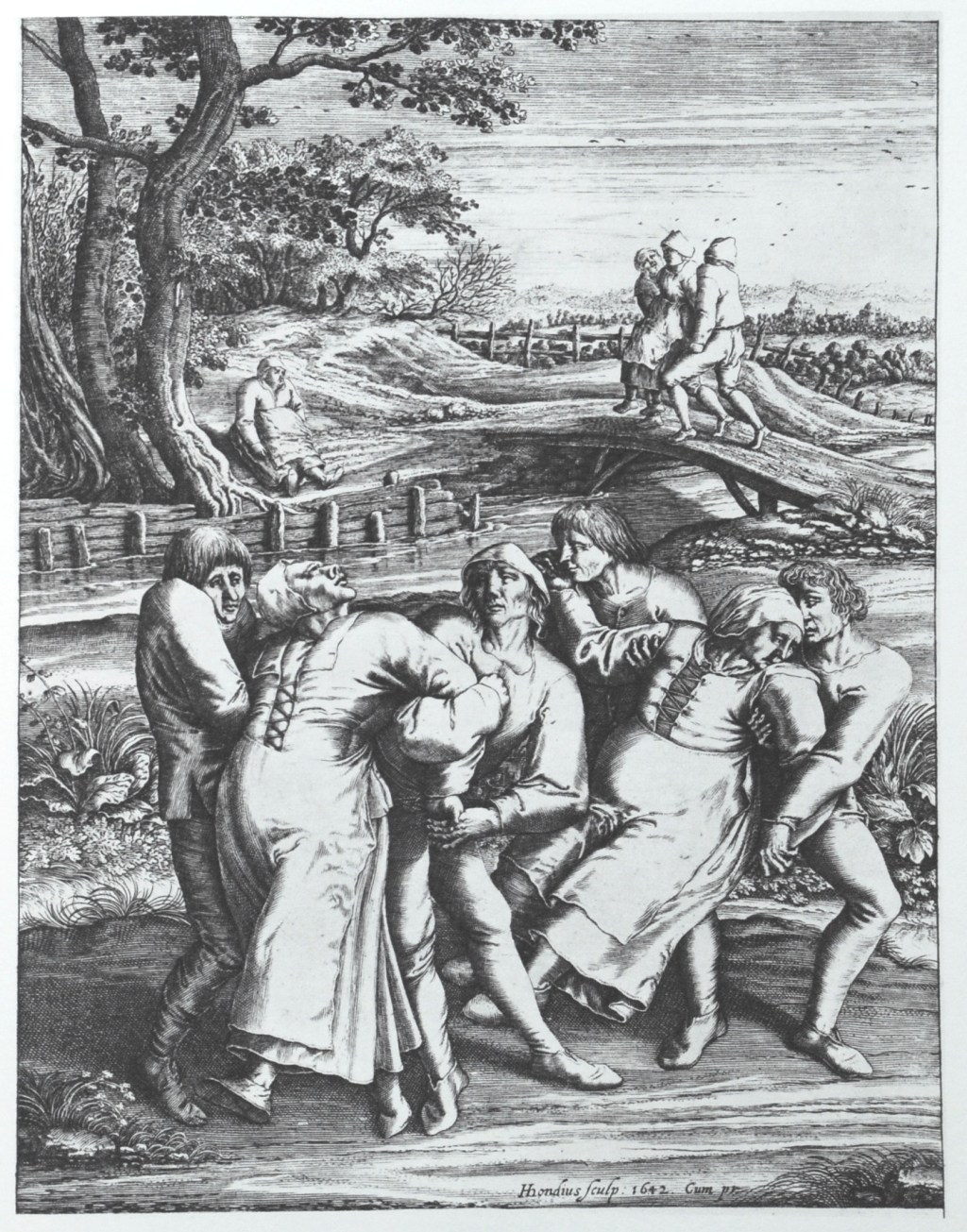
Saint Vitus, also known as Saint Guy, was martyred during the reign of Emperor Diocletian. He later became the patron saint of conditions such as epilepsy and chorea, both characterised by involuntary muscle spasms and nervous shaking – a legacy linked to the belief that he had cured Diocletian’s daughter. Yet, he is also associated with something stranger: a wave of mass hysteria that swept through Europe between the tenth and sixteenth centuries, particularly along the Rhine. Those afflicted would dance uncontrollably, often until they collapsed from exhaustion – or even died. The so-called St Vitus dance was marked by uncontrolled, trance-like movement, from which participants seemed unable to escape.
There have been numerous cases of people afflicted with St Vitus dance, with the majority of the confirmed cases coming from Western Europe, more precisely the Holy Roman Empire. One case came in 1347, where thousands of people reportedly danced uncontrollably in circles, holding each other’s hands and skipping, for weeks across Germany and France. Many onlookers believed that those dancing were not baptised properly, due to the priest’s immorality, a claim which the church disagreed with. Many said that the dancers were in a trance, seeing visions and acting irrationally, all while ignoring the physical toll the dancing took on their bodies. The first alleged case came from Kölbigk, Germany. On Christmas Eve of 1021, a group reportedly gathered and began to dance. The dancers spun in a circle holding hands, and the church priest, annoyed that he could not perform mass, cursed the crowd to dance for a year. According to later accounts, the dancers were said to have continued until the following Christmas, with some of the dancers dying – though historians debate the reliability of this story.
One of the best-documented outbreaks occurred in Strasbourg in July 1518. It began with a woman known as Frau Troffea, who started dancing in the street and did not stop until she collapsed from exhaustion. Over several days, her condition worsened – her muscles weakened, and her feet began to bleed. Authorities eventually placed her in a wagon and sent her to the shrine of St Vitus in Saverne, hoping for a cure. While her symptoms subsided, the phenomenon spread: within days, dozens had joined her. In response, officials made a disastrous decision. Believing that the only cure was to let the dancers continue, they hired musicians and encouraged the movement. Rather than containing the outbreak, this intensified it, and the number of participants rose into the hundreds. Contemporary reports suggest that up to fifteen people a day were dying from exhaustion, heatstroke, hunger, or thirst. The outbreak finally subsided in early September 1518. Across Europe, similar episodes faded by the mid-seventeenth century.
Through the ages people have theorised about what caused the St Vitus dance. Some believed that the St Vitus dance was caused by the devil, with many instances having exorcisms carried out on the dancers. Others blamed St Vitus himself as the cause for the dancing believing his wrath caused people to begin dancing uncontrollably in the first place. However, St Vitus was also able to cure the dancing and was often invoked by those afflicted in the hope of a cure. At the time many physicians believed the uncontrollable dancing was not caused by demonic possession, but by overheated blood. Others have argued that fungal toxins, ingested through infected rye flour, could produce similar symptoms, and some have argued that it could have been through indirect or direct drug use. But there is also a condition known as Sydenham chorea, which is also referred to as the St Vitus dance. This condition involved involuntary movements of the limbs and face, including compulsive behaviours, anxiety, loss of fine motor skills and slurred speech in some cases, all while those afflicted are awake. Sydenham chorea developed suddenly after a complication of rheumatic fever. Whilst the condition most commonly affects children aged five to adolescence, many of the participants in the dancing mania were adults, making Sydenham chorea an unlikely explanation. However, the most prevalent and accepted theory comes from John Waller in “A time to dance a time to die the extraordinary story of the dancing plague of 1518” where he argues that overlapping crises – famine, disease and plague – created intense social stress, increasing susceptibility to mass hysteria. Many who joined Frau Troffea’s dance may have shared her condition, while others were simply susceptible to suggestion. Some may even have mimicked the movements as an act of penance – or in the hope of escaping St Vitus’s wrath.
Bibliography
Bauer, P. (2019) ‘dancing plague of 1518 | Facts & Theories’, Encyclopædia Britannica. Available at: https://www.britannica.com/event/dancing-plague-of-1518.
Waller, J. (2009) ‘A forgotten plague: making sense of dancing mania’, The Lancet, 373(9664), pp. 624–625. Available at: https://doi.org/10.1016/S0140-6736(09)60386-X.
Liturgical Year : Activities : St. Vitus, June 15 (2025) Catholicculture.org. Available at: https://www.catholicculture.org/culture/liturgicalyear/activities/view.cfm?id=1129.
The real-life history behind Dance to the Bone (2022) Sherman Theatre. Available at: https://www.shermantheatre.co.uk/history-of-dance-to-the-bone/.
Sydenham Chorea – NORD (National Organization for Rare Disorders) (2019) NORD (National Organization for Rare Disorders). NORD. Available at: https://rarediseases.org/rare-diseases/sydenham-chorea/.
Waller, J. (2009). A time to dance, a time to die the extraordinary story of the dancing plague of 1518. Thriplow Icon.
Featured Image Credit: Hendrick Hondius I, Pelgrimstocht van epileptici naar de kerk te Molenbeek, 1642, engraving after Pieter Bruegel the Elder. Museum Boijmans Van Beuningen

