
Written By Helene Chaligne
29/3/2026
An all-too-familiar scene these days, one has either seen their friends succumb or had the privilege of being in such straits themselves: the situationship. The Cambridge Dictionary defines a “situationship” as a romantic relationship between two people who do not yet consider themselves a couple but who have more than a friendship. But how did we get here? How did we get to a point where commitment seems to be an afterthought? For answers, one must look back on the history of courtship (or dating) to understand how the loosening of social mores permitted us to end up in our current zeitgeist.
When considering the evolution of courting norms in the United Kingdom, it is useful to go back to what Claire Langhamer describes as the golden age of courtship: the period of 1930 to 1970. It has also been described as the golden age of marriage: “the only age, of the near universal, stable, long-lasting marriage, often considered the normality from which we have since departed” as Pat Thane has put it. In mid-century England, marriage, at younger ages, grew in popularity before the later decline of the institution.
Importantly, conceptions of marriage were shifting, and the companionate marriage, founded upon emotional and sexual satisfaction, emerged in the interwar years. The modern representation of conjugality, fused romance, material security, and self-development, became more apparent in 1930s England, mirrored by the media at the time. Notably, young women desired a life different from their mothers’, finding expression in leisure and consumption choices as well as the decline of domestic service as an occupation, smaller family sizes and the quest for their own homes. The importance of marriage for girls gave them a responsibility when it came to courtship, also encouraging a measure of agency. Although this was an agency bounded by gendered notions of appropriate intimate behaviour.
Marriage was the “normal” state for adults in mid-century England, and courtship was a rite of passage. However, much like today, the language of courtship was unstable and contested. In a 2001 panel run by Mass Observation, participants saw courtship as an antiquated term, they saw it as belonging to the previous era, predating the 1960s. Diane Leonard’s earlier studies of marriage and courtship in late 1960s Swansea also show a lack of consensus, which made it hard for couples to define the stage of their relationship. The language surrounding courtship was thus also heavily affected by class and gender, with the verb being characteristically working class while the noun spoke to more middle-class but outdated rituals. Women were more likely to claim the language of courting for more than one relationship, whilst men tended to keep this language to describe only relations that ended in marriage. There were significant advantages for women to name their relationship a courtship, as it might ease the level of parental control as well as legitimise degrees of sexual intimacy which “casual” did not. “Dating” was used by some in post-war England, but it was also considered to be a foreign American concept.
The most popular place to court and find a marriage match was, in the 1940s, the dance hall. As Langhamer states, “Within the middle years of the twentieth century commercial leisure venues increasingly functioned as the primary arenas for ‘picking up.’” The cinema was also a dominant area for romantic encounters; this differed from the pre-war years when it was predominantly via family, church, societies, clubs, and the workplace. This is indicative of a stripping down of the whole process that would occur around the time of the Second World War.
The “lonely hearts” advertisements, that is, ads in newspapers for matchmaking, have recently drawn comparisons to modern dating, as observed by Harry Cocks. In his chapter on “The Pre-History of Print and Online Dating, C. 1690-1990”, he asserts that arranging courtship through a third party is not a modern matter. Molly Gorman’s article on the evolving language of dating underlines this further, as she goes as far back as 1539 with Hans Holbein’s portrait of Anne of Cleves. This portrait served to present her to her future husband, Henry VIII. Henry’s ambassador qualified the painting as being very lively and accurate; however, historians have accused the painter of exaggerating her beauty. A debate for an early instance of catfishing is there.
Looking to later eras, Harry Cocks observes that the “transition, from the “arranged” system that belonged more to what is known as the “stem family” defined by broad kinship among a wide group of relatives, to one in which romantic love and free choice of partners is allowed has been seen as a significant moment of transition in Western history.” This transition should not be seen as entirely linear, as Medieval historians caution against viewing past ages as a monolith in regards to courtship, with medieval texts, especially legal codes, accounting for individual choice and romantic love. However, it is clear one cannot overlook the role of pressures from the parents and one’s community in influencing individuals’ choices and how the dissolution of that had a significant impact on courtship and dating.
Matrimonial advertisements can be traced back as far as the eighteenth century, and, similarly to online dating, endured reputation shifts with the inevitable unsavoury stories that occurred as a result of them. The latter includes the infamous murder of Maria Marten by William Corder. Sensation arose when it was revealed in 1828 that he had been a regular user of matrimonial columns.
Cocks singled out a shift at the start of the twentieth century with the lonely hearts ads. The significant difference is that they are searching for friends and “companions”, matrimonial intent is not stated. This started around the First World War to cater to service men. The Link (originally called Cupid’s Messenger) was founded in 1915 by journalist and comic novelist Alfred Barrett, and it firmly defined itself as a “Great Social Medium – Not Matrimonial.” Before long, this attracted the attention of moral campaigners and the police, viewing it as a potential medium for prostitution. Although very little evidence of prostitution by women was uncovered, they did uncover ads arranging contacts between gay men, which were therefore more obviously illegal. This put an end to the wartime craze and solidified them as having a low reputation. It was not until the 1960s that the statement of matrimonial intent would lose its dominance and the lonely hearts’ status would no longer be seen as suspicious.
The sexual revolution, counterculture movement, and feminist movements thus permitted the rise of courting or dating without marital intent. This is, once again, not an entirely linear progression; people would have been having “situationships” all throughout history, especially marginalized communities for whom it was often the only option. However, it clearly became far more common and normalised once courting was not seen as necessarily being a means to find a marriage match. The fight for women’s equality thus allowed women to gain better economic conditions and agency, allowing for them to not have to date with intentions of marriage. Other developments, such as the rise of online dating and the economic instability and flexibility of Millennials and Gen Z contributed to this. The phenomena of job hopping and digital nomadism reflect these generations’ preference for flexibility and freedom, which has affected their outlook on their romantic lives.
One can thus see how changing norms and expectations have allowed for us to end up in a society where commitment, and by extension marriage is no longer paramount. However, looking at examples throughout history, we can also observe many more similarities between the past and today, with the act of advertising oneself being far older than the launch of OkCupid in 2004 or Hinge in 2012. Additionally, undefined relationships and dating without marriage as an end goal far predate millennials and Gen Z.
Additional note: The Instagram account @longlostpersonals on Instagram hosts a lovely archive of personal ads from people trying to find connection.
Bibliography
LANGHAMER, CLAIRE. 2007. “LOVE and COURTSHIP in MID-TWENTIETH-CENTURY ENGLAND.” The Historical Journal 50 (1): 173–96.
Gorman, Molly. 2025. “Beyond Words: The 200-Year-Old Hidden Languages of Dating.” Bbc.co.uk. BBC. July 6, 2025. https://www.bbc.co.uk/future/article/20250703-the-200-year-old-hidden-languages-of-dating.
“Lonely Hearts: A History of Dating Ads – Discover Your Ancestors – Jayne Shrimpton Explores the Origins of Lonely Hearts Ads and Their Role in Finding Love through the Ages.” 2023. Thegenealogist.co.uk. 2023. https://www.thegenealogist.co.uk/featuredarticles/discover-your-ancestors/periodical/118/lonely-hearts-a-history-of-dating-ads-2311/?.
Kibbe, Kayla. 2025. “Apparently, We Were All in the Same Life-Altering Three-Month Situationship.” Cosmopolitan. November 19, 2025. https://www.cosmopolitan.com/relationships/a69475967/three-month-situationship/.
Cambridge Dictionary. 2026. “Situationship.” @CambridgeWords. March 11, 2026. https://dictionary.cambridge.org/dictionary/english/situationship.
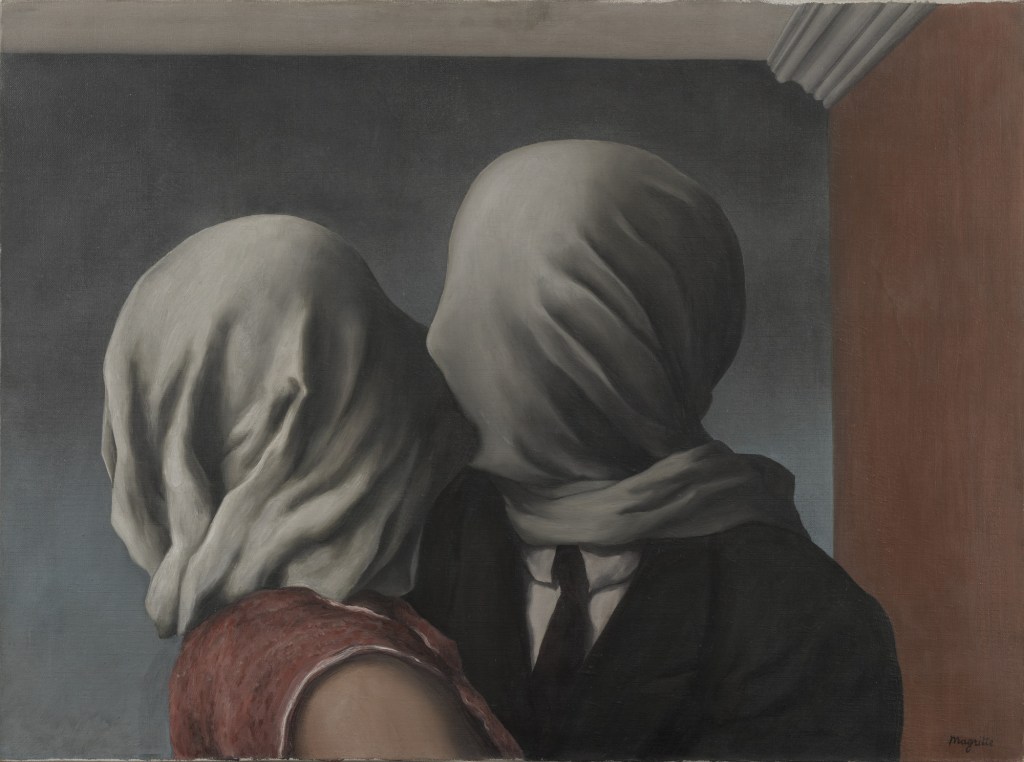
Featured Image Credit: René Magritte, The Lovers, 1928. Oil on canvas. The Museum of Modern Art, New York.

