
Written by Manahil Masood
Satirical prints in late-eighteenth-century England were a crucial medium through which restless public sentiments were both expressed and actively shaped. As Vic Gatrell notes, these prints “speak volumes about the engravers and purchasers’ shifting attitudes” during a period of rapid social change in London. It is in this context of turbulence, expansion, and intensifying debates over class, gender, and empire that Black dandyism became a recognisable cultural presence. As Monica Miller convincingly argues, free African men who dressed in conspicuously fashionable styles “illustrated and mediated the political, social, and cultural power of visuality and visibility in an age of colonialism, imperialism, revolution, and nation-building”. In turn, their appearance in British print culture made Black sartorial refinement a publicly legible and contested visual form, shaping the shared visual repertoire of the European imaginary through which Blackness was understood.
This article examines two satirical prints depicting finely dressed Black men: A Mungo Macaroni (1772), attributed to Mary and Matthias Darly, and Abolition of the Slave Trade, or The Man the Master (1789) by William Dent. In the former, the Black dandy appears as an ‘amusingly’ objectified ornamental figure; in the latter, the same sartorial markers of sophistication are mobilised to depict him as a figure of subversive political threat. As Bella Ruhl stresses, “clothes serve an iconographical function”, and when placed upon the oft-Orientalised and stripped Black body, clothing becomes a site of meaning-making rather than mere adornment. By analysing these prints’ satirical tone and content, this article argues that the Black dandy served as a cultural figure through which white British audiences negotiated anxieties surrounding race, hierarchy, and the blurred boundaries of social power. Indeed, as Diana Donald observes, “fashion was perceived as a phenomenon which dissolved traditional hierarchy”; in this sense, the Black dandy was troubling because he made visible the fragility of racial stratification in Britain.
This discussion proceeds by first expositorily analysing the medium of satirical print culture in London, before turning to A Mungo Macaroni to present dandyism as a form of ornamental Blackness tied to performance, possession, and aesthetic display. From there, Black dandyism is explored as a mode of macaroni self-fashioning, examining The Man the Master to show how similar visual markers of refinement could, in the changing political climate of the 1780s, be made to signify autonomy and rebellion.
Whilst ostensibly created for entertainment, in the “century of Enlightenment”, the printed image emerged as “the principle medium for conveying visual information”, shaping how political discourse circulated among an increasingly literate urban public. Advancements in engraving and cheaper mass-production by the 1770s meant that prints were not elite art objects, but widely accessible commodities that were purchased, displayed, and discussed regularly by metropolitan consumers. Print shops, such as the Darly’s on the Strand and Moore’s on Drury Lane, operated as open exhibitions, attracting crowds who collectively interpreted provocative images. Since satirical images were “less easy to control than texts”, their didactic function relied on shared close-cultural assumptions that decoded the “essential truths” from exaggerated etched distortions.
However, as Temi Odumosu notes, the cheap ephemeral nature of such prints meant that they circulated far beyond their intended audiences, projecting the imperial capital’s anxieties outward during moments of heightened colonial tension. While designed for the amusement of white, middling Londoners, their reach was potentially less contained; London itself was home to an estimated 15,000—20,000 Black residents. Yet, as Miller reminds us, the “Black image” often preceded the Black person in white British consciousness, encountered first through staged performance and satirical imagery before human interaction. Indeed, these prints are particularly valuable to historians as visual culture was materially entangled with racial capitalism, with many eighteenth-century art dealers also selling enslaved people in the same coffee houses. The circulation of Black figures in satirical artwork must therefore be read within a marketplace where Blackness itself was commodified.
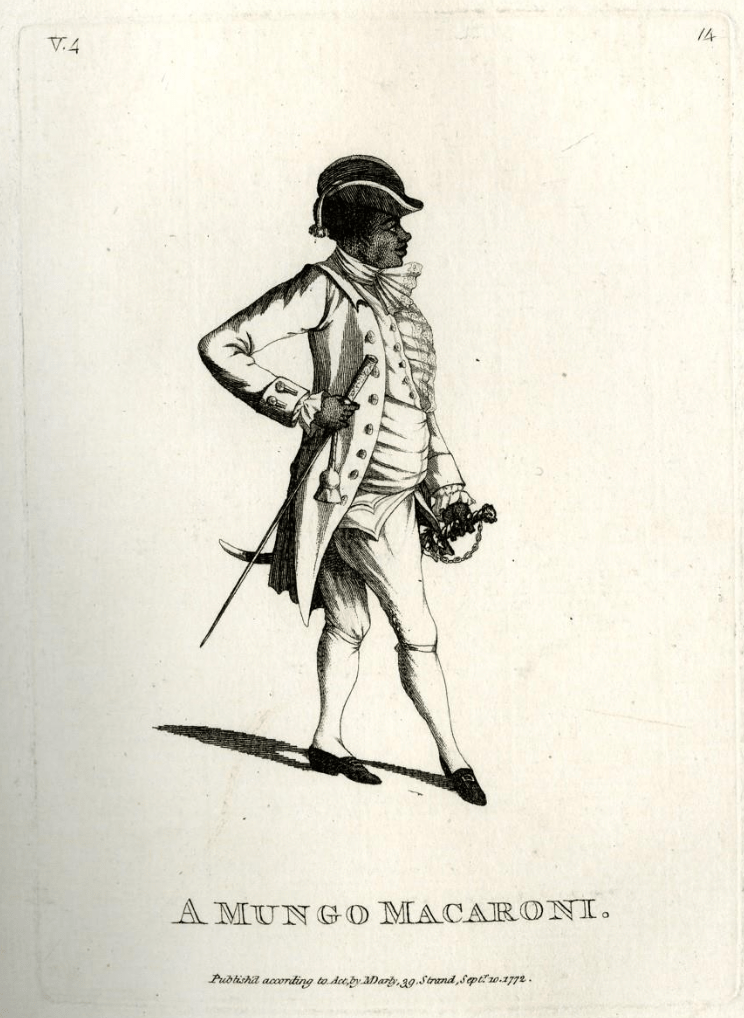
Figure 1: A Mungo Macaroni (1772)
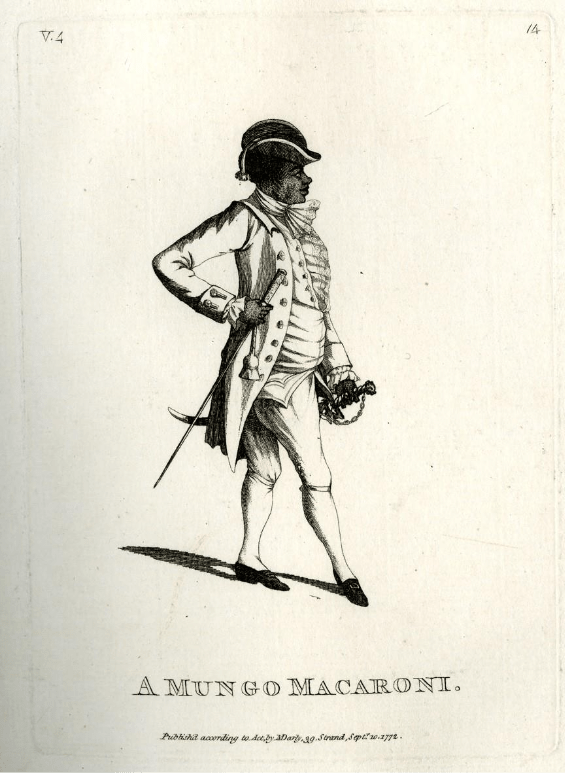
A Mungo Macaroni (1772) depicts a finely dressed Black man in exaggerated macaroni fashion. He has donned a fitted frock coat, a neckcloth tied high under the chin, tight knee-breaches, silk stockings, and buckled shoes. He stands in profile, his weight shifted onto one leg in a pose as theatrical as the walking-stick he grasps. In his other hand, he holds a phallic sword, perhaps signalling the juxtaposition of genteel duelling culture and effeminate macaroni fashion. The print style is sparse with no background or contextual scene, ensuring that the viewer’s attention is fixed entirely on the figure as a spectacle.
The name “Mungo” refers to the enslaved character from the hugely successful comic opera The Padlock (1768). Soon after the inaugural performance, it had “apparently become typical to think of black slaves in terms of society and fashion”. Indeed, Mungo’s glittering foreign uniform, Miller writes, could be read either as a cover-up for his dehumanisation or a visual intensifier of his ornamental status. Simultaneously, this print draws directly on the celebrity of Julius Soubise, the formerly enslaved companion of the Duchess of Queensbury, renowned in London for his flamboyant dress and foppish wit. His presence seemed to unsettle racial expectations of Black masculine status. Despite this, or perhaps because of this, the print seems to collapse Soubise back into the theatrical figure of Mungo, petulantly refusing to acknowledge his sartorial choices as dandy self-fashioning.
This logic draws upon a longer visual vocabulary of ornamental Blackness in British art. In traditional aristocratic portraiture, Black servant pages were placed within compositions as decorative accessories, dressed in expensive livery, posed in positions of staged obedience, and often wearing chattel collars, padlocked in place as pet-like emblems of exotic cosmopolitan taste.
Therefore, rather than relying on physiognomic caricature, the joke here is that Mungo (or Soubise) has dressed beyond his station, and the viewer is invited to participate in policing the boundary his clothing threatens to blur. The macaroni, as contemporary commentators observed, was an anxiety-inducing Francophile man who “exceeded the ordinary bounds of fashion”, a style devotee whose cosmopolitan dress eroded distinctions of class, gender, and national identity. However, for Black men like Soubise, the adoption of macaroni aesthetics represented an added transgression, destabilising norms of masculinity and class, but also unsettling racial hierarchies by “signalling the potential for a black character to constitute identity by actually and figuratively talking back”.
According to Katherine Hart, it is rare that individuals at the margins of social order appear in English visual satire as humans with their own agency. Perhaps then, this print is particularly significant, almost serving as an “ironic mirror” used by the artist to ridicule an African man’s attempt at self-representation against the reality of his position under English nobility. Thus, conceivably, the precariousness of Soubise’s position forms the butt of the joke for white audiences tentatively amused by this potentially autonomous boundary pushing. Whilst the Black dandy was allowed to glitter, he must be contained as empty spectacle to ensure no real threat to the racial hierarchy.
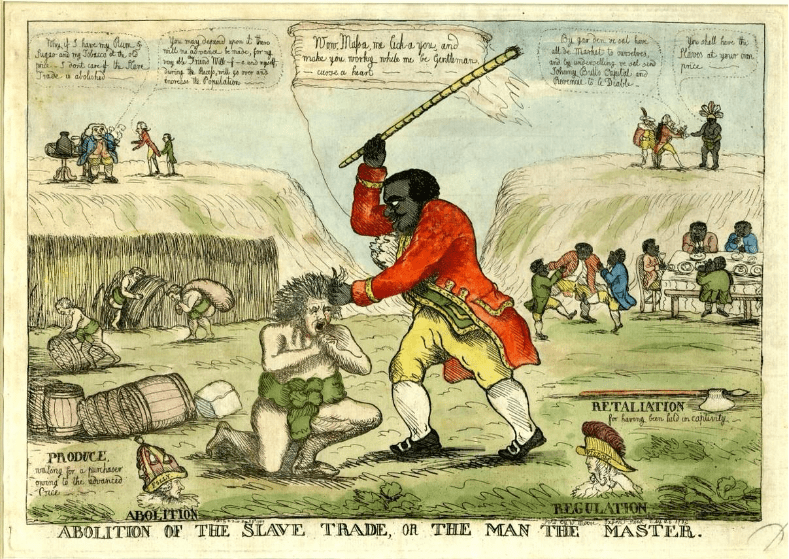
Figure 2: Abolition of the Slave Trade, or The Man the Master (1789)
If A Mungo Macaroni presented the spectacle of Black refinement as comic folly excess, Abolition of the Slave Trade, or The Man the Master (1789) shifts that spectacle into something explicitly politically threatening. Published by William Dent during a period of intense abolitionist debates, the print imagines an inverted colonial order: a well-dressed Black man in a frock coat and breaches, reminiscent of dandy Soubise, beats a half-naked white labourer with a sugar cane, declaring in dialect, “Now Massa, I lick a you, and make you worky while me be gentleman. Curse a heart”. Behind them, white figures toil in the cane fields whilst Black men dine and dance. The composition appears to reverse the noble savage abolitionist emblem, “Am I Not a Man and a Brother?”; the pleading slave is now the white victim, kneeling in the same pose of submission.
Dent’s image was disseminated within a charged context of imperial anxiety, and his use of familiar iconography as well as supplementary text spells out a clear anti-abolitionist message. By the late 1780s, as David Bindman and Odumosu similarly note, British debates over abolition coincided with fears that emancipation would “provoke an uprising leading to massacre of the whites”. This indicates that the spectre of revolt loomed large, particularly as news from Saint-Domingue and revolutionary France reached London. Interestingly, very few caricatures of the period addressed slavery directly, perhaps in part because the genre of satire risked trivialising the gravity of abolitionist debates. Hart goes further, claiming that slavery appeared in print merely as an abstract “condition or state of being, not as the fate of a particular people or race”. However, this article would argue that this image is unmistakably racialised; the exaggerated Black figure, dressed with the markers of genteel modernity, embodies a specific African threat that characterises Black power and the “folly” of abolitionists.
Indeed, scholars agree that graphic satires “consciously worked against the dominant sentimentalism of antislavery propaganda”, instead amplifying “mistrust and indignation towards the notion of Black agency or achievement”. Crucially, the humour here is uneasy, even defensive. The print’s joke depends on the oxymoronic impossibility of the Black gentlemen, and yet it betrays the fear that such inversion might one day be realised. Here, the dandy’s fine clothes, once the source of mockery in A Mungo Macaroni, are redeployed as signs of usurpation and revenge.
Read together, these satirical prints reveal to historians how Black self-fashioning destabilised the racial order on which imperial authority depended, marking Black dandy autonomy as absurd or threatening. In anxious caricaturising of that threat, these prints expose how the etched line itself became an instrument of white containment, forcing Black sartorial visibility into ridicule and spectacle.
Bibliography
Prints Used (in order of appearance)
Mary and Matthias Darly. “A Mungo Macaroni”, 1772. Satirical print, 125mm x 176mm. The British Museum, London.
William Dent. “Abolition of the Slave Trade”, 1789. Satirical print, 346mm x 245mm. The British Museum, London.
Secondary Sources
Bindman, David. ‘“They are a Happy People”: Some Newly Identified Pro-Slavery Caricatures from the Age of Abolition’, in Elizabeth McGrath and Jean Michel Massing (eds.), The Slave in European Art: From Renaissance Trophy to Abolitionist Emblem. London, 2012.
Childs, Adrienne L. and Susan H. Libby, “Introduction: Figuring Blackness in Europe” in Blacks and Blackness in European Art of the Long Nineteenth Century. Routledge, 2017.
Clayton, Timothy. The English Print, 1688-1802. Yale University Press, 1997.
Dabydeen, David. Hogarth’s Blacks: Images of Blacks in Eighteenth-Century, English Art. Dangaroo Press, 1985.
Donald, Diana. The Age of Caricature: Satirical Prints in the Reign of George III. Yale University Press, 1996.
Farmery, Denise. “The Black Figure in 18th Century Art.” In Fairhall, Issue 25, October 2018. Available at: https://johnstoncollection.org/THE-BLACK-FIGURE-IN-18th-CENTURY-ART~68391
Festa, Lynn. “Fashion and Adornment.” In A Cultural History of Hair in the Age of Enlightenment, edited by Margaret K. Powell and Joseph Roach. Bloomsbury Publishing, 2019.
Gatrell, Vic. City of Laughter: Sex and Satire in Eighteenth-Century London. Atlantic Books, 2006.
Hall, Catherine. ”Introduction” in Lucky Valley: Edward Long and the History of Racial Capitalism. Cambridge University Press, 2024.
Hart, Katherine. ‘James Gillray, Charles James Fox, and the Abolition of the Slave Trade: Caricature and Displacement in the Debate over Reform’, in Angela Rosenthal (ed.), No Laughing Matter: Visual Humor in Ideas of Race, Nationality, and Ethnicity. Dartmouth, NH, 2016.
Huck, Christian. “Visual Representation.” In A Cultural History of Dress and Fashion in the Age of Enlightenment, edited by Peter McNeil. Bloomsbury Publishing, 2018.
Miller, Monica L. Slaves to Fashion: Black Dandyism and the Styling of Black Diasporic Identity. Duke University Press, 2009.
Myers, Norma. Reconstructing the Black Past: Blacks in Britain, 1780–1830. Frank Cass, 1996.
Odumosu, Temi. Africans in English Caricature, 1769–1819: Black Jokes, White Humour. Harvey Miller Publishers, 2017.
Ruhl, Bella. “Dress, Class, and Caricature in Late Eighteenth Century England.” The University of Arizona Journal of History, vol 3 (2019).
The British Museum Collection. Accessed February 2025, at https://www.britishmuseum.org/collection/
Featured Image Credit: Mary and Matthias Darly. “A Mungo Macaroni”, 1772. Satirical print, 125mm x 176mm. The British Museum, London.

