
Written by Owen James
08/03/2026
Most of us will know, or at least, have heard of the Vietnam War. Contrary to its name, the conflict was not solely fought in Vietnam. To the west of Vietnam, we find Laos and Cambodia, two countries heavily involved and often overlooked when we study the Cold War in Asia. The latter of which, Cambodia, is the focus of today’s article.
The aim of the article is to bring to light, not only a tragic genocide brought about by a murderous regime, but also to argue for American complicity in its creation.
Cambodia since World War Two
Modern Cambodian history is quite eventful and warrants its own attention in detail, but I will do my best to provide some basic context before wide-scale American involvement in the country.
Cambodia was under French imperial control, forming part of French Indochina alongside Vietnam and Laos, until it gained independence in 1953. King Norodom Sihanouk, an enigmatic, God-like figure within the country, had claimed independence when Japan temporarily lifted French control in 1945, however tangible power remained in French hands until 1953.
Following Cambodian independence, Sihanouk presided as King until 1955, when he abdicated and passed control to his father, Norodom Suramarit. Following Suramarit’s death in 1960, Cambodia was governed, for the most part, by Sihanouk again, who acted as Chief of State. Sihanouk then controlled Cambodia until 1970.
As we move through the 20th Century, Cambodia became increasingly involved in the Vietnam War, in which the US were fighting the North Vietnamese communists and supporting South Vietnam.
The Bombing of Cambodia (1965-1973)
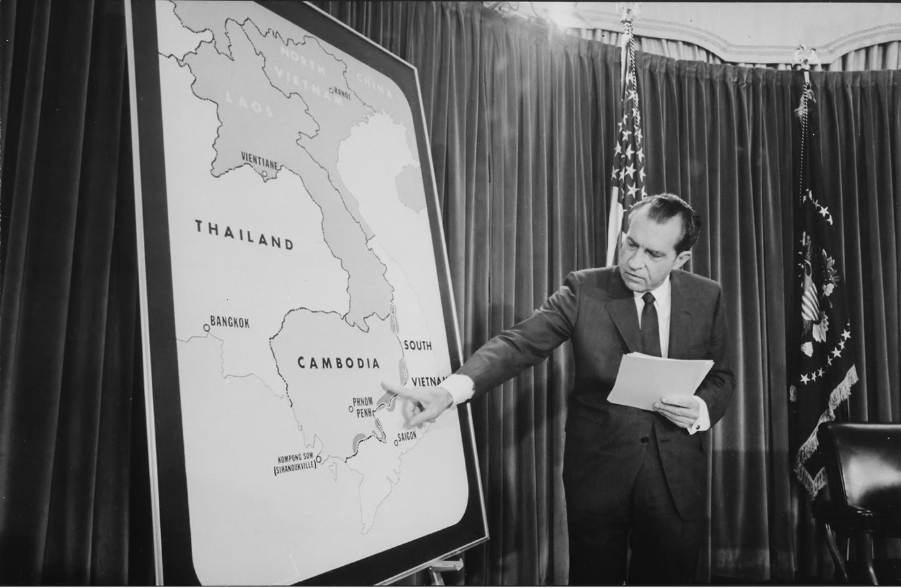
‘‘They have got to go in there and I mean really go in… I want everything that can fly to go in there and crack the hell out of them. There is no limitation on mileage and there is no limitation on budget. Is that clear?’’ – Richard Nixon escalating the bombing of Cambodia in a telephone call with Henry Kissinger in December 1970.
Contrary to popular belief, the bombing of Cambodia started under Lyndon Johnson, rather than Richard Nixon, in 1965. However, it was under Nixon’s tenure where the magnitude of bombing ramped up.
Motivations behind the bombing campaigns were multi-faceted. Nixon’s national security advisor, Henry Kissinger, claimed America was not bombing Cambodia, but instead, the North Vietnamese in Cambodia. Importantly, the Ho Chi Minh trail that supplied the North Vietnamese with supplies and troops against their campaign with the US ran through Cambodia and Laos. Sihanouk was discontent about the presence of the North Vietnamese in his country but was ultimately powerless to do anything about it.
From 1969, we witness an escalation to carpet bombing of the country. It aimed to destroy the mobile headquarters of the Viet Cong and the North Vietnamese Army in the Cambodian jungle. The magnitude of the bombing has been subject to different estimates. The latest revision, however, suggests the US dropped around 500,000 tons of bombs on Cambodia, yet this figure may be significantly higher as some sources cite more than 2.7 million tons. All told, the impact was catastrophic, and between 50,000-150,000 Cambodians were killed in the campaign.
The Cambodian bombing had two pivotal, unintended consequences. The first was it pushed Vietnamese communists further into Cambodia, meaning the US’ ‘enemy’ controlled more of the country. Secondly, and perhaps more ominously, many citizens who fled the bombing joined the Khmer Rouge, a group of revolutionary guerillas whose chance of having any sort of political influence was initially slim, until the American bombing. In fact, The Khmer Rouge grew from a small force of fewer than 10,000 in 1969 to over 200,000 troops and militia in 1973.
It’s important we understand the bombing campaign of Cambodia was really a covert operation due to fervent congressional opposition to US involvement in Indochina. As late as April 1973 administration officials testified before congressional committees denying that there had been any bombing of Cambodia prior to May 1970, which was false. Interestingly, the first articles of impeachment drawn against President Nixon were related to the war in Cambodia, not the Watergate scandal.
The Khmer Republic (1970-1975)
In March 1970, whilst Sihanouk was visiting France, Sisowath Sirik Matak and Lon Nol, both high-ranking members of the Cambodian government, ousted him in a coup. Notably, Sihanouk had previously broken ties with the US, subsequently looking towards China and the USSR for diplomatic support. It has been suggested that the coup was of CIA planning, yet the evidence for this is inconclusive. What has been widely agreed upon, though, is that the US were aware of the coup, and had some degree of involvement or influence. To put it simply, Nixon’s chief of staff H. R. Haldeman, said that Lon Nol’s ouster of Sihanouk ‘was all right with us’.
Upon seizing power, Lon Nol established the Khmer Republic, a short-lived military dictatorship, characterised by rampant corruption and unstable leadership. He immediately faced revolutionary threats in the countryside instigated by the Khmer Rouge, led by Pol Pot. Again, it’s important to remember that the American bombing of Cambodia is still occurring during this period, further driving support towards the Khmer Rouge. The Vietnamese communist threat in Cambodia was essentially impossible to quell, according to the Americans.
America and the Khmer Rouge (1975-1989)
I have mentioned the Khmer Rouge throughout this article but have provided little context to substantiate what it was.
Khmer Rouge is the popular term used to describe Democratic Kampuchea, the official name of Cambodia between 1975-1979, led by the brutal dictator, Pol Pot. The Khmer Rouge had gained power after the fall of the capital, Phnom Penh in 1975, following a civil war.
The Khmer Rouge’s actions in Cambodia were despicable, morally reprehensible and heinous. Estimates vary in terms of how many were killed under the regime, but figures around 2 million are often cited, around a quarter of the population. This figure may well be much higher. A policy of utopian agrarianism, ethnic cleansing, anti-intellectualism and autarky was initiated, resulting in a mass genocide. So, what were the US attitudes towards such a brutal regime?
Well, we already know that the US were, in part, responsible for the growth in support for the Khmer Rouge and its eventual control of the country. But what about after 1975? The following quotes by Henry Kissinger provide us with a crucial insight.
‘‘We bear no hostility towards them. We would like them to be independent as a counterweight to North Vietnam… We will be friends with them. They are murderous thugs, but we won’t let that stand in our way.’’ – Kissinger to Thailand’s foreign minister in November 1975 describing attitudes towards Cambodia.
‘‘We don’t like Cambodia, for the government in many ways is worse than Vietnam, but we would like it to be independent.’’ – Kissinger to President Gerald Ford and the US-backed dictator of Indonesia, Suharto in December 1975.
From these quotes, it is clear the US knew the extent of barbarity of the Khmer Rouge, or at the very least, knew of its potential happenings. Yet, America’s fixation with Vietnam during this period resulted in American ‘support’ for Democratic Kampuchea.
Upon the 1979 Vietnamese invasion of Cambodia, and the removal of the Khmer Rouge from power, the US supposedly spent tens of millions of dollars funding guerrillas associated with Pol Pot’s regime. Moreover, throughout the 1980s the US pressured UN relief agencies to supply humanitarian aid to feed and clothe the Khmer Rouge hiding out near the Thai border, thus enabling the Khmer Rouge to fight against Vietnamese.
Perhaps most strikingly is that both the Carter and Reagan Administrations voted for Pol Pot’s representative to occupy Cambodia’s disputed UN seat following the Vietnamese invasion. In 1982, the Khmer Rouge flag still flew over New York during Reagan’s tenure.
Even in 1989, US Secretary of State James A. Baker III, sought to replace the Hun Sen government, proposing to include the Khmer Rouge in a new regime.
Final Thoughts
I believe the following quote by journalist, Brett S. Morris, encapsulates perfectly my thoughts when researching this fascinating, yet tragic topic.
‘‘If we can expect anything from US foreign policy, it’s atrocities and complicity, cloaked in the language of democracy and human rights.’’
Bibliography
Clymer, Kenton J. The United States and Cambodia, 1969-2000: A Troubled Relationship. Routledge, 2004.
Kiernan, Ben. ‘‘The Cambodian Genocide and Imperial Culture’’ Aztag Daily, April 2005.
Owen, Taylor and Kiernan, Ben. ‘‘Bombs over Cambodia’’ The Walrus, October 2006.
Owen, Taylor and Kiernan, Ben. ‘‘Roots of U.S. Troubles in Afghanistan: Civilian Bombing Casualties and the Cambodian Precedent.’’ Asia-Pacific Journal Japan Focus 8, no.26 (2010): 1-14.
Nixon, Richard and Kissinger, Henry. ‘‘Telephone Conversation Discussing an Escalation of Bombing in Cambodia.’’ Transcript. December 9, 1970. National Security Archive. https://nsarchive.gwu.edu/document/30323-document-74-nsc-telcon-kissinger-and-president-richard-m-nixon-december-9-1970-845
Tyne, James A. From Rice Fields to Killing Fields Nature, Life and Labour under the Khmer Rouge. Syracuse University Press, 2017.
Wright, George and Sony, Ouch. ‘‘Henry Kissinger’s Cambodia Legacy of Bombs and Chaos’’ BBC News, December 3, 2023, https://www.bbc.co.uk/news/world-asia-67582813
Featured image credit: Jack E. Kightlinger (White House Photo Office). Public domain, via Wikipedia commons.
https://upload.wikimedia.org/wikipedia/commons/6/61/NixononCambodia.jpg

