
Written by Bethany Hicks-Gravener
Without a doubt the Parthenon, which sits atop the Akropolis of Athens, is one of, if not the most, identifiable pieces of architecture of the ancient world. Every year millions of tourists travel up to the Akropolis to revel in the Athenian cult sites and pay particular interest to the Parthenon. For many years now, one of the most heated topics of debate amongst scholars in regard to the Parthenon is what the frieze that snakes around the structure depicts. The Parthenon frieze was crafted out of Pentelic marble, sculpted in low-relief, and is believed to have originally been around 525 feet long; however, unfortunately, around 100 feet are lost to us today. Whereas other sculptural elements of the building are easily recognisable, the frieze stands apart and seems full of too many inconsistencies to be firmly understood as one specific event.
The earliest account to date of the frieze comes from Cyriacus of Ancona, an Italian merchant and Humanist, from c. 1436 A.D. He described the frieze as depicting the ‘victories of Athens in the time of Pericles.’ Construction on the Parthenon ceased in 432 B.C., three years prior to Pericles’ death in 429 B.C., and it was built under the banner of the ‘Periclean building program’. On the surface, Cyriacus’ ideas concerning the frieze make sense: the Greco-Persian wars had left the city-state in ruins and Pericles’ rule can be viewed as a period of rebuilding and rebirth for the city. However, one trap that Cyriacus’ theory falls into is that it suggests some sort of military depiction across the frieze; whilst this is a fairly plausible theory, other more modern scholars have had differing thoughts.
Arguably, the most common idea subscribed to by scholars is that the frieze depicts the (Greater) Panathenaea. The Panathenaic festival was celebrated every year in Athens as a celebration of the city’s patron goddess, Athena. Every four years, the festival was celebrated on an even grander level with increased festivities including sports, theatrical, and musical events: this was known as the Greater Panathenaea. One of the main purposes for which the Parthenon was believed to have been constructed was to house the grand cult statue of Athena, confirming the Parthenon to have been a cult site of the goddess. Due to this, we can begin to understand theories that the frieze depicts a festival that celebrates Athena; the use of iconography which eternally celebrates the goddess would garner the Athenians divine favour.
The scholar Chrysoula Kardara has suggested that the frieze is potentially a depiction of the first ever Panathenaea held during the reign of Kekrops, the first king of Athens in mythology. Kardara’s theory is interesting because it allows scholars some leeway when thinking about all the elements of the frieze and it almost acts as an ‘explain away’ for some glaring omissions that you would otherwise expect to be showcased on a piece of art that interprets the festival. Perhaps the omissions are there because the Panathenaea of Kekrops wasn’t as ‘fleshed out’ as the Panathenaea contemporary to the sculptors working on the piece. Within their theory, Kardara also identifies a few of the figures on the frieze as potential figures from mythology, such as Theseus and Aigeus. However, this is also controversial because Kardara theorises that some figures feature on the scene multiple times at different stages in their lives. The mythology element does open discussion up a bit more though: if the frieze does depict a Panathenaea, then it sticks out as a bit of a sore thumb amongst the other sculptural elements of the Parthenon. The Panatheaea was not derived from myth and was a festival that we know was celebrated every year in Athens, whereas the sculpture work of the Parthenon metopes and pediments all feature scenes from myth. On one hand, this makes the frieze stand out as it is still celebrating Athena whilst also drawing your eye to it because of its different take on a celebration of the goddess; but on the other hand it makes the frieze feel like a bit of an outlier and takes away a certain sense of cohesion that you might otherwise expect from such a piece.
Other scholars have argued that the frieze depicts a military scene, with John Boardman suggesting that it could have been designed in honour of the Athenians who died at the Battle of Marathon in 490 B.C. Like other interpretations, there are holes in Boardman’s theory; for example, his theory is based on the number of riders on the horses and in the chariots, arguing that they correlate exactly to the number of hoplites who died at Marathon. However, hoplites were foot soldiers, not riders, which makes his theory difficult to believe. Also, the riders have no identification on them to suggest that they are even going into battle; for all we know they could just be horse riders and charioteers (potentially competing in some sort of games event, therefore lending weight to the Greater Panathenaea theory). That being said, the horses are actually too small for their mounts. This, along with a number of other inconsistencies, suggests that they were sculpted in a bit of a rush without much clear direction; maybe the omission of any specific military weaponry does not fully support Boardman’s theory.
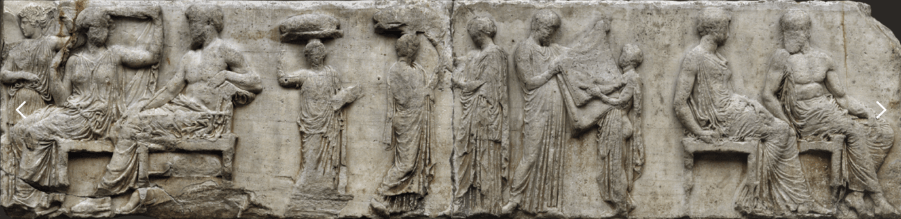
The scholar Joan Connelly has argued one of the most controversial interpretations of the subject of the frieze. Connelly’s theory solely concerns the ‘central’ scene of the frieze (which is shown in the image accompanying this article). She believes that there is a case to be made for the idea that the central scene of the frieze portrays a human sacrifice. Connelly links her theory to the myth of the sacrifice of the youngest daughter of Erechtheus, popularised through Euripides’ play Erechtheus. What is particularly interesting about this theory, and potentially opens the debate to a few holes, is that Euripides’ play was presented for the first time in 422 B.C. However, work on the frieze began in 447 B.C. and continued until 432 B.C., predating the play by ten years. Although Euripides did not create this myth, he popularised it through his play. It also feels like quite a morbid piece of iconography to place above the entryway into such an important cult site for the patron goddess. There is also a lack of some of the assumed iconography one would expect to see in such a scene: there is no knife or altar depicted. Such elements would identify the action of sacrifice to onlookers of the frieze, and as Neils points out in his commentary of Connelly’s theory, the rest of the frieze also needs to be considered to help provide context for the central scene and the rest of the frieze has a more jovial and celebratory tone to it. That being said, other elements of Erechtheus’ mythology are celebrated around the Akropolis, the most notable example being the Erechtheion, which was named in his honour; it’s not completely out of the question for this to be a valid interpretation.
Overall, if one thing is for certain in regard to the Parthenon frieze, it is that we have not quite worked out what it is depicting. Although some scholars favour one theory, many others favour another and even those with strong opinions can point out the glaring inconsistencies that weaken their arguments. There are many elements to be considered when discussing the frieze and at times one panel (or section) may lend itself perfectly to one theory, but then you turn a corner and the theory completely comes apart. As time goes on, I believe that we will see many more ideas about the frieze and maybe one day the mystery will finally be solved.
Bibliography
Barringer, Judith. ‘Lecture Six’. Lecture presented online at the University of Edinburgh, Edinburgh, UK, 14th October 2024.
Boardman, John. ‘The Parthenon Frieze, A Closer Look’. Revue Archéologique 2 (1999): 305-330.
Connelly, Joan B. ‘Parthenon and Parthenoi: A Mythological Interpretation of the Parthenon Frieze’. American Journal of Archaeology 100, no. 1 (1996): 53-80.
Holloway, R. Ross. ‘The Archaic Acropolis and the Parthenon Frieze’. The Art Bulletin 48, no. 2 (1966): 223-226.
Lonely Planet. ‘A guide to the Acropolis of Athens’. Accessed 9 February 2026. https://www.lonelyplanet.com/articles/a-first-time-guide-to-the-acropolis#:~:text=Many%20ancient%20cities%20around%20Greece,your%20visit%20to%20the%20Acropolis.
Neils, Jenifer. The Parthenon Frieze. Cambridge: Cambridge University Press, 2001.
Senseney, John R. ‘The Architectural Origins of the Parthenon Frieze’. Journal of the Society of Architectural Historians 80, no. 1 (2021): 12-29. https://doi.org/10.1525/jsah.2021.80.1.12
Wilcox Classical Museum. ‘The Parthenon Frieze’. Accessed 9 February 2026. https://wilcoxcollection.ku.edu/s/wilcox/item/11616
Featured image credit: https://parthenonfrieze.gr/en/explore-the-frieze/east-frieze/?b=5

