
Written by Finley Farrell
22/02/26
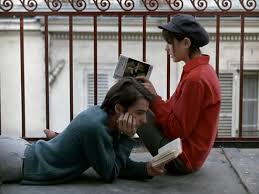
Releasing in 1967, Jean-Luc Godard’s La Chinoise is situated in a key time for France’s political history, its Marxist ideological tensions, and Godard’s filmmaking itself. La Chinoise follows five students in a Maoist cell, renouncing Soviet revisionism, the French Communist party, and French bourgeoise society. The story loosely follows a plan to assassinate the Soviet minister for culture, though it is more concerned with the characters’ daily, almost time-free, actions and interpretations of the three-way tension between Maoism, Soviet Marxism, and contemporary French culture.
Form is arguably more important than content in Godard’s work than context, believing that undermining traditional mass-produced structures and image was equally as effective at creating revolutionary art. In La Chinoise, scenes alternate between realist conversations or mock interviews and a pop-art “mockumentary” format the characters are filming as a propaganda piece. Loud music, harsh, quick edits of the documentary sections with sermon-like readings of Marxist theory often crash unexpectedly through quieter, realist scenes. This form is attempting several things. By blurring the narrative events with meta pieces of art seemingly made by the characters, the film attempts to make its conscious historical place feel ongoing. A criticism Godard had of other counter-cultural films was the use of a traditional realist narrative would place its ideological standing inside the French bourgeoisie framework it was critiquing. One way La Chinoise attempts work outside traditional narrative is to obscure time using alternating, brash editing, and have most of the setting take place in the unchanging apartment cell. The few points of action, such as the suicide of one of the members Kirilov, are disorientated within the story and largely unresolved, pushing the viewer back towards the holistic portrayal of the cell.
This use of form has prompted two interpretations of Godard’s method: La Chinoise being didactic or Brecht-like dialectical. Norman Silverstein, a contemporary film and cultural critic, argued the former, that the film was a “pop-art manual of revolution”. He especially highlights an extended scene where Véronique, the titular Chinoise, argues with Francis Jeanson, a political activist, about Maoist revolutionary violence. Silverstein argues Véronique is a pure mouthpiece for Godard’s adoption of French Maoist tradition – particularly that violence can break the strength of bourgeois cultural hegemony. Just a year after the film’s release the phrase l’imagination au pouvoir, power to the imagination, was chanted and spread around occupations of Sorbonne University among other locations. The use of media within the film and in pop-art style segments also lends itself to this approach. They, despite on the surface seeming to aim at a Brechtian “estrangement effect”, instead act as a straight satire and discussion on the relationship between the hegemonic culture, that of post-war capitalism and especially commercialism, and the counterculture.
The use of the original pop song, “Mao Mao”, a repeated motif through both montage and realist sections, represents this. It backdrops the fictional documentary and takes a standard pop style in line with the pop-art style of the documentary shots. This speaks directly to the French Communist zeitgeist: the pervasiveness of a parent culture and the wider development of structuralism. Several other scenes suggest a more didactic execution. A scene in the film’s second act shows one of the cell members crossing off names of philosophers, artists, and filmmakers while another militant narrates on the use of art for the communist cause. By the end of the scene, only Brecht is left. Kirilov, speaking, argues for artistic production acting as its own science. Art, like science, should be a method of analysis, not simply a commentary, as Kirilov says: “art doesn’t reproduce the visible – it makes visible”. This is a meta-commentary on Godard’s beliefs on filmmaking and the wider Maoist thought on “concrete analysis”. This method of analysis was a response to the greater stratification of labour, and capital’s increasing ability to obscure class consciousness. The method uses a wide collection of oral data and experience of workers to make up a more systematic “whole”. A proponent of this model, Robert Linhart insists the worker’s knowledge is “fragmented and partial, if also profound”. Godard is trying to use this idea in relation to the young revolutionaries and push it didactically through the exposition and the fragmented yet whole experience of the cell. Whether these sections were intended to create a Brechtian “epic theatre” is unclear, but much of the content reads as straight discussion on the relationship of revolutionaries to their parent culture, the struggles in resisting and creating art, and a world outside bourgeois cultural hegemony.
The second interpretation, that La Chinoise is Brechtian “epic theatre”, also has merit, especially on the use of form. Many of these techniques are present in the film: a timelessness, use of sharp interruptions in editing, direct addresses to the audience using word cards or speech and a mixing of fiction and documentary styles. The structure also follows a similar form, Godard taking particular attention to breaking the viewer out of catharsis of the story, a concern shared by Brecht. The intense atomisation of scenes, many being narratively disconnected and interrupted by montages or title cards, is an attempt to resist the apathetic identification with narrative elements Godard saw especially in Hollywood films. The blurring of third and first-person narration serves this purpose. It is often unclear who is narrating over images or title cards, or whether these are part of the documentary inside the story or outside of it. This also plays into the obscuring of the perspective itself. In one scene, Guillaume speaks to the camera: “you’re getting a kick out of this. Like I’m joking for the film because of all the technicians here. But that’s not it. It’s not because of a camera. I’m sincere”. These elements try to push the movie to self-consciousness of itself as a piece of art, and the characters as actors. This is a key piece of dialectical theatre, and Godard takes parts of it into La Chinoise. Instead of actors playing multiple characters, one technique used in theatre for this effect, Godard contrasts the “realist” section characters with intense close-ups, different characterisations, and direct speeches, in the montage and documentary sections. The characters resist the audience identifying with them in this way. This interpretation sees La Chinoise, as Maureen Kiernan puts it, as “a politically motivated film rather than a political film”. That the explicit political messaging is simply a technique among others to politically engage the audience in the subject matter is a core principle of dialectical theatre.
Another argument related to the Brechtian interpretation is Godard’s lack of synthesis of the contradictions set up. This argument sees La Chinoise in a category with Godard’s later works such as British Sounds (See you at Mao), which move almost entirely away from character towards radical film essays. These later films take the breaking down separation between form and content to a greater extent, explicitly attempting to employ the French Maoist “concrete analysis”. In La Chinoise, some of this is present. In the final scene, Véronique murders the wrong person due to misreading the door number. It seemingly represents the wider contradiction in the film between the cell being violent on behalf of the working class while not engaging with them. The final line of the film explicitly leaves this contradiction without resolution: “on the one hand I was wrong, I thought I had taken a leap forward, then I realised I’d only taken the first timid step on a long march”. This theme is mostly not explored didactically, barring the long conversation on the train to Nanterre. Form is very important in making this style possible, images and sounds often acting as one side of the dialectic while the character or content contrasts it. Because of this, interpretations of the film’s specific messages are hugely varied, ranging from condemnation of theory-driven student Marxists to explicit endorsement of the Maoist strategy they are learning.
Overall, La Chinoise leans more towards being didactic, despite Brechtian methods being central to Godard’s execution. The sharp and disorientating cutting between realism, montage, and documentary formats do work to develop some contradictions that flow throughout the film but are never central to the messaging put across in others. Nevertheless, the messaging throughout tends to be direct, even if told through these Brechtian forms. The film speaks heavily to the focus on cultural hegemony in French Marxist thought, and the self-consciousness of a pivotal point in history after the beginning of the Sino-Soviet Split in 1966. La Chinoise is very aware of its structuralist relationship with the French and Western Capitalist culture, its simultaneous impact and tension with the opposing ideas of Marxism and Maoism. Its methods of storytelling, form, and content all are fighting with this core theme, much as French Maoists and structuralists were in the second half of the 1960s.
Bibliography
Kiernan, Maureen, and ﻛﻴﺮﻧﻦﻣﻮﺭﻳﻦ. “Making Films Politically: Marxism in Eisenstein and Godard / ﻋﻤﻞ ﺍﻷﻓﻼﻡ ﺳﻴﺎﺳﻴﺎً: ﺍﻟﻤﺎﺭﻛﺴﻴﺔ ﻋﻨﺪ ﺃﻳﺰﻳﻨﺸﺘﻴﻦ ﻭﻏﻮﺩﺍﺭ.” Alif: Journal of Comparative Poetics, no. 10 (1990): 93–113.
Şerban, Silviu. “GODARD AND THE LANGUAGE OF CINEMA.” Geopolitics, History, and International Relations 3, no. 2 (2011): 260–65.
Silverstein, Norman. “Godard and Revolution.” Salmagundi, no. 9 (1969): 44–60.
Silverstein, Norman. “Godard’s Maoism.” Salmagundi, no. 18 (1972): 15–30.
Rekret, Paul. O’Cearnaigh, Eoin. King, Patrick. “Introduction to Robert Linhart: Concrete Analyses in the Spider’s Web of Production,” Viewpoint Mag, December 5, 2022, https://viewpointmag.com/2022/12/05/introduction-to-robert-linhart-concrete-analyses-in-the-spiders-web-of-production/
Van Tine, Shalon. Enaa Greene, Doug, “A Fight on Two Fronts: On Jean-Luc Godard’s La Chinoise,” Cosmonaut, August 19, 2019, https://cosmonautmag.com/2019/08/a-fight-on-two-fronts-on-jean-luc-godards-la-chinoise/
Featured Image Credit:

