
Written By Harry Child
Louis XIV is a colossal figure in history. He is the longest verifiably reigning monarch in history, reigning over seventy-two years, with this rule seeing the flourishing of the arts in France, which the Palace of Versailles, itself, can attest to. It is perhaps unsurprising, therefore, that such a character should gain for himself such a grand nickname as ‘The Sun King’. You may ask, though, where this term came from?
The Palace of Versailles’ website does a good job of explaining this, highlighting that it was Louis himself who selected the sun as his ‘personal emblem’, as it was connected with the Roman God Apollo, who is often invoked in classical allusions to represent the sun, such as in this instance at Burghley House, Lincolnshire; the God is also closely tied to the arts. The website goes on to explain that the sun was also such a perfect emblem, as ‘it is the star which gives life to all things, rising and setting with unfailing regularity’. As an absolute ruler who claimed to be divinely appointed, Louis would certainly want to subscribe to the idea that he was in control of the world.
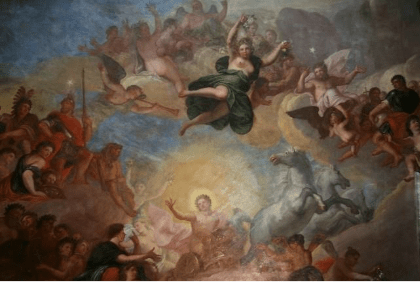
Fig I: Apollo riding in his chariot, depicted on the ceiling of the Bow Room at Burghley House, we can see the light of the sun beaming from his head. Image reproduced by kind permission of Burghley House Preservation Trust.
This idea of absolutism and world domination potentially runs deeper though, especially if we think about astronomy and cosmology in seventeenth-century France. Beverley Ridgely highlights something very interesting, that it was during the seventeenth century, particularly with Galileo and Kepler’s ‘perfections’, as she says, of the Copernican theory, that Copernicus’ idea that the Sun was at the centre of the world, rather than the earth, really gained traction in France. Prior to this, she highlights, it had been a topic of discussion for but a few intellectuals.
Now The Palace of Versailles’ website highlights that ‘in the seventeenth century, astronomy was considered to be the only scholarly pursuit worthy of kings and the most prestigious scientific discipline’. Consequently, it does not seem too much of a stretch to suggest that Louis may well have dabbled in it, something made ever more likely by the fact that in1666 Louis founded the Paris Observatory. At the very least, we could suggest that he was well aware of the developments in it.
As such, perhaps it would be fair to propose that this ‘new astronomy’ (and cosmology) was a factor in Louis taking the name ‘The Sun King’. We have already established that the idea of being in control and an absolute ruler was central to Louis’ agenda; what better way to illustrate this than by comparing yourself to the newly established centre of the world, the sun? By drawing this comparison, Louis was not just demonstrating his knowledge of new scientific developments but was making a metaphorical statement that he really was the ruler of the world.
Bibliography
Henry, John. Moving heaven and earth Copernicus and the solar system, (London: Icon Books, 2017).
‘Louis XIV’, Chateau De Versailles, retrieved from: https://en.chateauversailles.fr/discover/history/great-characters/louis-xiv, last accessed: 01/02/2026).
Ridgely, Beverly S. ‘Dalibray, Le Pailleur, and the “New Astronomy” in French Seventeenth-Century Poetry’, in Journal of the History of Ideas, 17:1, (1956), 3-27.
‘Virtual Exhibition Sciences at Versailles’, Chateau De Versailles, retrieved from: https://en.chateauversailles.fr/news/life-on-estate/sciences-versailles#chapter1-sciences-power, (last accessed: 01/02/2026).
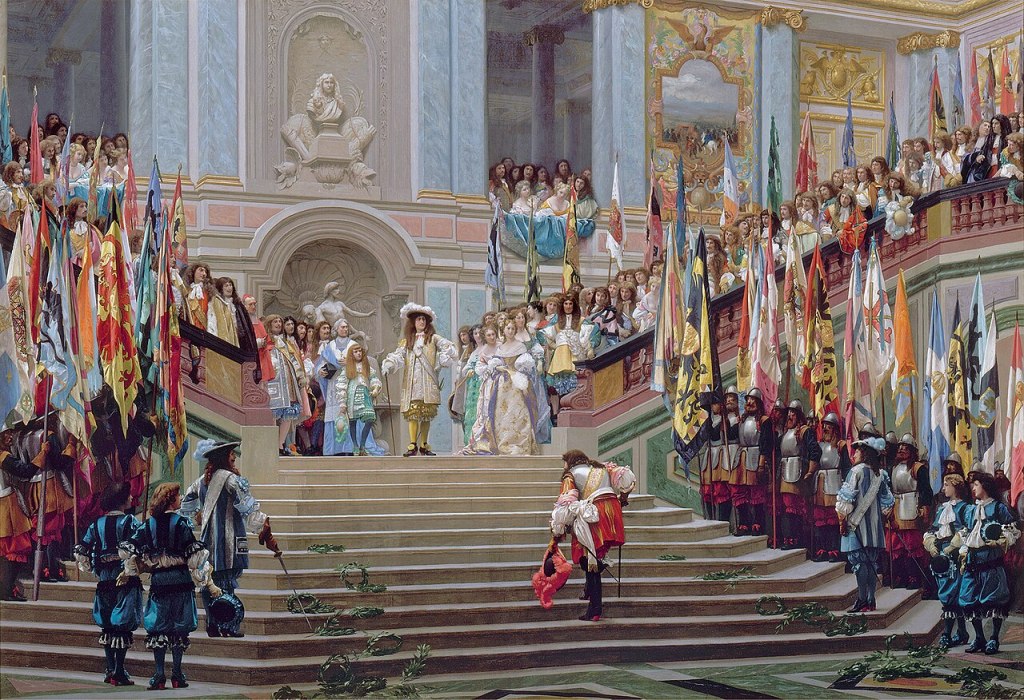
Featured Image Credit: Réception du Grand Condé à Versailles, by Jean-Leon Gerome, painted 1878, retrieved from: https://commons.wikimedia.org/w/index.php?search=Louis+XIV+depiction+in+the+Palace+of+Versailles&title=Special%3AMediaSearch&type=image.

