
Written by Christian Denham-Davis
16/02/2026
The Declaration of Independence and the Constitution represent the two foundational documents of the United States. The Declaration articulated the colonies’ ideological justification for independence, drawing on Enlightenment theory such as John Locke’s theories of natural rights and Thomas Paine’s Common Sense. Though the fighting had already begun, the Declaration formally severed political ties with the Kingdom of Great Britain. Thirteen years later, the Constitution, drafted by the Constitutional Convention and ratified by all thirteen states, put these principles into practice and outlined the structure of government intended to replace the supposedly tyrannical British monarch. In light of the semiquincentennial anniversary of the Declaration, this piece examines the turbulent transition the colonies made from ideals to a practical form of government that has stood the test of time yet remains politically and intellectually contested today. How a fear of tyranny and the subsequent desire for a weak central government caused instability and a fear of the union’s dissolution. Though the Declaration was of immense importance, it did not create a country nor a way to structure and build a government. Whether these principles could be translated into a functioning state was deeply uncertain and as likely to fail as to succeed.
The Declaration arose out of the colonists’ frustration with British “taxation without representation”, increasingly oppressive and restrictive policies like the “Intolerable Acts”, and military aggression – violating the colonists’ understanding of political legitimacy. Enlightenment ideas and social contract theories of government heavily influenced the declaration and pushed some colonists over the edge toward independence from the Crown. The document was a significant moment in formally separating from Britain and justified the colonists’ actions. Core to the Declaration was deriving a government’s legitimacy from the consent of the governed, with the principles of “life, liberty and pursuit of happiness” central to this ideal. It offered an aspirational vision of government while providing no practical blueprint for institutionally protecting these ideals. The document’s purpose was immediate: to legitimise resistance. The future beyond this purpose was uncertain for the North American entity. The commitment to liberty left the new states with ideals but few workable mechanisms of government. There was no path to follow, and, based on the success of the Revolutionary War, the ensuing years were essentially an experiment to determine the best way forward, for which everyone had differing answers.
The first attempt to turn these ideals into reality was the Articles of Confederation, the United States’ first written constitution, which established a loose “league of friendship” among the thirteen independent states. The Articles embodied the ideals of the Declaration of Independence with distrust of concentrated authority. It acted as a provisional government to coordinate resistance against Britain. Though in theory a central authority, the Articles prioritised state sovereignty, reflecting distrust of the British Crown’s centralized power. The Articles encouraged the states to act as independent republics, rather than collectively as a unified nation. The weak national government had no executive or judicial branches and subsequently could not forcibly raise taxes to fund the military effort. The Articles further demanded democracy at the highest level for all decision-making from the section of society that could “afford it”, meaning that national authority largely existed only in theory. Financial chaos, cultural disunity, and Shay’s Rebellion highlighted the government’s ineptitude and structural instability, making the possibility of disunion very real. Genuine fears emerged that the country would break into separate republics and the “league of friendship” would disband, and, as the Declaration says, they would be “free and independent states”. Furthermore, each state still had its own army, printed its own money, taxed separately, and frequently ignored Congress altogether. Interstate rivalry regularly hindered collective action, and with the Crown absent to keep the states together, the union was questioned. The Articles made the thirteen states closer to the European Union in today’s world, rather than a nation-state; the term “United States” was in name only, with regional separation considered by some. This was also typified by a lack of international faith with Britain keeping its position at American forts, expecting a collapse at some point.
The multitude of issues the United States faced led some individuals to believe that the principles of the Declaration were too idealistic to be fully implemented. The views taken by such individuals can be strongly argued as the reason for the existence of the United States of America to this day. Figures such as James Madison, George Washington, Benjamin Franklin, and Alexander Hamilton, to name a few, feared the consequences of separate states, including conflict among themselves and the possibility of European reconquest. Learning from experience as a new nation, the Constitutional Convention drafted the Constitution to address real-time problems faced by the republic while retaining the ideals of the Declaration. The Constitution created a flexible government with multiple branches, each with checks and balances to curb a strong central government, whilst attempting to balance the interests of the states, with individual rights still central to its ideals. The Constitution represented a conscious retreat from revolutionary idealism towards pragmatic state-building. The Founding Fathers now also recognised their task at hand and its complexities, designing the Constitution to be a “living document”. This concept posited that the Constitution could change in accordance with the needs of the country over time, a recognition that the Founders were still chasing the best way to move the country forward. As such, since its creation, there have been twenty-seven separate amendments to the Constitution, beginning with the Bill of Rights in 1791. The lengthy ratification process for amendments reflects the Constitution’s strong democratic principles. Its rigidity, adaptability, and core principles have allowed the Constitution to endure for over two centuries, with the Founding Fathers drawing on the experiences of the young nation’s thirteen-year history. Though the Constitution has its critics, the document helped navigate the sovereign states toward a fledgling, strong union, providing an effective and realistic solution to the Articles of Confederation, whilst also keeping the Declaration’s core principles at heart.
As a new political entity, the United States was inevitably going to encounter issues. For the colonists, their entire existence had been under British and European rule, and they attempted to build an unprecedented political order based on a set of uncompromising revolutionary ideals: fear of anarchy and strong central government. Therefore, the Founders tried to build a new government to rule based on their desire for a weak ruling body—an inherent juxtaposition. The Articles of Confederation offered the first solution in translating the Declaration’s values into a form of government. However, the model, which the Founders deemed too idealistic, drove the union towards dissolution. The Founders created a central government with no authority over the virtually autonomous states, resulting in financial ruin and insecurity. Ironically, the very principles that justified independence made stability in the Union initially very difficult. In response, the Constitutional Convention was formed and attempted to address these issues. As such, it created the Constitution, a living document which created a stronger central government with effective checks and balances, whilst still holding the revolutionary ideals at heart. The Founders acknowledged that the Constitution was not perfect, but it lay within their own powers and desire to ensure the union succeeded.
In a conversation following the Constitution’s ratification, Benjamin Franklin was asked “What do we have?” to which he supposedly responded “A Republic, if you can keep it. Now it is up to us.” which to this day the United States attempts to fulfil. The imperfection of the document has long sustained conversation over the foundational documents. The Declaration asserting that “all men are created equal”, despite one third of its signatories being slave-owners and one fifth of the country at the time being enslaved particularly shows how ideas of freedom and fairness were inherently contradictory in the making of the America’s foundational documents. The contradictory nature of the foundational documents is particularly relevant considering Donald Trump’s second term, in which recent controversies surrounding presidential power illustrate the persistent strain placed on the Constitution’s interpretation 250 years later. The inherent contradiction of upholding slavery at the inception of the US proves that we should be weary of proclaiming the ideology of revolution born within the Declaration of Independence as utopian. Donald Trump’s supposed undermining of constitutional framework demonstrates that although the Founding Father’s created a flexible system which could survive societal progress, it also left the Constitution vulnerable to manipulation and the ability to fundamentally undermine the Founding Fathers intended principles.
Bibliography
American Battlefield Trust. “From Declaration to Constitution: The Creation of the American Charters of Freedom.” Archived December 13, 2023. https://www.battlefields.org/learn/articles/declaration-constitution
Foster, John. “The Declaration of Independence: Its Influences & Legacy.” Posted Jan 17, 2026, by MentorPublicLib. YouTube, 58:54. https://www.youtube.com/watch?v=yGhcQpOO9T0.
Ginsburg, Douglas. “The Global Impact Of America’s Declaration Of Independence.” Posted December 4, 2025, by The American Story – US History Documentaries. YouTube, 56:12. https://www.youtube.com/watch?v=eAWSRsNYAVg
Heritage. “The Genius of the Constitution.” Accessed February 3, 2026, at https://www.heritage.org/the-essential-constitution/the-genius-the-constitution.
Kiniry, Laura. “Ten of the Most Exciting Ways to Commemorate America’s 250th This Year”. Smithsonian Magazine, January 30, 2026. https://www.smithsonianmag.com/travel/ten-of-the-most-exciting-ways-to-commemorate-americas-250th-this-year-180988106/
National Archives. “Articles of Confederation (1777).” Archived October 23, 2023, at https://www.archives.gov/milestone-documents/articles-of-confederation
National Archives. “The Constitution of the United States: A Transcription.” Archived December 9, 2025, at https://www.archives.gov/founding-docs/constitution-transcript.
National Archives. “The Declaration of Independence: A Transcription.” Archived August 7, 2025, at https://www.archives.gov/founding-docs/declaration-transcript.
Office of the Historian. “Articles of Confederation, 1777-1781.” Accessed February 1, 2026. https://history.state.gov/milestones/1776-1783/articles.
Pincus, Steve. “Trump’s Rejection of America’s Founding Principles.” Project Syndicate, July 4, 2025. https://www.project-syndicate.org/commentary/trump-rejects-declaration-of-independence-free-trade-immigration-internationalism-by-steve-pincus-2025-07.
Rakove, Jack N. “The Declaration of Independence.” In The Annotated US Constitution and Declaration of Independence. Harvard University Press, 2009. https://ebookcentral.proquest.com/lib/ed/detail.action?docID=3300819&pq-origsite=primo
The Gilder Lehrman Institute of American History. “The Declaration of Independence in Global Perspective. Accessed Februrary 2, 2026. https://www.gilderlehrman.org/history-resources/essays/declaration-independence-global-perspective
The National Archives. “The Constitution: How Did It Help?” Archived November 28, 2023. https://www.archives.gov/founding-docs/constitution/how-did-it-happen
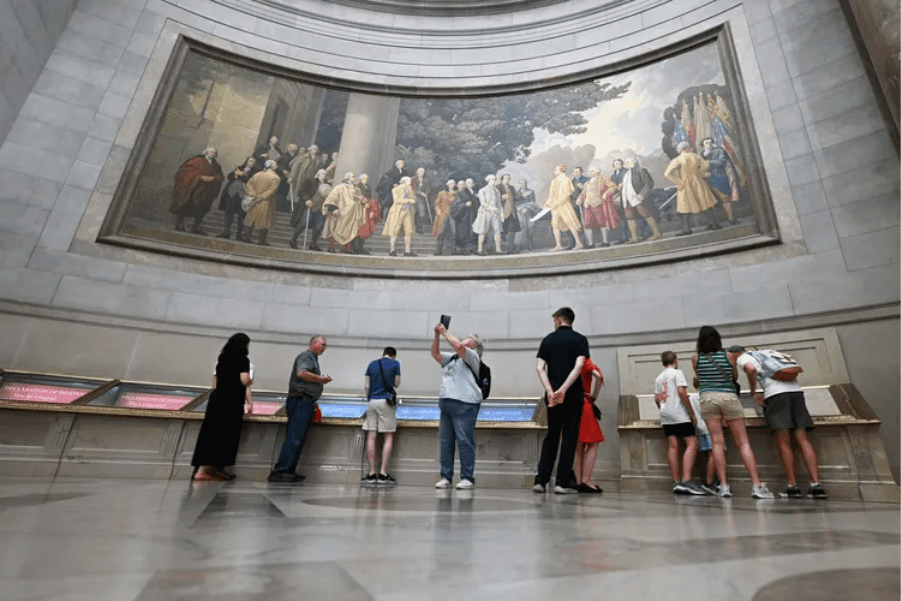
featured image: People view the Declaration of Independence and other documents at the National Archives in Washington, D.C

