
Written by Harry Child
If you ask someone to name a Medici Pope, chances are, if they know any of them at all, they will name Leo X and Clement VII. People know these two as they were massive papal presences in the sixteenth century: Leo X for his heavy involvement in shaping the Renaissance; Clement VII for having rather famous misfortunes, namely, the sack of Rome 1527, and being the Pope who refused Henry VIII his request for an annulment from his first wife, Catherine of Aragon. Many people forget, though, that whilst these two may have been the biggest forces of the Papal throne to hold the surname Medici, there were indeed two more successors of Saint Peter who had this name, who in their own way were critical to history and deserve better press: Pius IV and Leo XI. My aim with this article is to give a very potted history of each of these popes before, in my conclusion, thinking about what we can extract from their stories which can help us better understand both the nature of the early modern Papacy and the wider Early Modern European world.
Pius IV (1559-1565)
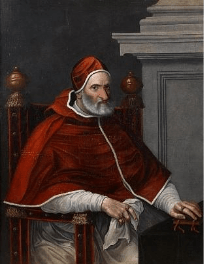
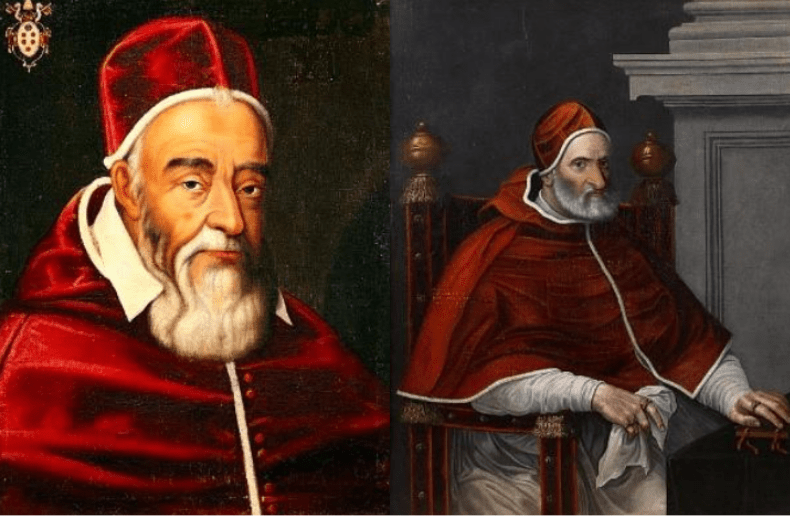
A stern-looking Pius IV, c.1560s by circle of Scipione Pulzone.
Pius IV should be more famous. If for nothing else, he was one of the few Popes installed in office on Christmas Day. Also, despite his last name Medici, he was not actually related to the famous Florentine family but rather belonged to the Milanese House of Medici. His election was far from set; indeed, it took over three months for the Cardinals in the 1559 conclave to decide that Pius, or Cardinal Medici, was the candidate they wanted. Indeed, the conclave at which he was elected was the longest of the sixteenth century.
This length, Catholic historian Ludwig Von Pastor highlights, was largely due to the complex web of alliances that existed within the College of Cardinals. Many cardinals were attached to a country, pertinently France, Italy, and Spain, and these factions consistently did not like the candidates the others endorsed for Pope. What occurred in the case of the 1559 conclave was a series of dealings in which various factions sought to bring enough of the other cardinals around to support their candidate (the support of two-thirds of the college present was needed to secure election). This went through various iterations until, by 20 December 1559, Cardinal Vargas said that the college would be willing to elect a piece of wood to the Papacy if only it would end the conclave.
The final battle was between Cardinal Cesi and Cardinal Medici, who had been bedridden for most of the conclave after arriving ill. Medici ultimately won, not because he was the favourite of any particular faction but because he was the only one that was half agreeable to all of them. As Von Pastor says, he was by far the best candidate ‘when everything else had failed’. Here we can see that the election of Medici was, in many ways, about appeasing all the geopolitical factions at the Papal court, rather than electing the best man for the job. This is all made especially pertinent if we take what Davis says at his word, that Medici had ‘no real theological knowledge’. Davis does say that Pius made up for this though by being a competent delegator and took the name Pius as he wanted to be the embodiment of that quality in both ‘name’ and nature.
Perhaps the principal thing Pius is credited for is resuming, in 1562, and completing in 1563, the Council of Trent. Davis tells us that he was not present at most of the council but did send competent papal legates to oversee it. Duffy, who also highlights Pius’ involvement in completing the Council of Trent, is rather scathing of Pius, seeing him almost as this somewhat incompetent stop-gap Pope. However, whilst this is somewhat meritorious given what we have seen, Davis highlights that Pius was very quick following the end of the Council to create the Commission of the Cardinals, a body which ultimately sought to ‘interpret and enforce’ the decrees that had come out of the council. He did also institute some policies, like for example issuing a revised list of prohibited books in 1564, evidently an attempt to make good on some attempts at Counter-Reformation, a key goal of the council. So indeed, whilst Pius might not be that effective, as Duffy claims, compared to his successor, Pius V, he is not devoid of importance; the fact that he completes the council can be considered a great achievement, given that prior to his rule it had seen a ten-year suspension.
Pius is said to have died of complications surrounding gout in 1565, amidst a plan by a certain Benedetto Accolti to kill him.
Leo XI (1605)
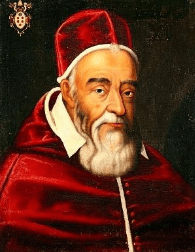
A friendlier looking Pope Leo XI, c.1605-1622.
Leo XI had considerably less time to make his mark than Pius did, scarcely lasting a month in office following his election in 1605.
Indeed, one of the most amusing anecdotes about Leo comes from his election, where it is said that King Henry IV of France (r.1589–1610) paid three hundred thousand scudi to the cardinals to secure the election of Medici. Why do this, you might ask? Well, Medici had been significantly involved in the French church. In 1596, he had been appointed papal legate to France to sort the corruption in the church. During the reign of Henry III of France, a situation had developed where, despite it being the King’s right to put forward new candidates for Bishoprics, wealthy families were doing so instead. This meant that, when it suited them, these families would keep these sees vacant and send a delegate to operate them and collect their revenues.
When Henry IV became the King, he felt compelled to continue this practice, as he wanted to secure the support of the great families of France for his rule, something especially pertinent given that when he became the King, he was a Protestant in a heavily Catholic country. However, as King, Henry did want the right of choosing his own Bishops back. The arrival of Medici, Bergin suggests, allowed Henry to move towards this. Medici would seek to root out the corruption that was going on, usually compromising with families and providing large payouts for them to release their grasp of the see, which in turn would help diminish the corruption and return some authority to Henry (and the church) in a quiet manner. Equally and perhaps most importantly, he was the one who convinced Pope Clement VIII to confirm Henry’s absolution following his conversion to Catholicism in 1593. Medici therefore was seen as a friend of France and especially Henry, and thus the ideal candidate for Pope.
On election, it is said Medici took the regnal name Leo, an action believed to have been brought on by the fact his great-uncle, the first Medici Pope, had taken this name.
It seems that Leo recognised the level of corruption that was occurring in the church after acceding to the Papal throne and tried to do something about it. For example, he introduced a new system of conclave voting, in which cardinals cast secret ballots as opposed to publicly paying homage to the person they supported to become Pope, the system in which he had been elected. As Von Pastor argues, this was a step towards preventing cardinals being peer-pressured into supporting candidates, thus a step towards reducing corruption at conclaves. However, Leo was not completely absolved of all corrupt practices, despite the terrible debt the papacy had got, he pledged his support of the Imperial faction in their bid to control Hungary instead of the Turks, as this had been part of the bargain with his election. Whilst, therefore, Leo might have made efforts to move away from the corruption at the top of the Catholic church, it was so engrained in the Early Modern papal system, even the ‘most worthy disciple of Philip Neri’, to quote Von Pastor, engaged in activity which had corrupt roots.
Medici caught a chill only seventeen days into his Papacy and died ten days later, just two months shy of his seventieth birthday.
Conclusion
These two characters tell us a lot about the Early Modern era. Primarily, their stories, or the pieces of them I have had space to tell here, enlighten us as to the levels of corruption that took place within Early Modern papacy and especially in the conclaves. If we think about both instances, there was this idea that candidates could be elected through the passing of enough money, or through the fact that they met the right geo-political purpose, as opposed to being principally about their competence as the successor of Saint Peter. Equally, linking to this in many ways, their stories tell us of the factionalism that existed within the Papacy and the College of Cardinals at the time: It is so easy for us to look back and say, especially with the Reformation, that in the Early Modern period there was a Catholic world against an emerging Protestant world, and maybe at one level this is true, but when you dig deeper, you find that many Catholic powers were themselves competing.
Perhaps, therefore, even though Pius IV ended the Council of Trent, we might want to question exactly how effective it was at rooting out corruption in the Early Modern Catholic Church. At the top of the tree, some forty years on from the council, candidates were still being selected based more on their geo-political benefits than their actual religious competence.
Bibliography
Bergin, Joseph. ‘Henry IV and the problem of the French episcopate’, in (ed.) Cameron, Keith. From Valois to Bourbon Dynasty, State & Society in Early Modern France, (University of Exeter, 1989), 127-144.
Casey, T. F. ‘Leo XI, Pope’, in New Catholic Encyclopedia, vol. 8, 2nd edition (Gale, 2003), retrieved from: https://go-gale-com.eux.idm.oclc.org/ps/retrieve.do?tabID=T003&resultListType=RESULT_LIST&searchResultsType=SingleTab&retrievalId=b788850d-7540-4f3e-9e6f-965103669f1a&hitCount=1>mSearchId=50b703ea-ccbe-4fad-a597-27ba738823f9&searchType=AdvancedSearchForm¤tPosition=1&docId=GALE%7CCX3407706617&docType=Biography&sort=Relevance&contentSegment=&prodId=GVRL&pageNum=1&contentSet=GALE%7CCX3407706617&searchId=R3&userGroupName=ed_itw&inPS=true&aty=ip, (last accessed: 30/01/2026).
Davis, H. H. ‘Pius IV, Pope’, in New Catholic Encyclopedia, vol.11, 2nd edition, (Gale, 2003), retrieved from: https://go-gale-com.eux.idm.oclc.org/ps/retrieve.do?tabID=T003&resultListType=RESULT_LIST&searchResultsType=SingleTab&retrievalId=6cf304de-eafc-46a0-94c1-43debfab3cf9&hitCount=42>mSearchId=f23a27a7-5eb2-47d1-8ded-70e1b5a0ba96&searchType=AdvancedSearchForm¤tPosition=1&docId=GALE%7CCX3407708868&docType=Biography&sort=Relevance&contentSegment=&prodId=GVRL&pageNum=1&contentSet=GALE%7CCX3407708868&searchId=R4&userGroupName=ed_itw&inPS=true&aty=ip, (last accessed: 30/01/2026).
Duffy, Eamon. Saints and Sinners, (Folio Society, 2009).
‘Leo XI’, in Oxford Reference, retrieved from: https://www.oxfordreference.com/display/10.1093/oi/authority.20110803100100620, (last accessed: 30/01/2026).
Lipscomb, Suzannah. and Fletcher, Catherine. ‘Medici Popes: Power over Piety’, on Not Just the Tudors, (2024), retrieved from: https://open.spotify.com/episode/55XmhtT1VfSKiFEtxuzjWh.
Morgan, Elizabeth. ‘6 Interesting Historic Events That Happened on Christmas Day’, The Collector, (2025), retrieved from: https://www.thecollector.com/historical-events-that-happened-on-christmas-day/ [Accessed: 03/01/2026]
Von Pastor, Ludwig Freiherr. The History of the Popes from the Close of the Middle Ages, (ed. & trans.) Kerr, Ralph Francis., Vol. 15, (London: Kegan Paul, Trench, Trubner & co. Ltd, 1928).
Von Pastor, Ludwig Freiherr. The History of the Popes from the Close of the Middle Ages, (ed. & trans.) Graf, Dom Ernest., Vol 25, (London: Routledge & Kegan Paul Ltd, 1952).
Featured image credits
Pius IV. Retrieved from: https://commons.wikimedia.org/wiki/File:Portrait_of_Pope_Pius_IV,_three-quarter-length,_seated_at_a_draped_table_(Circle_of_Scipione_Pulzone).jpg.
Leo XI. Retrieved from: https://commons.wikimedia.org/wiki/File:Pope_Leo_XI_-_Portrait.jpg.

