
Written by Roya Kenny
08/02/2026
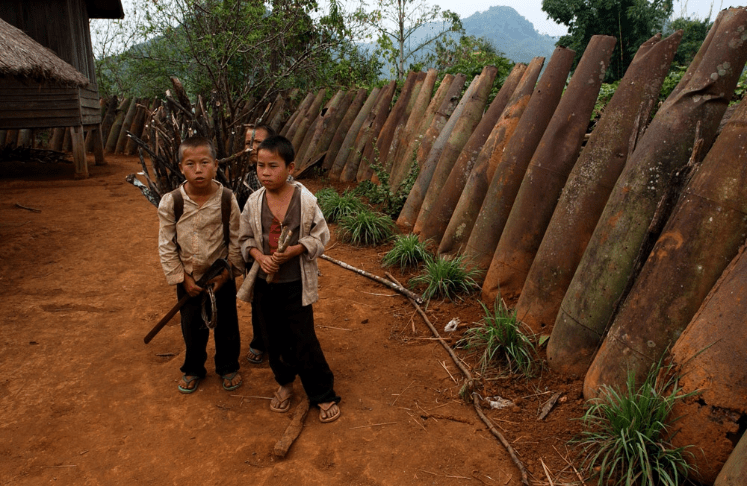
The United States’ “secret war” in Laos, despite no longer being denied its existence by the U.S. government, is an oft-forgotten history with far-reaching impacts to the present day. The U.S. government funded and carried out an almost decade-long bombing operation on Laos in the name of preventing the “domino effect” of communism. The 2.1 million tons of bombs dropped over the period of 1964 to 1973 equate to one bombing mission every 8 minutes, every hour of the day for the entire length of time that the operation lasted. As Barack Obama stated in his 2016 visit to Laos, the U.S. dropped an immense number of bombs over the country, “more than we dropped on Germany and Japan combined during all of World War II.” It is necessary to continue acknowledging that the U.S. government unjustifiably caused insurmountable and lasting destruction to Laos, a country caught between competing powers of the Cold War and the victim of tremendous violations of international law and agreements.
A Short History Prior to the ‘Secret War’:
Laos gained full independence from France on 22 October 1953. Upon its independence, Laos became a constitutional monarchy, but it quickly became the site of political tension between the Royal Lao Government, which sought aid from the United States, and the Communist Pathet Lao resistance, which was aided by the Viet Minh. Essential to the following events are the 1954 Geneva Accords, which designated Laos as a neutral country and created a coalition government comprising the Neutralists and the Pathet Lao, which held the northeastern provinces of Houaphan and Phongsali. The 1950s and 1960s were an unstable period for Laos, during which the U.S., the Soviet Union, and China had conflicting interests amid shifting power balances and coalition governments. During the 1950s, the U.S. saw Laos as a borderland for the communist threat and thus supplied arms, training and money to anti-communist government officials. In addition, the U.S. gave $167 million in aid from 1955 to 1958, most of which went to the military. As Khamvongsa and Russell state, this aid did not benefit the rural population and thus pushed them even more toward communism.
In the April 1960 elections, the U.S. believed the Pathet Lao would have the majority and took part in rigging the elections by vote-buying and ramping up aid. Frustrated by the constant U.S. interference, Royal Lao Army commander Kong-Le staged a coup, attempting to form a moderate government. Subsequently, the U.S. responded by supporting and aiding a countercoup by the rightist leader, Phoumi Nosavan. In response, the neutralists joined the communists, and civil war erupted. The civil war led to the second Geneva Conference in 1962 and a subsequent one the following year, which reaffirmed the neutrality of Laos and prohibited foreign bases and troops. Despite this, the U.S. continued supplying and aiding the Royal Lao Army and the CIA recruited and supplied ethnic minorities, including the Hmong, to fight a guerrilla war behind enemy lines. In order to evade the Geneva Agreements, the CIA hired ‘private contractors’ such as Air America and Continental Air Service, and reclassified military pilots as civilians to supply and carry out bombing missions under the cover of delivering humanitarian aid.
‘The Secret War’:
2. The civilian population as such, as well as individual civilians, shall not be the object of attack. Acts or threats of violence the primary purpose of which is to spread terror among the civilian population are prohibited. (Protocol I, Article 51) – 1949 Geneva Convention II
In 1964, another coup was led by two Royal Lao Army generals. The same year, the U.S. began flying reconnaissance flights from Thailand to territory under Pathet Lao control and began bombing such territory after a plane was shot down. The U.S. mainly targeted Pathet Lao territory, as well as the Ho Chi Minh Trail, a supply line for Communist troops. Despite direct bombing, the U.S. denied its actions. It was all too easy to gloss over the direct violation of international agreements that the U.S. was perpetrating in Laos; especially as the world became focused on the 1965 bombing raids on North Vietnam. The interconnectedness of U.S. attacks in the region during this period cannot be denied, as many bombs that were meant for North Vietnam made their way to being dropped in Laos. Khamvongsa and Russell write that when inclement weather or heavy fire meant that bombing missions meant for North Vietnam were rerouted to Laos, to avoid the risk of landing back at bases in Thailand with full ordnance.
In 1968, Lyndon B. Johnson announced the partial and then full halt to the bombing of North Vietnam, saying, “The overriding consideration that governs us at this hour is the chance and the opportunity that we might have to save human lives on both sides of the conflict.” However, as Khamvongsa and Russell assert, North Vietnam bombers were then diverted to Laos. Haney quotes an American official saying, “We couldn’t just let the planes rust.” By 1969, bomber sortie raids reached 405 per day, equating to a planeload of bombs dropped every 3.7 minutes, around the clock, for an entire year. Bomber sorties, referring to a flight from takeoff to returning to base, continued to increase as restrictions on targeting civilians were relaxed. Extensive survivor accounts attest to bombs falling on fleeing civilians.
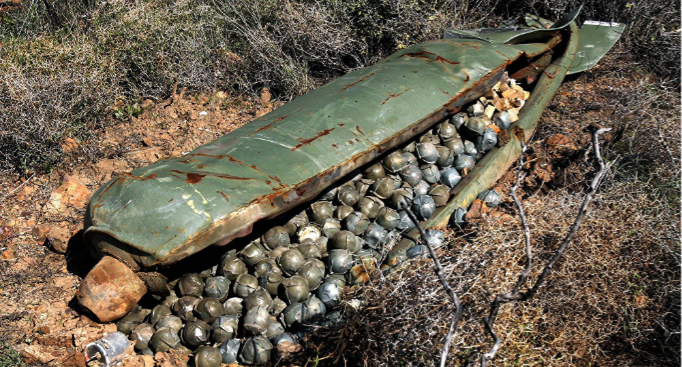
Further, U.S. involvement in Laos saw one of the first large-scale uses of cluster bombs: large casings that hold 600-700 bomblets or submunitions per bomb. Once released midair, the bomblets scattered over a wide area. About the size of an orange, each could unleash deadly shrapnel in a 65-foot radius – injuring anyone within nearly 330 feet. In total, about 2.1 million tons of ordnance were dropped on Laos from 1964 to 1973, and it became the most heavily bombed country per capita in the world. The U.S. ended its secret war with the 1973 peace agreement between North Vietnam and the US, and in 1975, the Pathet Lao gained full control of the country.
Implications:
“They were at home. This was before everyone had fled their homes. A big, big bomb set everything on fire. ‘Mother was burned up. Father was burned up. The children were burned up. Everything was burned up.’ There were no soldiers in the village.” Account of 1966 bombing by Pho Xieng Onh from Ban Pung in a 1970 interview at a refugee camp,” Channapha Khamvongsa and Elaine Russell. 2009
It is estimated that 30 per cent of all cluster bomblets dropped on Laos did not detonate on impact, which left about 80 million unexploded cluster bombs along with other types of munitions that had not detonated. It is estimated that 50,000 people have lost their lives to the unexploded ordnance (UXO) that lies everywhere around the country, from fields to residential areas. The bomblets are small and toy-like, and according to the Mines Advisory Group, almost half of those who have been killed by UXO were children. The UXO that contaminates much of the country to this day has far-reaching effects, causing fatalities, injuries and slowing agricultural production to the point that it cannot sustain the growing population. The resources and processes needed to clear contaminated land are costly and time-consuming. Thus, in a country where, according to the World Bank, approximately 1 in 5 people live below the national poverty line, the full decontamination of UXO seems distant. Foreign aid is necessary to fund these decontamination projects, and according to a 2022 press release from Humanity and Inclusion, at least 10,000 villages remain contaminated with UXO.
For 20 years, Laos received no aid or acknowledgement from the U.S. regarding the lasting state of disaster they had left the country in. Beginning in the mid-1990s, the U.S. began funding the clearance of UXO, never exceeding $5 million per year until the 2010s, when funding increased significantly. By 2024, the U.S. had allocated $391 million to Laos since 1995, which, if evenly distributed, would amount to approximately $14 million per year. Yet, according to Khamvongsa and Russell, the U.S. spent $2 million per day for the nine years that it bombed Laos.
Bibliography
Haney , Walt . 1972 . “ The Pentagon Papers and the United States involvement in Laos ” . In The Pentagon Papers, Gravel edition: Critical essays , Edited by: Chomsky , Noam and Zinn , Howard . Vol. 5 , Boston : Beacon Press .
Haney , Walt . A survey of civilian casualties among refugees from the Plain of Jars, Laos . Testimony before the Subcommittee to Investigate Problems Connected with Refugees and Escapees of the Committee on the Judiciary . July 22 1971 . United State Senate .
“How Cluster Bombs Work.” 2017. How Cluster Bombs Work. Humanity and Inclusion US. June 30, 2017. https://www.hi-us.org/en/news/how-cluster-bombs-work.
“How MAG Is Working to End the Deadly Legacy of War in Laos | MAG.” 2020. Maginternational.org. Mines Advisory Group. February 20, 2020. https://maginternational.org/whats-happening/how-mag-working-end-deadly-legacy-war-laos/.
Khamvongsa, Channapha, and Elaine Russell. 2009. “LEGACIES OF WAR: Cluster Bombs in Laos.” Critical Asian Studies 41 (2): 281–306. doi:10.1080/14672710902809401.
Ounmany, Kiengkay, and Edo Andriesse. 2018. “The Legacy of the Vietnam War: Making a Living amid Unexploded Ordnance in Xieng Khouang Province, Northern Laos.” Asian Studies Review 42 (3): 439–58. doi:10.1080/10357823.2018.1481365.
“To Walk the Earth in Safety (2024) – United States Department of State.” 2025. United States Department of State. August 7, 2025. https://www.state.gov/reports/to-walk-the-earth-in-safety-2024/.
World Bank (2026), Poverty and Inequality Platform (version 20250930_2021_01_02_PROD) [data set]. Pip.worldbank.org
“50 Years on from the End of U.S. Bombing, Laos Needs 50 More Years to Be Clear of Explosive Remnants of War.” 2022. Humanity and Inclusion. Humanity and Inclusion UK. December 24, 2022. https://www.humanity-inclusion.org.uk/en/50-years-on-from-the-end-of-us-bombing–las-needs-50-more-years-to-be-clear-of-explosive-remnants-of-war.
1975 . Senate Congressional Record , Washington, D.C. : U.S. Government Printing Office . 14 May
Image credits: https://asianamericanhistory101.libsyn.com/the-history-of-the-secret-war-in-laos-part-2

