
Written By Abby Hughes
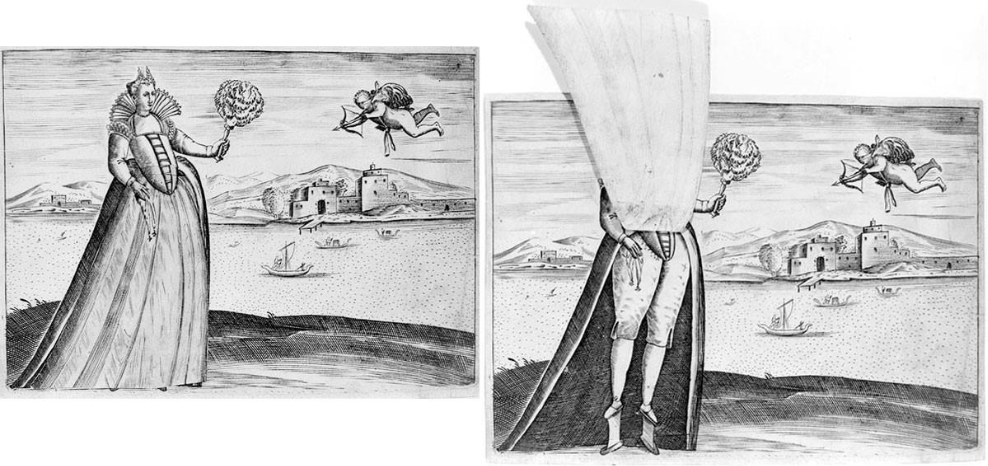
Figure 1. Courtesan and Blind Cupid, 1588. Pietro Bertelli.
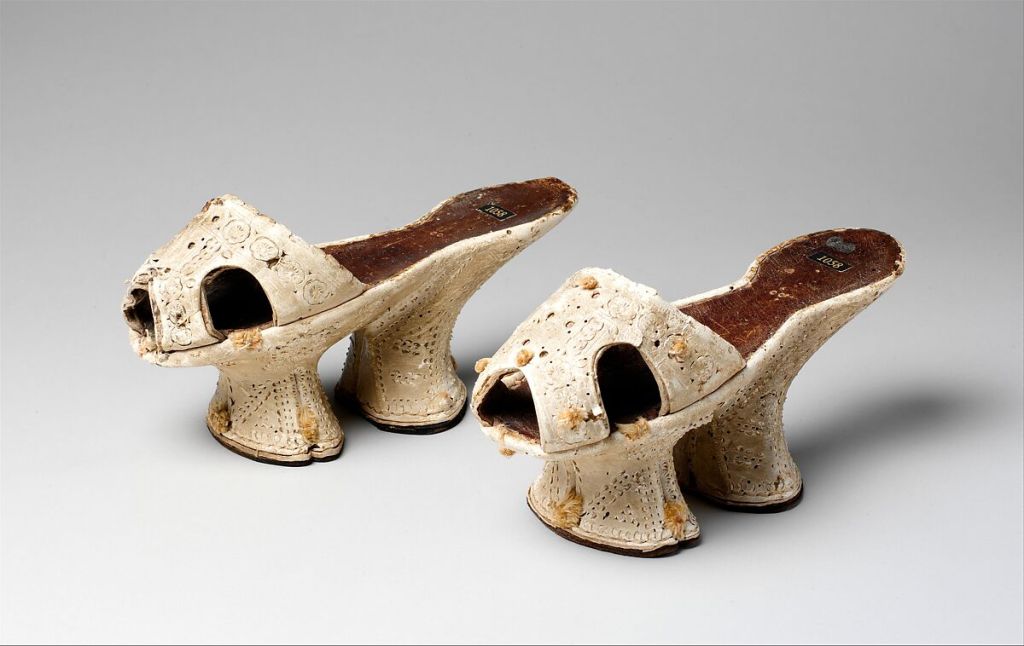
A tourist visiting Early Modern Venice might find themselves confronted with a strange sight. Winding their way down Venetian alleyways, they would pass by canals, wrap around the walls of palazzi, and in their path find a woman of impossibly giant stature. Leaning on attendants, this colossal figure would slowly and carefully make her way along the cobbled pathway. Startled, our tourist might consider whether they had run into a creature of legend. Certainly, as early as the thirteenth century, Franciscan friar Jacopone da Todi noted the presence of short Venetian women transformed into giants. This strange effect was not some supernatural marvel, but rather the effect of extreme platformed shoes, known as chopines.
The chopine is not unique to the Early Modern Venice – indeed, the word itself, and the platformed style it is famous for, derives from the Spanish ‘chapin’. The presence of platformed shoes can be traced further back to Ancient Greece and Rome, seen in the ‘Etruscan sandals’ worn by Athenian women, for example. However, the extreme height of Venetian chopines is rare and distinctive. According to extant copies, the tallest chopine measured fifty-four cm in height, with a base carved from a single piece of wood, as opposed to the Spanish examples which tended to be constructed from layered cork. Visually arresting, such tall platforms provoke questions such as; ‘why were Venetian women motivated to take up such extreme fashions’? and ‘how did these styles affect the practicality of everyday movement’?
Centrally, unlike their Iberian counterparts, Venetian chopines were, despite their occasional adornment, expected to be entirely concealed when worn. This much can be determined from Figure 1, an etching titled Courtesan and Blind Cupid. Produced by Pietro Bertelli around 1588, this piece was made with a hinged paper dress, which, when pulled back, reveals a pair of Venetian ‘undergarment-style’ chopines. Elizabeth Semmelhack, senior curator at the Bata Shoe Museum in Toronto, notes the strict etiquette around concealing these strange shoes, which required skirts to graze the ground at all times. Further revealed in the instructive text Il Ballarino written by the dance master Fabritio Caroso da Sermoneta, the careful instruction of how to keep one’s chopines hidden is dictated. Writing in 1581, Caroso directed that a woman’s ‘gown shall come to remain even with the ground, nor will it show yet moreover in this manner the pianelle’. Semmelhack has suggested that such etiquette was dictated consciously as ‘a means of substantially increasing the amount of expensive cloth required to make women’s dresses’. A central trade hub for fabrics travelling through Europe from the Near East, and a manufacturer of luxury textiles itself, Venice derived much of its wealth and influence from the textile market. Beyond this, the concealed nature of Venetian chopines contradicts the commonly accepted notion that they existed to prevent skirts from grazing the floor and being covered in mud. Instead, the prominent stature of women wearing tall chopines functioned to promote their family’s wealth and influence. Ruled over by a uniformed confraternity, Venice formed an ideal setting for women to express their wealth through the mode of fashion, placing a distinct burden on their manner of dress that allowed for the rise of such a surreal accessory. Rather than the shoe itself forming the trend, its constant concealment indicates that the uncanny height it afforded was the ultimate aim of this style.
Returning to Figure 1, the question of whether chopines were always worn by noble women, acting as living signposts for their family’s status, can be called into question. Notably, the figure in the etching is not a noble woman, nor pretending to be, but is instead singled out as a courtesan. However, this cannot be simply read as a trend having filtered through from upper to lower classes. The sixteenth century saw an extreme case of dowry-inflation, making it impossible for many noble families to marry off more than one daughter per generation. Remaining daughters commonly found themselves in nunneries, and the resulting shortage of eligible young women sparked a moral panic centred around potential sexual ‘deviance’ of unmarried noble men. To tackle this issue, both Church and State sanctioned the ‘honest courtesan’, who acted as escort to upper class men, without being marked with the same condemnation faced by common prostitutes. Expected to dress and perform as if she were an upper-class woman, the honest courtesan therefore dressed in her fashion, from her characteristically expensive gown, to her tall concealed chopines. Despite being adopted by this new category of woman, the chopine and its stature fundamentally remained a performance of social superiority. Why, then, does Bertelli feel the need to mark out his etched figure as a courtesan? It could be argued that, inspiring curiosity and wonder, the chopine’s concealment fuelled desire to have it exposed. However, by rendering his etching vulnerable to being exposed, Bertelli must be careful to denote her as a courtesan, and therefore acceptable to uncover, where a noblewoman would not be.
As status symbols, chopines allowed noblewomen and honest courtesans alike to tower above their contemporaries. However, their practicality was evidently limited. Nilay Kayaalp notes that the shoes would commonly add an ‘awkward instability’ to a woman’s gait, requiring her to physically rely on at least one attendant to walk. For the Venetian noblewoman, walking unsupervised in public was already condemned if not entirely impossible. Semmelhack emphasises that ‘Venetian upper-class women were sequestered and hidden from view most of the time, and only put on view certain times of the year’. Rendering these women not only socially constrained to their domestic setting, but also physically incapable of movement around any space unsupervised, the chopine could be regarded not merely as an unusual, upper-class fashion, but a tool used to reinforce a rigid social hierarchy in which noble women were confined by a lack of agency.
The chopine would eventually cycle out of fashion, reflecting Venice’s own diminishing influence as the linchpin of an expanding European horizon. Supplanted by other influences, including the influence of Persian riding boots in both women’s and men’s raised heels, the chopine would eventually fade into obscurity. However, the brief window it opens into this era remains a telling subject of analysis. These objects functioned not merely as curious accessories but formed a rare method by which Venetian noblewomen were visible, and physically dominant in an otherwise controlling public scene. Whether we remember the chopine as an enforced marker of a strict and competitive social hierarchy, or as a way in which these overlooked women exercised a modicum of power, depends on the lens of analysis. Either way, is it evident that these concealed shoes, like the hidden women who wore them, are revealing subjects of historical investigation.
Bibliography
Semmelhack, E. (2013). Above the rest: chopines as trans-Mediterranean fashion. Journal of Spanish Cultural Studies, 14(2), 120–142.
Oatman-Stanford, H. These Chopines Weren’t Made for Walking: Precarious Platforms for Aristocratic Feet, Collectors Weekly, April 17th, 2014.
Kayaalp, Nilay. “Fashion In Venice1: An Expression Of Modernity//Fashion In Venice1: An Expression Of Modernity.” Megaron 3.2 (2008): 124.
Featured Image Credit: Pietro Bertelli, “Courtesan and Blind Cupid,” 1588. the Metropolitan Museum of Art.
Featured Image Credit: The Metropolitan Museum of Art, New York; The Elisha Whittelsey Collection, The Elisha Whittelsey Fund, 1955.

