
Written by Elizabeth Hill
08/02/26
Over the course of the eighteenth century, china, porcelain and other chinoiseries became deeply embedded within society and culture not just as physical objects of worth but as symbols of growing gender divisions. Porcelain has long been associated with femininity, particularly for its fragility and delicacy. In eighteenth-century Britain however, it also became a site through which female desire, ownership and subversion were observed and contested. Despite these connections, porcelain was not solely a female good nor just a symbol of femininity; the decoration and purchasing of porcelain, particularly armorial wares, was often intricately tied with ideas of masculinity, honour and status. China was thus an important part of eighteenth-century gender relations and identity, teetering the line between enforcing traditional ideas and acting as a vehicle for feminine revolution.
‘Blank Slates’
It is perhaps unsurprising that the association between women and porcelain in the eighteenth century – particularly in literary texts – largely comes from the perception of both as fragile, delicate and needing to be treated with care. But perhaps the strongest reasoning for china as a trope for femininity is, as Beth Kowalski-Wallace argues, its quality as a surface. Like porcelain, women in the eighteenth-century had no purpose or worth until they had been shaped, painted and valued: both were effectively blank slates, and women were as much of a commodity as the chinoiserie with which they decorated their homes. No other object could have represented the woman’s lot in the same way, right at the centre of her universe as a domestic item. The prevalence of porcelain on the tea-table expanded this association with women outside of their similar characteristics; effortlessly domesticated, china invaded the woman’s space to the point that it was seen as an object of purely female consumption. China represented the frivolity of women occupied solely with appearance and performance: a superficial attraction to “things”. The spread of chinoiserie signalled a move away from the older classical tastes and their inherent masculinity, disrupting the sexual politics of the century even further. Women were not usually the ones looking at and possessing objects, nor were they educated in the art, where previously beauty had been located in the educated man’s gaze. This attraction to “things” was seen as a depravity, and women who were so attracted by them were seen as vapid, yet this view did little to curtail porcelain’s popularity.
“Picking the Husband’s Pocket”
Among the most well-known collectors of porcelain were Queen Mary II, Queen Anne and Henrietta Howard, Countess of Suffolk, but china was not exclusively a commodity amongst only the upper classes. China quickly became central to conversations around curtailing the female desire to collect, a problem that spanned all levels of society. Women were, worryingly, engaging within the market in a way that had not happened before, and not just from the consumer end. As David Porter emphasises, a significant number of china merchants in early eighteenth-century London were women, and their active involvement within the trade displayed the newfound position for women to publicly contribute to and control culture and taste. Thus, through chinoiserie, women in the eighteenth-century transformed from objects of male desire to the desiring subjects. In 1714, Joseph Addison described a wife’s obsession with china leading her to sell old clothes:
“The common way of purchasing such trifles, if I may believe my female informers, is by exchanging old suits of clothes for this brittle ware…this is but a more dextrous way of picking the husband’s pocket, who is often purchasing a great vase of china, when he fancies that he is buying a fine head, or a silk gown for his wife.”
This preoccupation was evidently seen as dangerous not merely due to frivolous overconsumption but the subversion of control it entailed, though it is likely somewhat overstated in misogynistic satirical pieces as Addison’s. Nonetheless, a woman’s passion for china – and the lack of control husbands had over it – was certainly seen as excessive. This perceived lack of restraint over female desire inevitably provoked deeper anxieties around female sexuality, and china was often used by writers such as Addison and Pope as a means to discuss these ideas. In The Country Wife (1675), William Wycherley uses china as a metaphor for adultery, associating it with a female “appetite” beyond just admiration and commodification of objects, well before chinoiserie was widespread in England. Almost from its introduction, china was thus deeply embedded within cultural perceptions of female desire and sexuality.
Masculine Wares
It is equally as unsurprising that this image of excess and sexuality did not apply to the accumulation of masculine forms of porcelain. Chinese armorial ware was particularly popular amongst the male upper classes, especially those with connections to the East India Company. Armorial dinner services were difficult to obtain – they took three years to arrive from ordering and cost around £11,000 today – and thus they were closely associated with exclusive and elite status, often bearing the coats of arms of the collector. It was not just the inclusion of family crest and lineage that signalled masculine identity; the porcelain displayed a man’s role within the East India Company and, subsequently, the wider world and empire. They embodied reputation, status and imperial reach. Rather than female fragility, the armorial wares connoted masculine strength while being fundamentally the same. These wares were displayed and used in masculine spaces – most notably the dining room – which only furthered the gendered division between the porcelain wares.
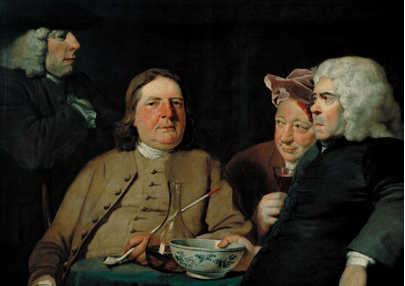
Fig. 1 – Joseph Highmore, Mr Oldham and his Guests, c. 1735-45. Oil on canvas, 1235 x 1475 x 88mm. Tate Images.
Though male and female porcelain wares were enjoyed separately, they still belonged in the same sphere, under the same roof. The feminine tea-drinking ritual could take place during the day and be replaced with the masculine punchbowl (Fig. 1) at night for the middle classes, or in larger homes each ritual could occur in specifically allocated rooms. The differing purposes of the china – punch bowls or pots for the men and teaware for the women – certainly did have inherent gender divisions, but they were not so dissimilar. Punch pots could look virtually identical to teapots apart from their larger size, often not only similar in shape but also decoration and imagery. It is intriguing that punch-drinking, commonly associated culturally with barbarity and masculinity, could take place in such a visibly domestic setting, emulating the refinement of the feminine tea-drinking. Yet the depiction in Fig. 1 hardly connotes the vulgarity and barbarity that was so heavily associated with punch, instead conveying an image of domestic male friendship.
The gendered associations with china in eighteenth-century England were both divisive and constantly evolving. The conflation of women and porcelain began with ideas of fragility and passive refinement, but gradually expanded to include anxieties over uncontrolled female desire. What had once disempowered women was, paradoxically, reworked into a form of cultural and economic agency: women shaped demand, influenced taste, and even participated in trade. At the same time, male-centred porcelain created an oppositional sphere. Armorial wares in masculine dining rooms and punchbowls in gentlemen’s clubs reinforced ideals of honour, reputation and respect – meanings entirely detached from the femininity of tea tables. Both forms of porcelain emerged from the same material object, yet ownership defined their meaning. If it belonged to a man, china signified strength and social authority; if it belonged to a woman, as Addison puts it, it was merely “brittle ware.”
Bibliography
Harvey, Karen. “Barbarity in a Teacup? Punch, Domesticity and Gender in the Eighteenth Century.” Journal of Design History 21, no. 3 (2008): 205–21.
Kowaleski-Wallace, Beth. “Women, China and Consumer Culture in Eighteenth-Century England.” Eighteenth-Century Studies, Vol.29, No.2, Winter 1995/1996. The John Hopkins University Press, pp.153-167.
Porter, David L. “Monstrous Beauty: Eighteenth-Century Fashion and the Aesthetics of the Chinese Taste.” Eighteenth-Century Studies 35, no. 3 (2002): 395–411.
Smith, Kate. “Manly Objects?: Gendering Armorial Porcelain Wares.” In East India Company at Home, 1757-1857, edited by Kate Smith and Margot Finn, 113–30. UCL Press, 2018.
Featured Image Credit:
https://artuk.org/discover/artworks/a-lady-taking-tea-138380

