
Written by Peiqi An
16/11/25
Viewer Warning: This article contains ideas that might be considered as derogatory to disabled people. The author does not agree with these ideas and presents them solely for description, analysis and the sake of completeness.
Shi Tiesheng (1951-2010), a prominent Chinese author in the late twentieth century, has often been read as a “disabled writer”. Both his fictional and autobiographical writings place strong emphasis on the experience of disability that are either drawn from Shi’s own life or refracted through his fictional characters having various forms of impairment, including those who share his physical condition (paraplegia, resulting from a spinal cord injury). One recurring trope in Shi’s works is his fetishisation of strong, powerful bodies. This is evident in his prose Good Luck to Design 好运设计 (1990), where Shi envisions a “flawless form of life” physically identified by “robust muscles”, fitness, and agility. A similar set of bodily ideals appears in two of Shi’s short stories: Roses in Summer 夏天的玫瑰 (1983) and My Faraway Qingping Bay 我的遥远的清平湾 (1983), where these qualities are embodied by bulls—a bronze bull statue in Roses and two living bulls in Qingping Bay—rather than by human characters. The bodily imagery of these bulls functions as a corporeal rhetoric in Shi’s exploration of life and physical impairment.
To understand the metaphorical role of the bulls’ bodies – using body and corporeality interchangeably — it is necessary to situate Shi’s writing within the broader discursive context on impairment and disabled people to which he was exposed. According to Dauncey, disability remained at the margins of the socialist revolutionary discourse of the Mao era, typically framed through narratives of heroic triumph over infirmity. The everyday realities of people living with impairment, however, were largely excluded from the scope of revolutionary priorities. Dauncey further observes that, in the Chinese socio-linguistic context of the early post–Cultural Revolution period, the term equivalent to the English “disabled” (canjide, 残疾的) often carried the connotation of canfeide (残废的, invalid), in which the character fei (废, waste) particularly conveys a sense of social worthlessness. Partly stemming from Shi’s self-denial during the early stage of his disability, this stereotypical devaluation frequently emerges in his fiction, where impaired characters tend to internalise society’s pessimistic view of disability and perceive themselves as incapable of contributing meaningfully to the collective. This social metaphor of impaired corporeality is similarly projected onto the bodies of the bulls in both Roses in Summer and My Faraway Qingping Bay.
The bronze bull statue in the fictional story Roses in Summer is desired by an elderly man who makes a living selling paper windmills. Having lost his legs in his youth, the man becomes instantly fascinated by the powerful physique of the bronze bull displayed in a shop window. Shi describes the bull as possessing “sharp horns, towering shoulders, sturdy legs, and beautifully shaped muscles, charging forward with proud defiance”. Through this image, the fantasy of a strong, complete body is evoked in the elderly man’s mind, along with memories of his own youthful vigour. He recalls the days when he could lift a two-hundred-catty sack with his “thick calves” whose slightest exertion revealed “knotted, angular muscles”. He later lost both calves to vasculitis, along with his job at a construction site. Haunted by a sense of guilt for having “become a burden to society”, he left his hometown and never returned. In this sense, the man’s disability suggests not only a physical loss but also a profound detachment from the community he once belonged to, emblematic of a broader condition experienced by the disabled population in the era of the story’s composition.
The bull statue can also be read as the material manifestation of an idealised counterforce to the discrimination, humiliation, and fear the elderly man has endured. In his dreams, these internalised violences take the form of wolves, tigers, and other predatory beasts that pursue him on his imagined return to his hometown. Against these threatening figures, the bronze bull emerges as a phantasmic embodiment of corporeal wholeness and resistance, offering the man comfort and courage to begin his real-world homecoming journey. This emotional investment in bodily completeness, a signature motif in Shi’s writing, enacts a symbolic emancipation from the inferior condition experienced by both the author and his characters, all condensed into the metaphorical vessel of the bronze bull. By imagining a powerful, unbroken body through this figure, Shi enables his character to temporarily reclaim agency over the traumatic social discourses and to restore a sense of bodily integrity and reinhabitation into his community.
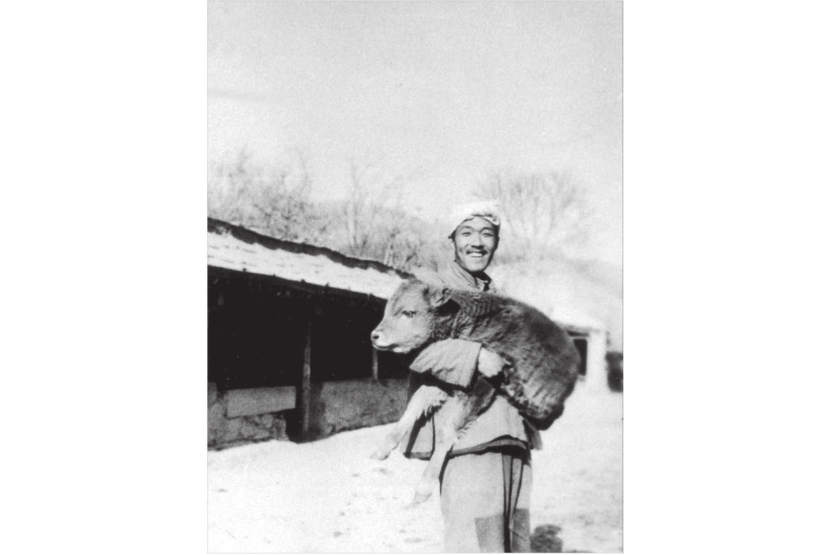
My Faraway Qingping Bay is a semi-autobiographical story written shortly before Roses in Summer. It recounts Shi’s experience in Qingping Bay, a rural area of Shaanxi Province, during the Sent-Down Movement of the Cultural Revolution. Because of his deteriorating health, Shi was assigned to feed the cattle, who subsequently become central figures in his narrative, with two bulls standing out: a red bullock and an old black bull. At the beginning of the story, Shi explicitly expresses his admiration for the red bullock, describing it as possessing “tall, prominent shoulders, a long waist and strong legs, able to pull the plough single-handedly [. . .] with thick, curved horns.” This red bullock may also serve as the prototype for the bronze bull in Roses, its strength and vigour corresponding to the author’s ideal of abundant vitality. The old black bull, by contrast, is depicted as “cunning and weary [. . .] panting heavily even when yoked in pairs”, a figure that Shi initially disdains. Within this bodily comparison, Shi evaluates the two bull figures primarily in terms of their agricultural utility. This standpoint, as Tsang argues, reflects the revolutionary discourse of productivity and physical robustness as measures of social worth. During a bullfight, in which the red bullock triumphs over the old black bull and becomes leader of the herd, Shi celebrates its victory with pride. Here, Shi once again projects the communal preference of strength and value of labour onto the bulls’ bodies, reproducing a discursive hierarchy that privileges corporeal vitality over frailty.
Shi’s perception of the old black bull alters profoundly after discovering that, in its prime, the animal had once defended the village from a wolf attack and had greatly contributed to the prosperity of the village through strength and labour. Yet these merits failed to spare the bull from its tragic fate: to be slaughtered after accidentally becoming crippled and losing its agricultural value to the village. At this stage of the narrative, Shi’s initial disdain for the black bull transforms into a sense of compassion due to an awareness of its deprivation of productive capacity. He adds that, a decade after leaving Qingping Bay, he was told by the villagers that the once-vigorous red bullock had also grown old. Imagining its inevitable decline, Shi associates it with the figure of the black bull. It is very likely that the red bullock, too, will ultimately face a similar situation once its productive function ceases and its value is erased within an enduring socio-economic order that ideologically regulates the worth and mobility of life. The parallel fates of the two bulls further mirror the author’s own experience of physical decline at the time the story was written, with him being forced to end his service as a sent-down youth, and thus enduring years of professional marginalisation before eventually achieving literary prominence.
As Tsang observes, from the elderly man’s symbolic struggle against disability to the physical decline of the two bulls, Shi does not write within the authoritative notion of “overcoming disability”, which encourages disabled individuals to be as socially and economically productive as their non-impaired counterparts. Instead, he embeds a pessimistic undertone concerning the social worth of an “incurable” body. The black bull cannot comprehend its past merit to the village, yet still “sheds tears at the end of its life”. The creature might be dimly aware of the injustice of such a fate, yet it is too weary in strength and spirit to resist it. In Roses in Summer, the elderly man ultimately gives away the bronze bull to a young couple, wishing them a healthy child who will be spared from physical suffering and career disadvantage, while consoling himself with the thought that he can still find meaning in life through selling paper windmills. In both narratives, the impaired characters’ struggles with their physical limitations run parallel to an internalised acceptance of the dominant discourse that marks them as inferior, one that binds an individual’s social value to corporeal integrity.
Bibliography
Dauncey, Sarah. 2017. “Shi Tiesheng: Writing Disability into Modern Chinese Fiction”. Chinese Literature Today 6(1): 48-55.
Shi, Tiesheng. 2016. My Faraway Qingping Bay. Changsha: Hunan Literature and Art Publishing House.
Shi, Tiesheng. 2016. Roses in Summer. Changsha: Hunan Literature and Art Publishing House.
Tsang, Gabriel F. Y. 2025. Chinese Educated Youth Literature: Ambivalent Bodies and Personal Literary Histories. London: Routledge.
Featured Image: Shi Tiesheng in Qingping Bay, from Shi Tiesheng, The Temple of Earth and I (Beijing: People’s Literature Publishing House, 2011), 146–47.

