
Written by Freia Nilsson
Note:
This is part two of a five-part series on the Millennium Clock Tower. It will serve as a guide through the four sections in which I will attempt to convey my experience by employing images and thoughts which come to mind. It is therefore important to note that the interpretations I make are unique to me, but hopefully I will inspire readers to visit the structure and form your own opinions.
You can find part 1 here: The Millennium Clock Tower: Your Journey through the Past 1000 Years – Retrospect Journal
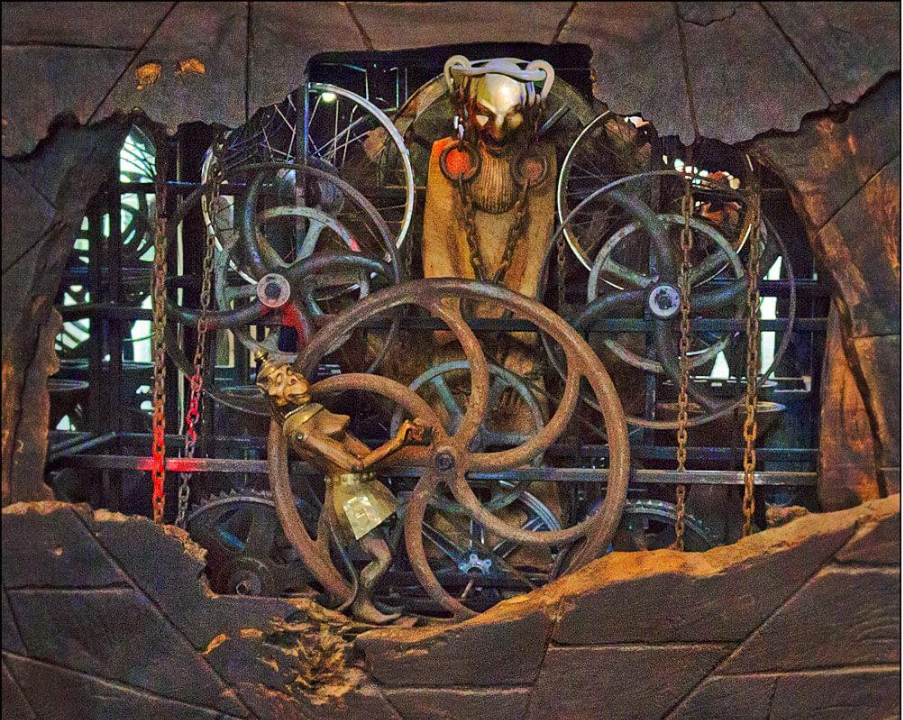
The statue of the monkey stands centre stage, a grimace or a smirk etched upon his face, you struggle to decipher which. The clock chimes the hour and the wheel begins to turn, the monkey thrown violently to and fro. Its hands clasp the crank, welded into place.
Round and round goes the wheel; round and round; round and round, churning up memories of humanity from the past millennium:
3 September 1794
She has worked at the textiles mill three years now, standing there grasping the crank, enduring the tedious task of spinning the wheel day in and day out. The spinning jenny and her, side by side; she has lost count of the number of times she has watched its performance, its trick, transforming cotton to thread. Round and round she turns the wheel.

Hypnotised by the display, she can almost drown out the constant, deafening growl of the metal maze she is trapped in. She can almost forget about the humidity which clings to her skin and the cotton in the air threatening to choke her. She can almost pretend she doesn’t care when she hears the scream of a child, a victim of the inhuman partner she works alongside daily. Almost.
She grasps the crank tightly and the wheel spins on. Her mind wanders back in time as she recalls life before the mill. She remembers when, as a family, her mother and her would sit side by side with little more than the spinning wheel and bag of cotton between them, spinning thread from their own home.
What family now? Her mother works but twenty metres from her and yet it felt like miles, separated by the metal pens which they were corralled in for twelve hours each day.
Their move to Lancaster was meant to be the beginning of a life more prosperous than the last. This past seems almost a dream to her, as the present does a nightmare. The only real thing is the rough surface of the wooden crank, its splinters etching into her hand. The wheel spins on.

As the hours of day pass by, crimson and golden light seeps into the vast building. She dares to look up from her work. Through the clouded glass panes, her eyes are drawn to the setting sun casting light and shadows across the port. However, one shadow stands unnaturally against the horizon, its dark, rigid, unimaginative figure ploughing through the sea of colour. The steamboat enters the port. It is only upon her second glance that she can distinguish the faint silhouette, a phantom-like figure of an old battleship trailing behind it.
The roar of machines, the clinging humidity, the cries of exhaustion, starvation, death summon her back to her present reality. The sensation of the splintering wood of the crank which remains in her hand feels almost natural now. And so the performance goes on. The wheel and her. Round and round; round and round.
Back in the clocktower, the monkey, unlike her, slowly comes to a halt. It is permitted a moment’s rest from its performance as the next stage of the clocktower comes to life. Here, we leave behind the cotton mill, but take with us mankind’s capacity to reduce itself to a mere appendage of the wheel. It is with recognition of this dehumanising capability as a feature of human progress that we progress to the nave.
CONTEXT:
This period saw dramatic developments in the textiles industry. The domestic system had existed since the pre-industrial period and involved the outsourcing of labour through local textiles manufacturers hiring individual families to produce thread from the cotton. However, this swiftly shifted following several innovations in technology such as the ‘Spinning Jenny’ created by James Hargreaves. This revolutionised the textiles industry, both in terms of the economics and the social organisation. The Spinning Jenny’s invention in 1764 increased the efficiency of the production of thread which both narrowed down the number of labourers required for this task and centralised the process of textiles manufacturing. By 1871 there existed approximately two thousand five hundred cotton factories across Britain, with Manchester and Lancaster becoming the largest hubs for textiles production.
The working conditions in these factories grew progressively worse. To prevent the thread from breaking, temperatures and humidity levels were kept very high. Fine cotton fibres filled the air, often causing serious lung diseases among workers. The factories would often hire entire families, which proved a large motivating force for urbanisation. However, the environment was especially dangerous for children, whose job was to clean cotton waste from beneath the heavy machinery, putting them at constant risk of injury or death.
RELEVANCE:
For me, the crypt evoked this image of a worker in the British textiles industry as I believe it clearly exemplifies its core message: the capacity for humans to be reduced to mere commodities. I see this as a reflection of the symbolism of the monkey which is a testament to the dehumanising manner in which people were, and in some cases continue to be, treated as cogs in a machine. These ideas are allusions to the works of Marx and Engels during the mid-nineteenth century; the Marxist political philosophy is rooted in the idea of this loss of humanity and destruction of natural social ties.
I also reference J.M.W. Turner’s painting The Fighting Temeraire (1839), often interpreted as a reflection on the end of pre-industrial society. To me, it further embodies the profound shift in human attitudes that occurred during this period—one which culminates in the image of humanity I perceive to be conveyed within the crypt.
Bibliography
Hopkins, Eric. “Working Hours and Conditions during the Industrial Revolution: A Re-Appraisal.” The Economic History Review 35, no. 1 (1982): 52–66. https://doi.org/10.2307/2595103.
National Gallery, London: Joseph Mallord William Turner | The Fighting Temeraire | NG524 | National Gallery, London
BBC, “The Industrial Revolution,” In Our Time, hosted by Melvyn Bragg, BBC Radio 4, October 13, 2005
BBC, “The Lancashire Cotton Famine,” In Our Time, hosted by Melvyn Bragg, BBC Radio 4, February 10, 2022
Encyclopaedia Britannica, s.v. “Spinning Jenny,” accessed November 8, 2025, https://www.britannica.com/technology/spinning-jenny
Doerr, Elizabeth. “Absolutely Crazy Millennium Clock Tower in Edinburgh Commemorating 1,000 Years of Rich History (With Video).” Quill & Pad, August 17, 2018. Photograph “The lowermost quarter is called the crypt … with burnt‐out wood paneling and stained-glass ‘eyes’” https://quillandpad.com/2018/08/17/absolutely-crazy-millennium-clock-tower-in-edinburgh-commemorating-1000-years-of-rich-history-with-video/.
Featured Image Credit: https://quillandpad.com/2018/08/17/absolutely-crazy-millennium-clock-tower-in-edinburgh-commemorating-1000-years-of-rich-history-with-video/?utm_source=chatgpt.com

