
Written by Harry Child
08/11/25
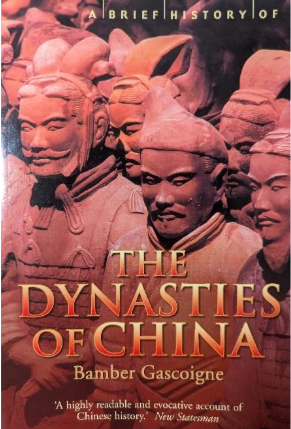
This is not a new book, it was released back in the 1973; however, I purchased a copy of the revised 2003 edition a little while back, hoping to get a good introductory insight into Chinese history and well, I was not disappointed. Bamber Gascoigne’s ‘A Brief History of The Dynasties of China’ has been the most engaging work of history I have had the pleasure of reading in quite some time. It is short, only 209 pages, but it gives a strong and easily accessible introduction to the key themes of Chinese history.
The book, alongside an introduction and postscript, is structured in eight chapters, with each of these taking you through a major dynasty that ruled China. This spans from as far back as the Shang dynasty (1600-1100 BC) through to the fall of the Qing in 1912 AD. A healthy amount of space is also dedicated to separating the fiction from the fact regarding the establishment of the first dynasty in China. It should be noted that, given the book concludes in 1912 (there is only a five-page postscript which gives some brief explanation of events post-1912), if you are looking for an introduction to modern Chinese history, this may not be the book for you, but it may still be useful in giving a wider context to China.
When I first started reading the book, I was apprehensive about how critical and ‘modern’ the information and arguments would be, especially since Gascoigne was a journalist, not a professional historian. However, as I read the book, this was quickly dispelled. Gascoigne’s writing, especially in argument, is critical, well evidenced and balanced.
Gascoigne frequently focuses on the cultural developments in China in the book, for example, the importance of poetry for elites and, more era specifically, the increasing importance of painting under the Song dynasty (960-1279 AD). In the latter case, landscapes being particularly favoured as it reminded the officials, busy working in the imperial bureaucracy in the cities, of the countryside. On this topic, one of the fascinating elements of the book was the importance of education for the ruling classes. Under the Tang, Song and beyond, people who sought to become officials had to sit a series of exams, the final one often being set and marked by the emperor himself. This struck me as a developed and institutionalised system of electing people to high office, and I could not help but compare it to Medieval England, perhaps even Medieval Europe at a similar time. It suggested to me that the era we call ‘The Middle Ages’ has much more to it than what we commonly associate through our Eurocentric lens.
So far this has been a glowing review; however, there are some limitations to the book which I would like to reference. Firstly, the book is focussed on an elite perspective: there is comparatively little time devoted to everyday people and their lives, although there are moments. This is perhaps to be expected though; the title essentially indicates that it’s a volume which will be principally concerned with the ruling classes. Secondly, it is not a complete history of each dynasty, rather Gascoigne employs a series of vignettes for each. Usually there is one from the beginning, one from the end and a few from the intervening years. Given the short nature of the book and that it is a brief history, I think that this can be expected and should not be held against the title. It is worth bearing in mind, though, if you are looking for more than an introduction to each dynasty.
Now that some of the major features of the book have been explored, I’d like to share two particularly enjoyable vignettes from the book. These will give you an indication of what is in store if you are to read the book. These are from the two ends of the book and indicate how its engaging nature persists:
The first relates to the inaugural Emperor of the Han dynasty (206 BC – 220 AD), Gaozu. Now Gaozu had been a peasant who had risen up in a bid for power during the civil war that followed the collapse of the Qin dynasty in 206 BC. The key reason I point this out is that he was not a scholar. Actually, in his early years as Emperor, he had a profound dislike for them, particularly of the Confucian sort. If a Confucian scholar met him, as one did, wearing their scholar’s hat, he would pluck the hat off their head and urinate in it. Showing his disdain, perhaps.
The second comes from 1800 years later. In 1636 AD, in the closing years of the Ming dynasty (1368-1644), an English merchant desired to trade with China. Charles I had granted John Weddell a charter giving him the right to trade with China and subsequently, with a fleet of ships, he set off for it. When he arrived, he was scarcely engaged with and this frustrated him, so he decided to show some good old fashioned British hospitality to the Chinese. Namely, he commandeered one of their forts, at this stage providing a letter to the locals that he was only wanted to establish good trading relations between England and China. When this too, fell on deaf ears – well you can see where this is going – he destroyed a few Chinese ships, burnt down a town and just for good measure obliterated another fort.
In conclusion, Gascoigne’s book offers a great introduction to Chinese history pre-1912. It is a highly readable, concise account, yet has noticeable rigour in its arguments. Whilst there are some limitations, particularly regarding what has been excluded, when considering that this is fundamentally a ‘brief history’, these issues pale into insignificance. In truth, Gascoigne’s ability to cram as much as he has into this book, which covers such a large scope and yet is so readable, is testament to his authorial skill. I would recommend this to anyone seeking an engaging introduction to Chinese history.

