
Written by Bethany Hicks-Gravener
08/11/25
Arguably one of the most distinctive genres of theatre to emerge in antiquity was that of the Roman mime. What mime actually was is hard to define. Fantham describes it as a “free form” theatrical genre that was both “improvised and irresponsible” in its content and its staging. It bridged the gap between comedy and tragedy by providing audiences with a more scandalous option. What really sets mime apart from other theatre of the ancient world is the fact that it was performed without masks. Instead, actors and actresses wore their own faces, creating a more intimate experience for the audience. Not only that, but mimes were performed with both male and female performers in their cast – the men would play the male roles, and the women would play the female ones. Therefore, through the genre of mime, we begin to see an emergence of the role of the actress within ancient Roman society.
Roman mime actresses, or mimae as they were more commonly known in society, held the social status of infames. The title of infame suggested a degraded social standing within Roman society. ‘Infame’ was the title of those whose profession was centred around public performance, so we see actors, actresses, and dancers all categorised as infames during this time. Due to the socially ‘lesser’ status of infames, they often would marry one another, causing their children to also fall into this social category. As a result, performance professions became, in their own way, what Duncan terms a “family business”. Cicero discusses the famous mima Tertia in his writings, and we know that her father was a mime actor himself. Similarly, Procopius writes about the mima Theodora, the wife of Emperor Justinian, whose father was a bear keeper and mother a dancer and an actress.
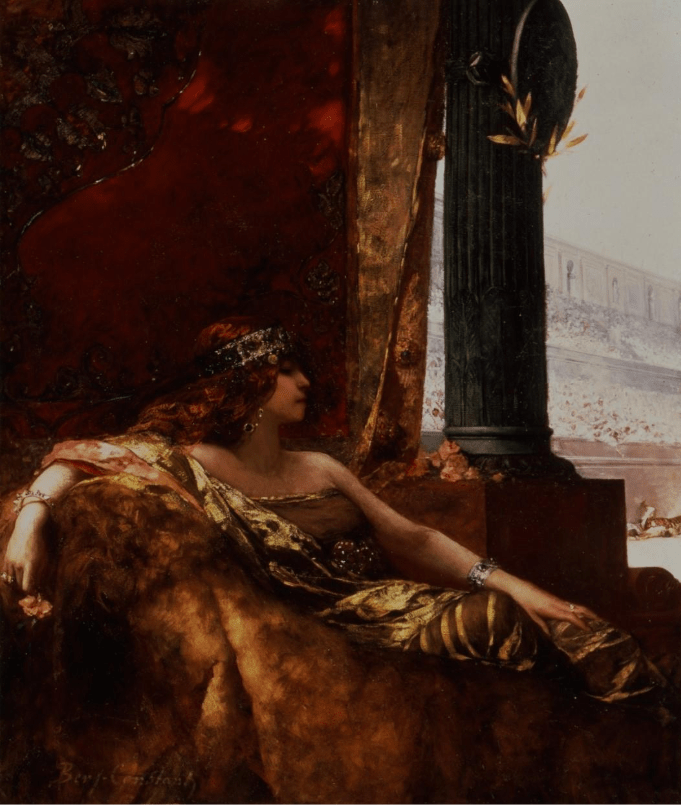
Regardless of the fact that mimae were socially classified as infames, they were considered to be desirable to members of the Roman social elite. A lot of mimae, like other public performers, were also slaves, meaning that they were controlled and promoted by members of the upper echelons of society. To have a mima as a member of your household was seen as something desirable. From the letters of Cicero we have accounts stating that the mima Cytheris would attend her patron’s parties for the purpose of being on display to her patron’s guests; this is key because for a patron of a mima, he would want his social circle to be aware that not only did he possess something of value, but he also controlled something of value. It is also known, from the writings of Procopius, that the Emperor Justinian’s wife, Empress Theodora was originally from a family of infames and was a mima herself. In his Anecdota, Procopius states, “but as soon as she came of age and was at last mature, she joined the women of the stage and straightaway became a courtesan.” It is believed that Theodora left the stage when she became the concubine of a man named Hecebolus who was a provincial governor. Some years later, Theodora then became the concubine of Justinian before then marrying him in 524 CE. For Justinian to be able to marry Theodora though, his predecessor and uncle Emperor Justin had to first pass a law that allowed men of a senatorial rank to marry courtesans.
The Ludi Florales, also known as the Floralia, was a particularly important festival for mime performances. We learn from Ovid that the Ludi Florales was held in honour of the goddess Flora, the “Mother of Flowers,” and that the festival occurred during the springtime. By 173 BC, the festival was centred around mime performance with at least two full days dedicated to the theatrical genre. From the writings of Valerius Maximus, who is recounting the experience of Cato the Younger when he attended a mime performance at the Ludi Florales, we learn that “when the same personage was watching Flora’s games, put on by Aedile C. Messius, the people blushed to ask that the actress be stripped naked.” This passage from Valerius Maximus is one of only two passages that we have concerning nudity within mime, the other coming from Procopius. It’s important to note that Procopius’ Anecdota primarily serves as a political critique of Justinian’s reign and so Theodora, especially her time as a performer, is used to express his political bias and also to shock and scandalise his readers. Procopius states:
“And often even in the theatre, before the eyes of the whole people, she stripped off her clothing and moved about naked through their midst, having only a girdle about her private parts and her groins, not however, that she was ashamed to display these too to the populace, but because no person is permitted to enter their entirely naked, but must at least have a girdle about the groins.”
The accounts of Valerius Maximus and Procopius have sparked scholarly debate about whether stripteases or full nudity ever occurred in mime. Mimes were notorious for their sexual nature and lewd themes; therefore, these accounts allow us to argue that nudity was in some way simulated for the audiences, whether that be full nudity or not. Webb argues that “the ‘nakedness’ was metaphorical, but it was no less shocking or significant” than other forms of partial nudity shown in the Roman world. One other school of thought amongst scholars, that is in particular highlighted through the work of Panayotakis, asks whether or not prostitutes were appearing in the place of mime actresses at the Ludi Florales, and perhaps these are the women Valerius Maximus refers to. With this theory, we do, however, need to remind ourselves of the society that we are discussing: while the average Roman male would not have cared to differentiate between prostitution and acting as Roman, Christian thought would have condemned both occupations.
Overall, despite their low-level societal status mimae played an important role in antique Roman society. They were key figures within the entertainment industry and provided their patrons with a type of envious social currency. Despite the fact that mimae were infames when they went on stage to perform, they were greatly celebrated, with some even gaining a local ‘fan following’. Entertainment as a whole was important within ancient societies, with both sporting and theatrical events being widely celebrated and largely attended. As a result, the role of the mima was crucial for allowing people to forget about the mundanity of their everyday lives and lose themselves in performance.
Bibliography
Primary Sources
Cicero. Letters to Friends, Volume II: Letters 114-280. Edited and translated by D.R. Shackleton Bailey. Loeb Classical Library 216. Cambridge, MA: Harvard University Press, 2001.
Ovid. Fasti. Translated by James G. Frazer. Loeb Classical Library 253. Cambridge, MA: Harvard University Press, 1931.
Procopius. The Anecdota or Secret History. Translated by H.B. Dewing. Loeb Classical Library 290. Cambridge, MA: Harvard University Press, 1935.
Valerius Maximus. Memorable Doings and Sayings, Volume I: Books 1-5. Edited and translated by D.R. Shackleton Bailey. Loeb Classical Library 492. Cambridge, MA: Harvard University Press, 2000.
Secondary Sources
Beacham, R.C. (1991) The Roman Theatre and Its Audience. Cambridge, MA: Harvard University Press.
Duncan, A. (2019) The Roman Mimae: Female Performers in Ancient Rome. In: Sewell, J. and Smout, C. (eds.) The Palgrave Handbook of the History of Women on Stage. Switzerland: Palgrave Macmillan, 21-49.
Dunkle, R. (2014) Overview of Roman Spectacle. In: Christesen, P. and Kyle, D.G. (eds.) A Companion to Sport and Spectacle in Greek and Roman Antiquity. Chichester: Wiley-Blackwell, 377-394.
Edwards, C. (1998) Unspeakable Professions: Public Performance and Prostitution in Ancient Rome. In: Hallett, J.P. and Skinner, M.B. (eds.) Roman Sexualities. Princeton: Princeton University Press, 66-98.
Fantham, E. (1989) ‘Mime: The Missing Link in Roman Literary History’. The Classical World, 82, no. 3, 153-163.
Foka, A. (2015) Gender Subversion and the Early Christian East: Reconstructing the Byzantine Comic Mime. In: Foka, A. and Liliequist, J. (eds.) Laughter, Humour, and the (Un)making of Gender. New York: Palgrave Macmillan, 65-83.
Panayotakis, C. (2006) Women in the Greco-Roman Mime of the Roman Republic and the Early Empire. Ordia Prima, 5, 121-138.
Taylor, L.R. (1937) The Opportunities for Dramatic Performances in the Time of Plautus and Terence. Transactions and Proceedings of the American Philological Association, 68, 284-304.
Webb, R. (2008) Demons and Dancers: Performance in Late Antiquity. Cambridge, MA: Harvard University Press.
Featured Image Credit: https://www.schillerandbodo.com/artists/constant/artworks/the-empress-theodora-at-the
 Retrospect Journal