
Written by Emily Martin
02/11/2025
Due to the Roman Empire surrounding the Mediterranean, it had access to a host of varying flora, fauna, bodies of water, and many other natural resources. These were exploited and used in numerous ways: for the military, entertainment, religious worship, and increased urbanisation. But it is the deforestation of the forests and woodlands in the empire that is arguably the most over-exploited natural resource during the age of the Roman Empire.
Technological advancements were key to the progression of the Roman Empire and the enlargement of its cities, especially Rome. Emperors would use building programmes to show their importance and success in the role. Examples of this include Septimius: Septimius Severus, with the arch and the Septizodium being restored for the secular games in AD 204; Hadrian and his creation of the Library of Hadrian, which is situated in Athens; and the multiple versions of the Arches of Hadrian and Gates of Hadrian being situated in the provinces he visited during his travels. New infrastructure, such as the ones Hadrian and Severus built, were meant for public use and therefore meant the increased urbanisation of these areas, as they encouraged migration into the cities such as Rome, which also created a higher demand for food. Arable land was needed and so deforestation occurred in order to produce the agriculture and spaces available to provide for this increased demand for pastoralisation.
By starting to commodify the land near the cities and other provinces, the Roman court allowed the forest and woodland areas to be overly exploited and transformed into a dry and desolate space. Authors such as Pliny record the view of some of these areas as being ruined. J. Donald Hughes quotes Pliny in his article stating how the deforestation caused “devastating torrents.” This shows how the land was not being cared for or respected in such a way that allowed the land to do what it needed to prevent, for example, mud slides. The fact that a senator and senior advisor to the emperor saw the destruction of the surrounding areas of the cities and were troubled by it indicates that the rate at which these trees were being felled and the natural landscape being upheaved to suit the increased commodification of the resources was fast and not sustainable. Deforestation led to the knock-on effect of soil erosion and bad water management, opening places to be flooded. But with agriculture being “fundamental to the Roman economy”, the Romans did not think to preserve the woodland and its resources or materials for any extended period.
The Roman army, being such a widespread and populous organisation, needed large volumes of sources of food to keep nourished. The diet for individual garrisons differed throughout the empire due to the sourcing of animals and what was native or not to the land. For example, Italian sites such as Campania, Etruria, and Latium showed a preference for pig, whereas the British sites showed a preference for cattle. This is a strong indicator that the army were aiming to be sustainable with their diets. It is thought that the pattern for keeping the animals is that they tended to slaughter the pig/cattle/sheep/goats when they were sub-adult. This means that they were selective in their choices to make sure that the supply was maintained. Therefore, this shows forward thinking and a more sustainable approach to the farming and supply of meat to garrisons within the Roman army, suggesting that the Roman military diet was not a reason as to how the Roman Empire over-exploited its natural resources.
Religious worship was a key aspect of Roman life in Rome and the provinces, meaning that practices, rituals and sacrifices involving animals were widespread. Evidence of aurochs’ cattle horn cores were found at a spa in Germany. Aurochs, a form of wild cattle found in the areas of Gaul and Germany, are no longer a living species but have been replaced instead by the smaller domestic cattle we see today. It is thought that these aurochs were hunted, killed, and then had their horns removed to be a ritual sacrifice to gods, potentially at the spa or moved thereafter. This indicates that religion plays a role in exploiting the wildlife in local areas and may show that this was a popular thing to do during the imperial age of Rome. It also shows how that landscape was overly exploited if they were hunted to extinction.
Religion also had a separate impact on the exploitation of the natural resources of the Roman world. Nature and woodland areas were once sacred and associated with the gods, and when deforestation was originally starting to aid in generating larger forms of income, there was a movement within the Roman government that aimed at afforestation. This also meant that “trees were planted to honour Roman emperors.” This would presume that religion, in the name of dedications, aided in helping restore the natural land to what it was, and to try to reduce the effect of deforestation. However, it should be noted that cutting down trees and groves was legally allowed in order to build monuments and temples. Therefore, religion may have, for a shorter period of time, enabled the civilians and the Roman government to care for the survival of their resources; but this was not long-lasting and, due to the positive impact of deforestation on the economy, meant that it was not as sacred as originally propositioned.
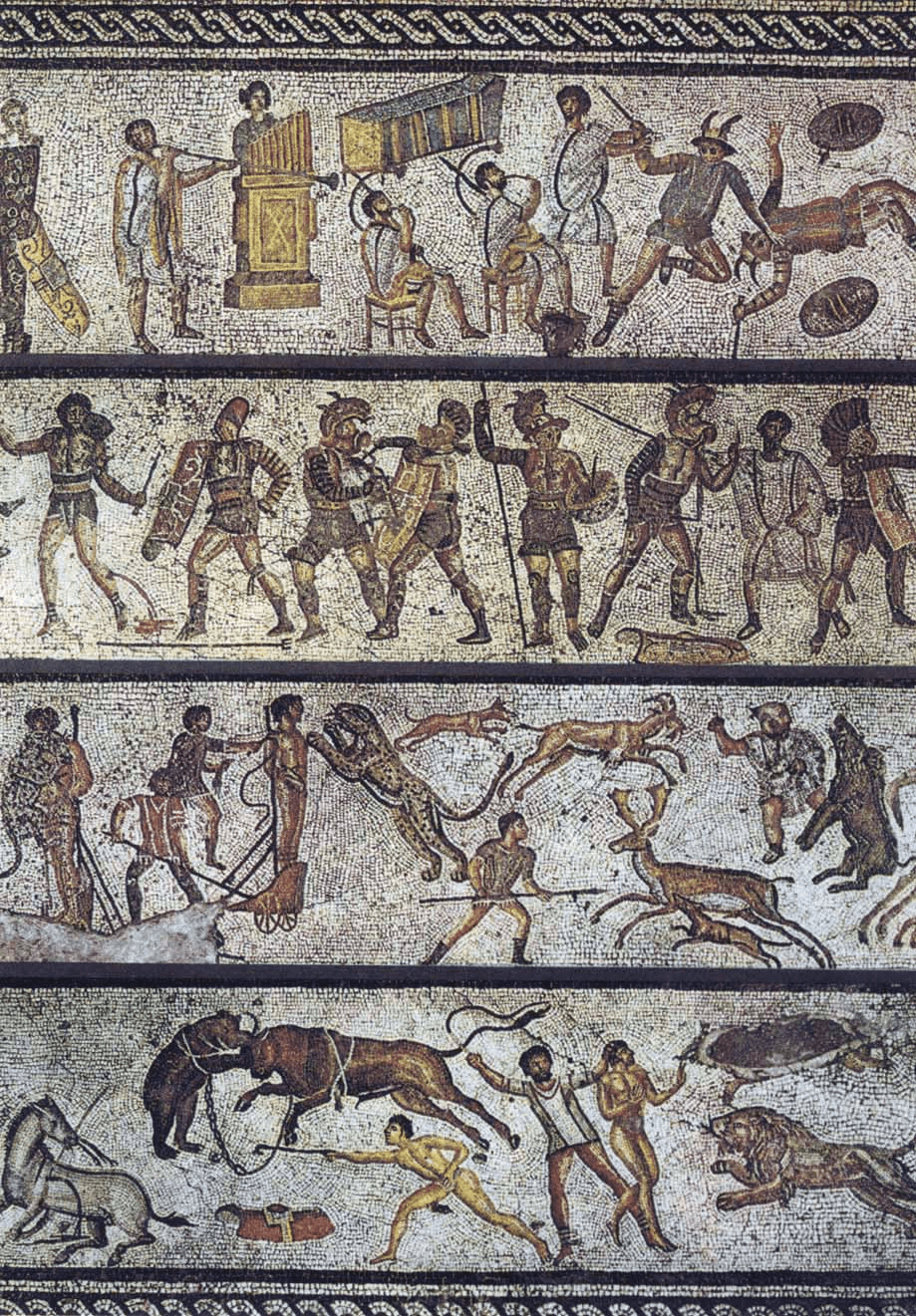
Entertainment in the ancient world had huge volumes of people gathering in one place to watch pre-planned events. An example of this is the infrastructure of amphitheatres which were situated all throughout the empire e.g. Arles and Rome. During these events, executions of exotic animals (or sometimes more locally sourced ones, such as aurochs, as a cheaper alternative) took place as well as fights between gladiators and these animals. This systematic form of killing these animals, does not suggest a care for the conservation of the species but instead a way to entertain the people and potentially gain some favour with higher-up Roman officials. But that was not the only form of entertainment: emperors are consistently shown as having gone on royal hunts, again for exotic animals such as panthers and leopards. There are various friezes and paintings that show these animals during, for example the leopard venatio in Lepcis Magna, modern day Libya, showing a leopard hunt. This being displayed in public illustrates how normalised and celebrated this activity was.
A further piece of evidence that suggests that animals, both exotic and domestic, were over-exploited and consequently depleted in numbers is in a piece of writing by Cassius Dio. Dio writes about Trajan killing eleven thousand animals after his victory over the Dacians in CE 106. This shows not only the authority of the emperor but that the direction of conservation of wildlife is heavily impacted by the emperor and his wishes. So, if Trajan with public knowledge allegedly killed eleven thousand animals, it probably incited an increase in hunts, executions and ritual sacrifice for the elite civilians as well. However, it may be that his piece of information is an exaggeration by Dio. Hunts were not reserved by the emperor and royal courts but were also participated in by members of the Roman army. This is a speculated reason as to why several mammal species, which are typically large in size, no longer exist in certain regions, such as a lack of lynx, wolves, bears, and aurochs in Germany. This directly indicates that the Roman army again was responsible for the destruction of wildlife in their associated areas.
In conclusion, the Roman Empire exploited its natural resources to progress and continue to succeed in its control of the Mediterranean and surrounding areas. From the evidence provided, it appears deforestation was the main reason for this because the timber was used for urbanisation. This is through the construction of aqueducts and water wheels in mining, building programmes, and through cutting down trees to make space for fighting, as well as through the use of timber in construction of infrastructure and in the creation of arable land. Deforestation is therefore prominent in all the areas of exploitation, meaning it is the main way in which the Romans over-exploited their natural resources. The wildlife was obviously exploited, but the numbers are significantly less than that of tree groves and sources have indicated that farming was moving towards a sustainable supply.
Bibliography
Grant, A., Sauer, E. (2006), ‘the aurochs, nature in worship and exploitation in eastern Gaul’, Antiquity 80, 622-637.
Hong, S., Candelone, J., Patterson, C. C., Boutron, C. F. (1994), ‘Greenland Ice evidence of Hemispheric lead pollution two millennia ago by Greek and Roman civilisations’, Science 265, 1841-1843.
Hughes, D. J. (1983), ‘How the Ancients viewed Deforestation’, Journal of Field Archaeology 10, 435-445.
King, A. (1999), ‘Animals and the Roman army: the evidence of animal bones’, in A. K. Goldworthy and I. Haynes and C. E. P. Adams (eds), The Roman army as a community: including papers of a conference held at Birkbeck college, University of London on 11-12 January, 1997, Portsmouth, RI, 139-149.
Sauer, E. (2023), ‘Nature, Wildlife and Resources’, The Roman World 1B: The Roman Empire, Edinburgh.
Wilson, A. (2002), ‘Machines, Power and the Ancient economy’, The Journal of Roman studies 92, 1-32.
Wilson, A. (2015), ‘Indicators for Roman economic growth: a response to Walter Schiedel’, Journal of Roman archaeology 22, 71-82.
Woods, A. (1987), ‘Mining’, in J. S. Wacher (ed.), The Roman World. Volume 1 & 2, London, 611-634.
Featured image credit: https://commons.wikimedia.org/wiki/File:Bestiarii.jpg


