
Written by Kate Taylor
Writing from exile in St Helena, Napoleon Bonaparte declared that “the Queen’s death must be dated from the diamond necklace trial”. Despite denial from historians in the Annales and Marxist schools, direct links can be drawn from this strange affair to the collapse of the French monarchy in 1792. Marie Antoinette was born in Vienna in 1755 as the youngest daughter of Holy Roman Emperor Francis I. By the age of fourteen, she was married to the French Dauphin Louis Auguste, becoming Queen Consort upon his accession to the throne as Louis XVI in 1774. In popular culture, she is well known for her disgustingly lavish lifestyle, a polar opposite to the experiences of those living beyond the gates at Versailles. This was adequately summed up by the words falsely associated with her: “let them eat cake”. Indeed, the Royal Necklace Affair of 1785 furthered resentment of her from the French public. However, they appeared to have not realised that she was not involved at all.
Simply put, the Royal Necklace Affair was a case of fraud. The self-styled Countess Jeanne de Valois St Remy de La Motte, a poor orphaned woman from a once-noble bloodline, convinced the out-of-favour Cardinal, Prince Louis Rohan, that she was part of the Queen’s inner circle. In doing so, she began passing letters to him, allegedly from Marie Antoinette, asking for money and gifts in exchange for his renewed favour in the Royal Court. The cumulation of this was a midnight meeting in the gardens of the Palace of Versailles in August 1784, where Rohan met a woman whom he believed to be the Queen. Now firmly thinking this business to be legitimate, he indulged when asked by de Valois to buy a necklace on the Queen’s behalf. The necklace in question had been created by Paris jewellers Boehmer and Bassenge in 1772 for Louis XV’s mistress, Madame du Barry. As he had died before the necklace’s completion, they had been desperately searching for a new buyer of the piece, which was estimated to have contained four hundred and seventy individual diamonds. Although offered to Marie Antoinette directly, she refused, stating that the 1.6 million Livres price tag should be put towards new ships for the French navy. It appears Rohan was not aware of this.
Through her continued false correspondence with Rohan as the Queen, de Valois convinced him to buy the necklace on Antoinette’s behalf, with payment being split into smaller instalments due after receipt. On 1 February 1785, the necklace was delivered to a man working with de Valois, pretending to be a porter of the Queen. Initially, the plan worked. The necklace was broken down into smaller pieces and sold in England and France, and no one was the wiser. However, by spring, Boehmer and Bassenge wrote to the Queen to enquire about missed payments for the necklace. Initially their claim was dismissed, but eventual investigation led to Cardinal Rohan’s arrest in the Hall of Mirrors on 17 August 1785. De Valois was arrested three days later.
The Affair itself, although scandalous, was not the main point of issue for the Monarchy. It was instead Louis XVI’s decision to turn the case over to the criminal justice courts instead of dealing with the matter internally that led to such public distain. Although the official newspapers were court censored, this made little difference in this case. In the nine months between the arrests and the trial, underground Parisien newspapers spread many rumours of Marie Antoinette’s involvement in the Affair, based on the extravagance that she had shown previously. Whilst Rohan was eventually acquitted, his defence was based on the idea that the Queen was the kind of person who would plausibly ask someone else to buy the necklace on her behalf to conceal the fact and conduct a midnight rendezvous in the gardens. Although the evidence now suggests otherwise, it was very easy for the French public to see how she may have been involved in the Affair. By this point, the people saw her as guilty simply because they wanted her to be guilty.
On the other hand, de Valois was found guilty of forgery, publicly branded with a ‘V’ for ‘voleur’ (thief), and sentenced to imprisonment for life. But this was far from the end of the story. Disguised as a man, de Valois managed to escape prison and eventually fled to England, where she published a collection of memoirs, arguing that she was a victim of the sexually perverse Marie Antoinette. Rumours had previously been spiralling in France of the Queen as incestuous, homosexual, cannibalistic, and podophilic to name but a few. Whilst there is little evidence to support any of these claims, the sexualised image of the Queen appeared to desacralize the Ancient Regime. De Valois’s memoirs were widely distributed, selling over five thousand copies in Paris during its first week. The Revolutionary movement turned her into a spearhead of their campaign, often depicting her leading the storming of Versailles, despite her death in London in 1791, having never returned to Paris.
Louis XVI attempted to prevent the Parisen publication of the final edition of de Valois’ books, ordering for them to be burnt in a kiln. The kiln workers refused to do so, highlighting that their loyalty was to the Revolutionary movement. Only eleven weeks later, in August 1792, the French monarchy was abolished. At her trial in front of the Revolutionary Tribunal, the Royal Necklace Affair was used as direct evidence of the perverse and scheming nature of the Queen, despite her evident lack of involvement. On 16 October 1793, Marie Antoinette was executed by guillotine aged just thirty-seven.
Bibliography
Burrows, Simon. ‘The Character Assassination of Marie-Antoinette’. In Routledge Handbook of Character Assassination and Reputation Management. Routledge, 2019.
Chateau De Versailles. ‘The Affair of the Diamond Necklace’. 1784-1785, 2025. https://en.chateauversailles.fr/discover/history/key-dates/affair-diamond-necklace-1784-1785.
Gruder, Vivian R. ‘The Question of Marie‐Antoinette: The Queen and Public Opinion before the Revolution’. French History 16, no. 3 (2002): 269–98.
Maza, Sarah. ‘The Diamond Necklace Affair Revisited (1785–1786): The Case of the Missing Queen’. In Marie Antoinette: Writings on the Body of a Queen. Routledge, 2003.
McCalman, Iain. ‘The Making of a Libertine Queen: Jeanne de La Motte and Marie-Antoinette’. In Libertine Enlightenment. Palgrave Macmillan, 2003.
Tikhonov, Mia. ‘The Crimes of the Queen(s): Dissimulation and the Diamond Necklace Affair’. Brown Journal of History 12, no. 1 (2018).
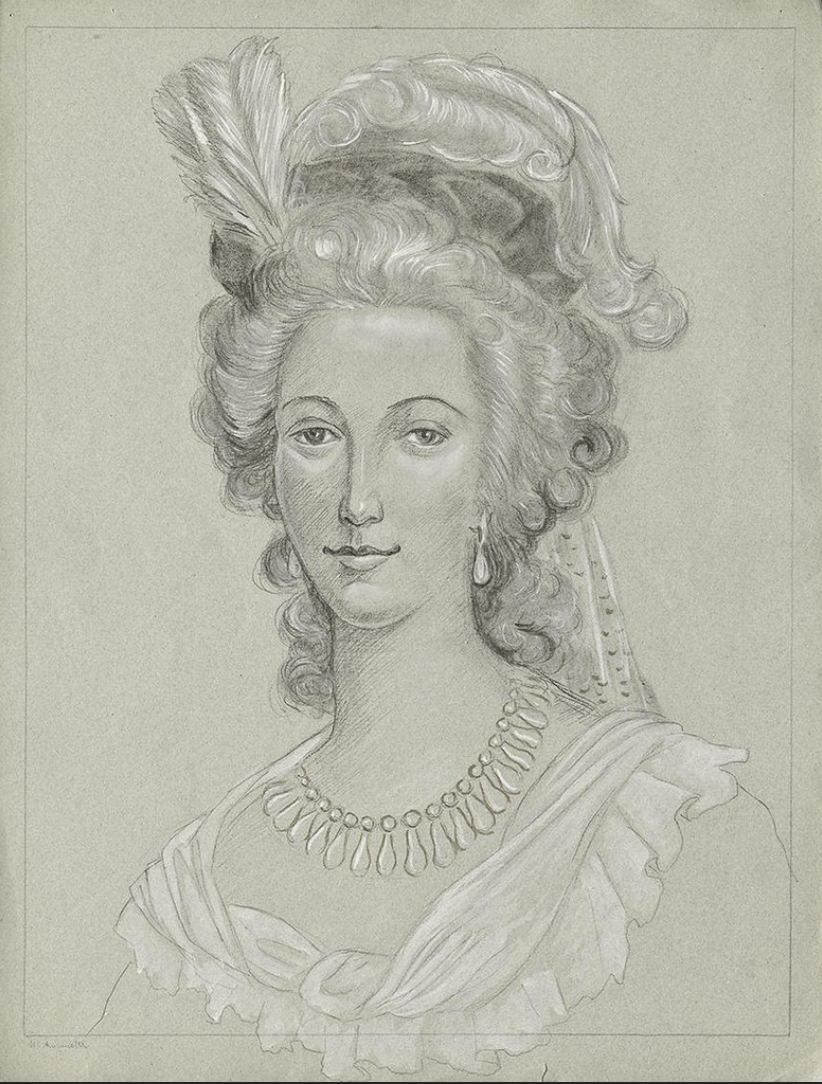
Featured Image Credit: “Königin Marie Antoinette | Franz von Matsch undatiert” by museado is licensed under CC BY-NC-SA 2.0: https://openverse.org/image/aafd9051-cc0b-4d86-86b8-e06ffeeaaa26?q=Marie+Antoinette&p=14
 Retrospect Journal