
Written by Poppy Williams
To evaluate the importance of the structural remains at Mycenae to our understanding of Mycenaean society, this investigation will focus on the Citadel of Mycenae. The Citadel has provided a wealth of structural evidence which has allowed for a deeper understanding of Mycenaean society. Parts of the citadel date to the Early Mycenaean period and was twice expanded and rebuilt in Late Helladic (LH) IIIA and LH IIIB. Therefore, we can observe the structural remains from three periods of the Citadel’s history, which are incredibly important as they provide insights into each respective period of Mycenaean society. However, although the structural remains of Mycenae are important to our understanding, they come with both advantages and limitations. These will be considered in the discussion of the remains of the citadel’s Megaron, the entrance gate and ‘Lion Relief’, and, lastly, the underground staircase protecting a cistern.
Like most Mycenaean palaces, the Citadel of Mycenae had a megaron at its centre: a building consisting of a main room with an antechamber, sometimes accompanied by a porch. At Mycenae, the citadel’s megaron was composed of three rooms: a porch which, through a vestibule, led into a large room with a throne set against the wall and a hearth in the centre. However, we must be wary not to let our imaginations divert from fact, as seen with Sir Arthur Evans’s excitement at Knossos where he believed he had found the seat of King Minos. Although the Mycenaeans were known to have kings (a wanax), we cannot impose our modern idea of a throne room as the seat of the king onto the citadel. The central position of the hearth is advantageous as it is seemingly more of a focal point than the ‘throne’, leading me to question whether it was truly a throne, or throne room, at all. Instead, I propose that the ‘throne room’ was a place for public gatherings and/or rituals. The throne seems rather passive on the side of the room. This positioning of the structural remains is incredibly useful as, when looking at the megaron as a whole, it is situated in the centre of the citadel. This is important to our understanding of Mycenaean society because in MH III and LH I, both the interiors and exteriors of settlements were divided both socially and functionally, which James Clinton Wright suggests meant that “economic, political, social, and religious activities were beginning to be centralised.” Although the idea that the ‘throne’ was in fact the seat of the wanax cannot be completely dismissed, the positioning of the hearth, and the megaron itself, in the centre suggests to me that the ‘throne room’ was more functional rather than symbolic of a ruler. Although these structural remains are limited in telling us more about the room’s function, the megaron is hugely important to our understanding of Mycenaean society because it provides evidence of a centralised organisation or gathering of some sort, which has allowed for numerous educated interpretations.
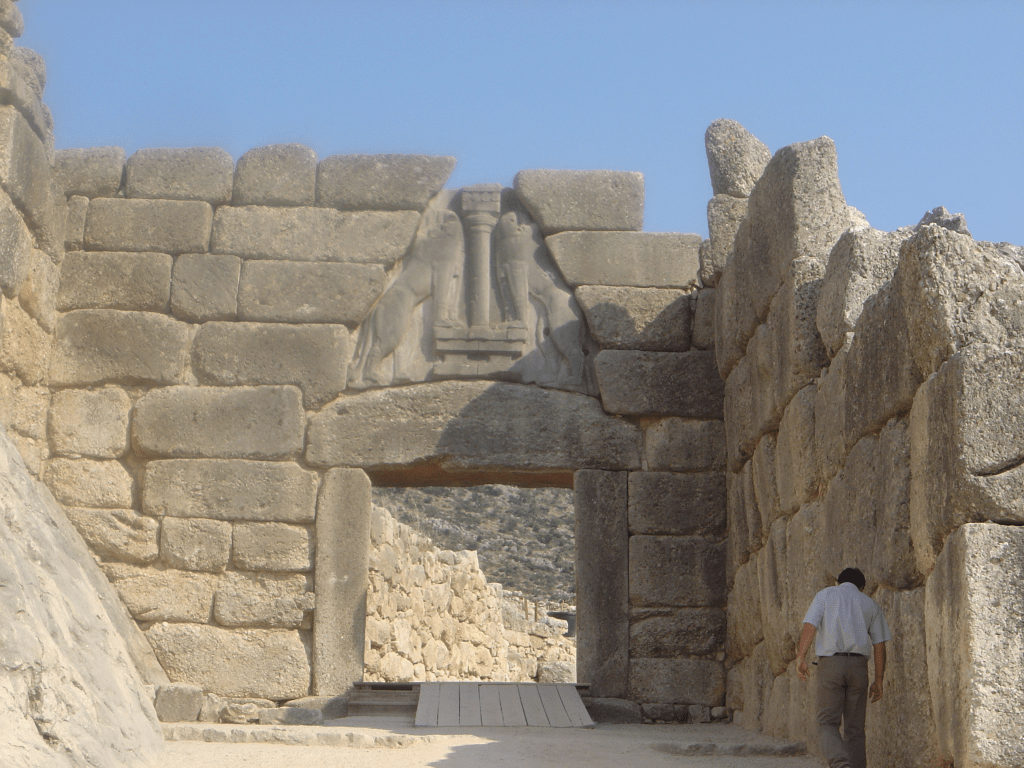
In LH IIIB, during the rebuilding of the palace, a new entrance to the citadel was constructed around 1250 BCE. This new gate was made to have both a functional purpose and symbolic meaning; four conglomerate blocks made up the gate’s side-posts, lintel, and threshold, whose grooves would have allowed for wheeled carts and wagons to pass in and out of the citadel. This illustrates how the structural remains of the gate are important to our understanding of Mycenaean society, as we can infer, specifically from the ruts in the threshold, that there would have been a movement of goods and peoples into the citadel, exhibiting that the Mycenaeans likely had internal trade connections alongside being known to the wider Greek world. Additionally, the survival of the gate’s structural remains is advantageous because it allows us, by knowing which building materials were available to the Mycenaeans, to identify whether these materials were local or imported—thus indicating the society’s abundance or lack of foreign trade. Whilst this is advantageous to scholars, the limitations of these structural remains are that they cannot tell us the larger picture of the Mycenaean’s trade relations: for example, how the two groups met and formed a trading relationship. Despite its limitations, the importance of the gate’s structural remains cannot be denied, as they exhibit movement in and out of the citadel alongside providing us with knowledge of the citadel’s building materials.
Furthermore, the gate of the new entrance was headed by a triangular space dominated by what scholars have deemed to be a ‘Lion Relief’. Here is where we can examine the symbolism of the gate’s structural remains. Firstly, the Lion Gate is significant as it is the singular surviving example of a sculpted panel being utilised to fill a triangular relief. The origin and meaning of the relief have, however, been a source of controversy. The top of the relief is damaged, causing scholars to speculate on whether it was actually lion heads which mounted the leonine bodies, with a minority believing that griffins were depicted. The advantage of the remaining structural evidence is that we can infer numerous meanings of the relief: guardian animals on gateways traditionally symbolise strength, protection and stability. Therefore, we can interpret that the image the ruler(s) of the citadel wanted to project was that they were known to be strong and resilient in the face of conflict. The ruler wanted to represent a solid structure in both their leadership and the citadel. In addition, there is a hole on the undamaged side suggesting the relief may have been topped by a decorative arrangement. Unfortunately, we are limited in concrete structural evidence for a decorative arrangement, leaving scholars to pose potential theories, most frequently that there were horns of consecration or birds topping the arrangement. Although these are promising theories, as both originate in Minoan culture and horns of consecration were a prominent image in Mycenaean culture, the structural evidence is limiting and thus we are unable to form a concrete judgement. Despite this, the relief is still important to our understanding of Mycenaean society as the traditional interpretation of an animal relief over a gateway allows us to infer the intentions of the Mycenaeans in its construction.
The final changes were made to the Citadel of Mycenae around 1200 BCE. These changes focused on the greater fortification of the citadel, extending existing fortifications in the northeast to protect an underground cistern which could be accessed by an underground staircase. The surviving structural remains are advantageous because they illustrate the architectural capabilities of the Mycenaeans: the staircase employed a corbelled arch coated with plaster, therefore allowing water to rise into a lower passage, securing a water source for the citadel. While the structural evidence is important in understanding the technological capabilities of the Mycenaeans, its limitation is that it does not give much indication as to why they implemented these measures. Creating a secure water source for the citadel seems more of a defensive measure rather than one of a warlike city; Preziosi and Hitchcock suggest that the Mycenaeans “were reacting to social and political circumstances” rather than direct involvement in conflict. Whilst the defensive measure of the hidden cistern allows us to infer general social and political tension, it is limited in its ability to explain the precise reasons behind the fortification of the citadel. Despite its limitations, the construction of the underground cistern is still important to our understanding of Mycenaean society. Its construction alone allows us an insight into the technological capabilities of the Mycenaeans and has hinted at the existence of greater societal tensions of the time, leading to future investigations into the potential conflict by scholars, encouraging them to find evidence the structural remains cannot give us.
In conclusion, the structural remains at Mycenae are hugely important to our understanding of Mycenaean society; in this investigation alone, they have illustrated potential functions of the megaron—the existence of trade and greater movement of goods and people; the meaning of the ‘Lion Relief’, providing an insight into Mycenaean symbolism; and the technological advancement of the Mycenaeans. Although each piece of evidence comes with its individual advantages and limitations, this does not negate the importance of structural evidence to our understanding of Mycenaean society; it is the most prominent archaeological remainder of their lifestyle and culture that we have today.
Bibliography
Shelmerdine, Cynthia W. ed., The Cambridge Companion to the Aegean Bronze Age (Cambridge University Press, 2008)
Preziosi, Donald and Hitchcock, Louise A., Aegean Art and Architecture (Oxford University Press, 1999)
Featured image credit: “Mycenae lion gate dsc06382” by David Monniaux is licensed under CC BY-SA 3.0.
 Retrospect Journal