
Written by Manahil Masood
26/10/2025
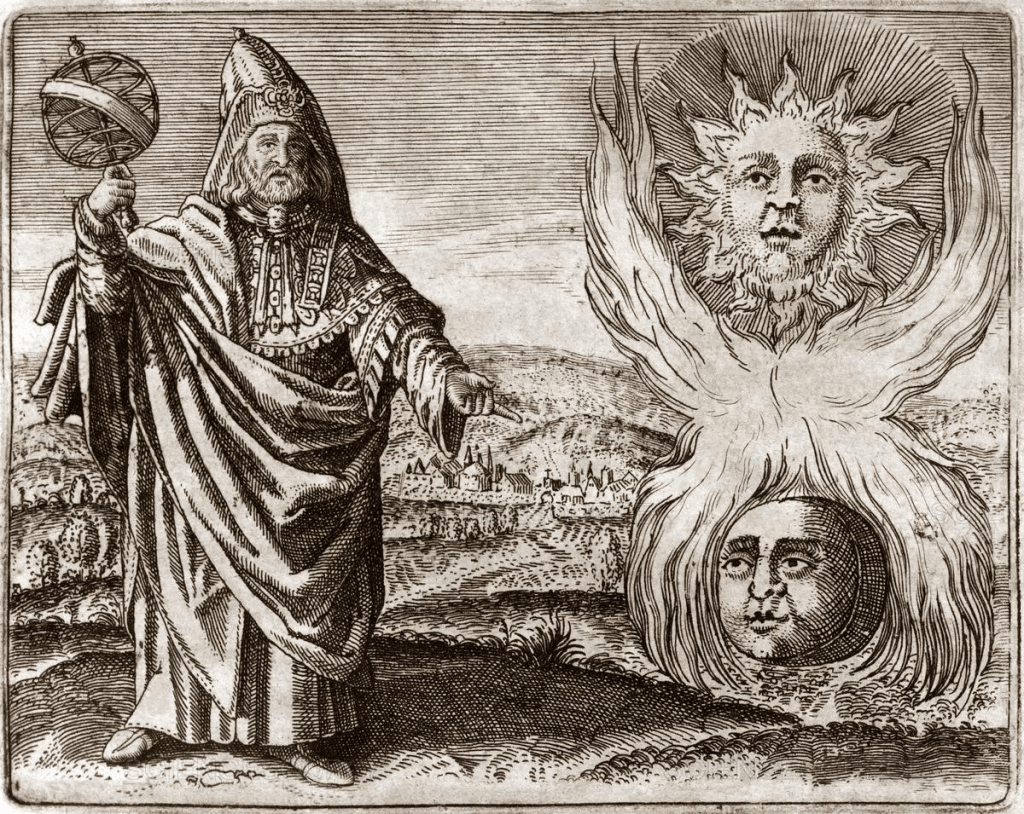
As Kevin van Bladel observes, understanding the allusive figure of Hermes Trismegistus requires more than an examination of his Arabic reception. One must trace his ancient roots and the cross-cultural purposes he has served. Indeed, this article argues that the transformation of Hermes from a Graeco-Egyptian sage into an Islamic prophet of science reflects the deeply syncretic nature of Islamic intellectual tradition, which reinterpreted ideas from Early Antiquity within an Abrahamic framework to advance scholarly fields in the Islamic world.
By tracing the figure of Hermes chronologically and thematically, this study shows how Hellenistic philosophies, particularly Gnosticism, Neoplatonism, and Stoicism, aligned Hermes with monotheism in Late Antiquity. These developments facilitated his later synthesis into Islamic intellectual thought as a primordial prophet of esoteric science.
Hermes Trismegistus first emerged as a syncretic figure combining Greek theology, Egyptian religion, and Hellenistic philosophy. While André-Jean Festugière sought to prove the purely Hellenistic nature of the Hermetica, other scholars, such as Christian Bull, point to earlier cultural exchanges. Herodotus (d. AD 420) noted Greek associations between the Olympian messenger god Hermes and the Egyptian god Thoth: moon-gods, cosmic orderers, divine scribes, and demiurgical sources of occult power.
Foreign settlers in Egypt found parallels between Thoth and the Greek Hermes, both trickster psychopomp messengers linked to the moon, medicine, and the realm of the dead. The epithet Trismegistus (“thrice greatest”), van Bladel notes, derives from an Egyptian Ptolemaic title for Thoth.
As Garth Fowden puts it, this integration of Graeco-Egyptian theology arguably “produced a sum that was greater than its parts, a divinity who could deservedly be placed amongst the dei magni of the pagan pantheon that presided over the Roman world”. Rather than simply considering Hermes as the equivalent psychopomp god to Thoth, the gradual dissolving of cultural barriers and the growing popularity of his cult at Hermoúpolis meant that the figure of the divine Hermes Trismegistus evolved in Late Antiquity.
Instead of a god, the theological figure of Hermes was viewed in line with Hellenistic Gnostic philosophy as a thrice-born, venerable mortal man who received emanated revelations from the divine world and achieved immortality. Figures like Ammianus Marcellinus (d. AD 390) described Trismegistus as a human with a powerful guardian spirit. This shift laid the groundwork for his portrayal as a philosopher-sage rather than merely a pagan combination of Thoth and Hermes.
Indeed, the Corpus Hermeticum (c. AD 100–300) depicts Hermes receiving visions from his guiding spirit, Poimandres, who reveals the divine order of the cosmos. These dialogues emphasise the role of daimons in leading humanity toward divine knowledge: a key Gnostic theme. The venerable sage Hermes remains amongst men to teach the manipulation of emanated occult forces through spiritual understanding.
The attributed dialogues in Asclepius (c. AD 100–300) expand on these ideas, presenting a monotheistic cosmology: God as “the maker of the world, and all it contains,” with matter as the receptacle for all forms. This reflects the Neoplatonic theory of “One” as the source of existence, mediated through emanations conveyed by spiritual intermediaries. Stoic ideas also appear in the portrayal of the cosmos as a living, interconnected organism bound by harmonious sympathy. The Hermetic worldview, despite its multiplicity, is ultimately unified under the concept of “one matter, one soul, one God.” This allowed Hermes’ teachings to resonate with monotheistic traditions in Late Antiquity, positioning him alongside prophetic figures in Judaism and Christianity.
Jewish intellectual traditions, influenced by Hellenistic philosophy, could have interpreted Hermes as akin to Enoch or Moses, a human sage granted esoteric wisdom by God. His teachings on spiritual ascent and divine union mirrored Kabbalistic themes, while his moral dualism recalled Jewish and Egyptian wisdom literature.
Interestingly, from the fourth century, Christian authors like Lactantius (d. AD 325) cited the Hermetica in apologetics, using its monotheistic passages to argue for Christian truth. In Renaissance Florence, Cosimo de’ Medici’s acquisition of the Greek Hermetica inspired scholars to revere Hermes as a pre-Flood authority equal to the book of Genesis. His emphasis on spiritual purification could be reinterpreted as a form of Christian salvation and baptism. These currents helped form the basis of later Hermeticism, a blend of Neoplatonism, Kabbalah, and occult philosophy.
The Abbasid translation movement in eighth and ninth-century Baghdad brought Hermetic ideas into a new linguistic and religious context. Greek philosophical and scientific works, often embedded in discovery legends, circulated widely. One example is The Secret of Creation and the Craft of Nature (c. AD 900), which tells of Apollonius of Tyana discovering the occult secrets of the Emerald Tablet beneath a statue of Hermes. Thus, Hermes retained his Graeco-Roman role as possessor of divine science, guided by spiritual intermediaries.
Yet in the Islamic world, Hermes was also recast in prophetic terms. The “three Hermes” tradition identified the first Hermes as an antediluvian prophet of science. Writers such as Abū Maʿsar al-Balkhī in The Book of the Thousands (c. AD 850) explicitly equated this figure with the Qurʾānic prophet Idrīs, who, like Hermes, was “raised to a lofty station.” The astrologer Maslama al-Qurṭubī’s Picatrix grimoire makes similar comparisons.
In this Islamic reinterpretation, Hermes was not merely a philosopher, but a divinely inspired prophet whose revelations preserved all sciences before the Flood. His knowledge, encompassing astronomy, astrology, and alchemy, was understood as emanating from God, legitimising scientific inquiry within a monotheistic framework.
The transformation of Hermes Trismegistus from Graeco-Egyptian deity to Islamic prophet of science illustrates the continuous layering of cultural and intellectual traditions. In the Hellenistic world, Gnostic, Neoplatonic, and Stoic philosophies reframed Hermes as a mortal sage and mediator of divine truths. Late Antiquity Jewish and Christian thought further aligned him with prophetic figures, paving the way for his integration into Islamic intellectual history. In the Abbasid period, translation and synthesis brought Hermes into dialogue with the Qurʾān, recasting him as Idrīs and affirming his role as a prophet of science. This syncretic evolution reveals how the figure of Hermes served as a bridge between pagan, philosophical, and monotheistic traditions, adapted to new religious contexts while retaining his association with esoteric wisdom.
Bibliography
Primary Sources (in order of appearance):
Hermes Trismegistus, Corpus Hermeticum, 100-300 C.E.
Hermes Trismegistus, Asclepius, 100-300 C.E.
Pseudo-Appolonius, The Legend of the Emerald Tablet in the Secret of Creation Craft of Nature. Composed in 900 C.E, translated into Latin in 1200 C.E.
Maslama al-Qurtubi’s, Picatrix (Ghayat al-Hakim) 900-1000 C.E.
The Holy Qur’an, 609 C.E.
Abū Ma’sar al‐Balkhi, The Book of the Thousands (Kitab al-Uluf) 850 C.E.
Secondary Sources:
Bull, Christian H. The Tradition of Hermes Trismegistus: The Egyptian Priestly Figure as a Teacher of Hellenized Wisdom. Brill, 2018.
Copenhaver, Brian P. Hermetica: The Greek Corpus Hermeticum and the Latin Asclepius in a New English Translation. Cambridge University Press, 1992.
Dunderberg, Ismo. “Cosmic Sympathy and the Origin of Evil” in Beyond Gnosticism: Myth, Lifestyle, and Society in the School of Valentinus. Columbia University Press, 2008.
Ebeling, Florian. The Secret History of Hermes Trismegistus: Hermeticism from Ancient to Modern Times. Cornell University Press, 2007.
Fowden, Garth. The Egyptian Hermes: A Historical Approach to the Late Pagan Mind. Princeton University Press, 1993.
Franz Rosenthal, The Classical Heritage in Islam. Routledge, 1992.
Remes, Pauliina. Neoplatonism. Taylor & Francis, 2008.
Van Bladel, Kevin Thomas. The Arabic Hermes: From Pagan Sage to Prophet of Science. Oxford University Press, 2009.
Featured Image: https://museumofwitchcraftandmagic.co.uk/object/reproduction-print-of-hermes-trismegistus/

