

Fig. 1, Giorgio de Chirico, The Enigma of an Autumn Afternoon, 1910, Peggy Guggenheim collection.
Written by Molly Marsella
26/10/2025
The Surreal first came to André Breton as an unconscious image, a sentence which no voice spoke, yet presented so clearly in his mind: ‘there is a man cut in two by a window.’ This sentence was an encounter with the “marvellous”, a concept introduced by Guillaume Apollinaire, forefather and friend to early avant-garde groups, who also first coined ‘sur-realism’ as an artistic label. The “marvellous image”, a concept greater than the objects, words, or symbols used to present it, seized the soul by tapping at the memory, which Breton believed was the source of imagination. This evokes an unconscious analogous association, uninhibited by the constraints of waking thought, and transcends into even “divine grace.” The marvellous, Breton said, was “always beautiful.” It could be seen masterfully employed in Lewis’s novel The Monk (1796), which Breton described as having “exercised an exalting effect only upon that part of the mind which aspires to leave the earth.”
Trailing contemporary infatuation with Freud’s psychoanalysis of dreams, as well as a personal curiosity about metaphysical communication, Breton’s first Manifeste du Surréalisme (1922) called for psychic attunement to the unconscious ‘truths’ he believed lurked under the surface of everything one encountered. What opened were the floodgates which enabled the creation of one of the most influential avant-garde movements of the twentieth century. Years later, Breton remained firm in belief, certain that “there is a world, an imperceptible world of phantasms, of hypothetical realisations, of wagers lost, and of lies.” Even with the fragmentation of the Surrealist movement, his infatuation with the metaphysical potential of Surrealism roared, culminating in his 1957 publication of L’Art Magique, a magical Surrealist perspective on art history.
Breton credits one man as getting “more than any of us… closest to the Surrealist truth.” Robert Desnos was Breton’s star who managed to “speak Surrealist at will.” Desnos’s dreams and illustrations populate the pages of La Révolution Surréaliste, the publication concerned with spreading and clearly defining the Surrealist message. One of Desnos’s automatic texts is accompanied by an illustration by Italian artist Giorgio de Chirico. The image is merely composed of suggestions meant to excite the subconscious imagination to fill in the blanks and revel in its ephemeral humanity. The horse in Chirico’s drawing is reminiscent of childhood, and the uncertainty of the figure could represent his disconnection from it.
The metaphysical works of Giorgio de Chirico produced between 1910-18 are consistently regarded by Breton, in both the Manifeste and L’Art Magique, as the epitome of the Surrealist concept of ‘magical causality’; the transcendence beyond current reality which reveals divine truths hidden in correlation. I argue that no other works better communicate Breton’s Surrealism.

Fig. 2, Giorgio de Chirico, Drawing from La Révolution Surréalist, 1924, Internet Archive.
The understanding of de Chirico’s metaphysical era lacks a uniform consensus among art historians. Fundamentally, his works initiate a personal encounter between the viewer and the Surreal, transcending the dimensions of the picture plane, temporal realities, and time itself as they continue to impart powerful psychic experiences. Breton defined Surrealism as “psychic automatism in its purest state… exempt from any aesthetic or moral concern.” It was something that sought to mimic the natural function of dreams– regarded as windows into a reality beyond that of the waking and unfiltered by the ‘morality’ of the consciousness. Automatism was treated as a fundamental exercise by Surrealists, manifesting in their game of cadavre exquis and early publications, like the Manifeste. In group séances and sleep sessions, they also worked to capture the Surreal in visual and literary terms.
The Enigma of an Autumn Afternoon’s looming dreamscape is characteristic of de Chirico’s early paintings. Florence’s Piazza Santa Croce is loosely recognisable, as is the statue of Dante Alighieri. De Chirico superimposes these images over a plane of stark flatness. The new background is bisected horizontally in a line of rooftops, dividing the plane into two blocks of similar muddy tones and textures. The verticality of the piazza and statue interrupts the horizontal bisection, in what becomes an unharmonious juxtaposition, with their smooth and rendered forms contrasting the jaggedness of their new setting. These monuments of the marvelous are recognisably out of place. This embodies the Surrealist collage aesthetic, meant to replicate how dream and reality blend despite being “seemingly so contradictory.”
The demeanour of the two human figures enforces interpretations of desolation and unease. Dottori believes these to be the artist’s mother and brother, mourning his death yet anticipating his glory. It is also possible that, in classical drapery, they represent the Italian people, stepping meagerly into the shade of the poet. Autumn Afternoon’s monuments, I believe, analogously represent the legacy of a passing Italian golden age, the descendants of which now wander in the shadows of their forebears’ ghostly shells. The greatness of the past, immortalised, now sits within a world unfamiliar to the one in which it was born. The sky above is painted in Veronese green, a synthetic pigment which de Chirico favoured, and his recurring use of the paint for backdrops to his monuments could imply the artificiality the artist found in his contemporary Italy. The ship sinking behind the row of buildings, noted by Bohn, “parallels the course of the sun” and contributes to the theme of a sunset, or penultimate time before darkness. Furthermore, the ‘autumn’ and ‘afternoon’ of the painting’s title strengthen parallel associations between sunsets and Italy’s waning glory with the transition to industrialisation and artificiality.
The statue, decapitated and dismembered, is a helpless artist who can only watch as his world sinks into ruin. Dottori believes that the inscription of the letters GC on its base indicates that the subject is no longer Dante, but the artist himself. It is key as well that Breton regards Dante as among “a good number of poets who could pass for Surrealists,” which thus allows more precedence for de Chirico, comparing their geniuses as figures of similar aspirations and divine inspiration. The weight of moody desolation and abandonment felt in Autumn Afternoon stems from de Chirico’s realisation that he has all the markings of greatness but would never achieve such status in the world’s impending state.
What Breton cherishes as symbols of inherent marvellousness, “capable of affecting the human sensibility,” mannequins and ancient ruins, de Chirico makes his main subjects. His images prelude the ‘collage aesthetic’ of 1920s Bretonian Surrealists to achieve their ‘reconciliation of two distant realities.’ De Chirico long told how his pictures came to him as a ‘revelation’; “suddenly, in a wholly spontaneous way and already complete in its visual content, so much so that the artist need only trace out its lines on the canvas.” He was a man as familiar with visual automatism as Desnos was with the literary. Breton accorded both men as gifted, in that their connection to the dreamscape was awarded by some unfathomable divine force which spoke to them in dreams using the language of the marvellous.
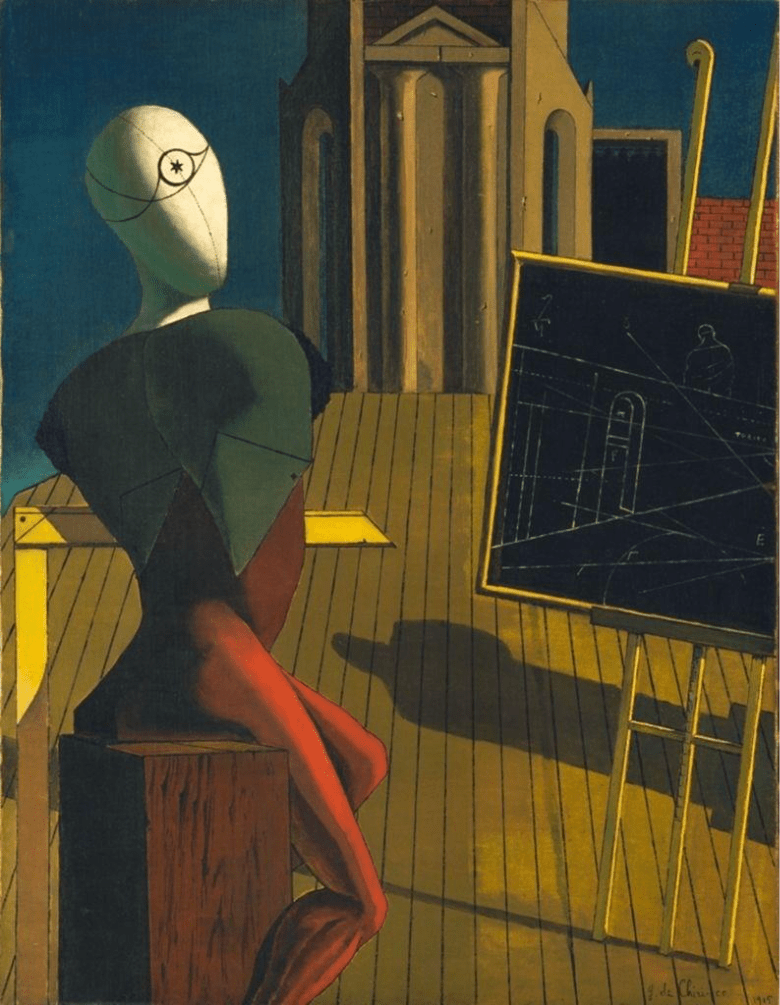
Fig. 3, Giorgio de Chirico, The Seer, 1915, New York City, Museum of Modern Art.
De Chirico takes this psychic conversation to a higher level, for he sincerely believed that he and his brother were the worldly manifestations of “twin forces” Apollo and Dionysus. Each of his metaphysical works includes representations of the deities bestowing divine guidance. He believed his mind was elite, of a high attunement, and as such, he also attracted deities of malevolence, which he called his ‘phantasms’. These figures are also littered throughout his works, perhaps more recognisable than Apollo, taking the forms of historical figures, most famously Napoleon III. Apollo repeatedly takes the shape of ‘the Enigma’, a motif manifesting as Dante’s shadow in Autumn Afternoon. His alignment with Dante permeates deeper, for he believed that Apollo was within both, and they became one, analogous, statue.
In The Seer, he directly explores his psychic abilities in an arguably conceptual self-portrait. While Autumn Afternoon feels much more haunted, The Seer seems to be possessed, with jarring animism. The picture feels overwhelmingly in motion, especially the mannequin, representative of the artist. The dreamscape of intersecting picture planes, lines and textures being juxtaposed together in a seemingly wild, inarticulate frenzy mirrors the apparent haphazard dreamscape, indecipherable to most. A blackboard with an architectural sketch in white chalk looks like a rudimentary plan of the cosmos, the night sky. The circlet with a star on the mannequin’s head identifies enlightenment, the metaphysical ‘third eye’, accompanying the Enigma’s form present in the small drawing. De Chirico aims, in his analogous way, to convey that this is how he sees, and this is how he “records”.
Giorgio de Chirico’s metaphysical works do not merely honour fundamental Surrealist methods and ideas; they indeed articulate the sublime otherworldliness and supernatural truth that was the true goal of engaging with the Surreal. While Breton did eventually dislike his later works, he always revered de Chirico’s metaphysical paintings and consistently included them in his discussions of Surrealism and magical art, describing his artist friend as “so admirable for so long.”
Bibliography
Bohn, Willard. The Rise of Surrealism: Cubism, Dada, and the Pursuit of the Marvellous. Albany: State University of New York Press, 2002.
Breton, André. L’art magique. Paris: Phébus, 1957.
Breton, André. Manifestos of Surrealism. Translated by Richard Seaver and Helen R. Lane. Ann Arbour: The University of Michigan Press, 1969.
Breton, André. Preface for a reprint of the Manifesto. Translated by Richard Seaver and Helen R. Lane. The University of Michigan Press, 1969.
Dottori, Riccardo. “Dream, Presage and the Disquieting in de Chirico’s Metaphysical Art.” In Metaphysical Art: The De Chirico Journals, n.14/16, 2016. 301-324.
Geis, Terri. “‘The Old Horizon Withdraws’: surrealist connections in Martinique and Haiti – Suzanne Césaire and André Breton, Maya Deren and André Pierre.” In Intersections: Women artists/surrealism/modernism, edited by Patricia Allmer. Manchester: Manchester University Press, 2016, 173-189.
Lippard, Lucy R. Surrealists on Art. Englewood Cliffs: Prentice Hall, 1970.
Matheson, Neil. “Desert Islands: magic and modernity in the work of Ithell Colquhoun.” In Intersections: Women artists/surrealism/modernism, edited by Patricia Allmer. Manchester: Manchester University Press, 2016, 153-173.
Rinaldi, Simona. “At the Origins of Giorgio de Chirico’s Painting Formulas.” In Metaphysical Art: The De Chirico Journals, Fondazione Giorgio e Isa de Chirico. n.11/13, 2013. 194-207
Schmied, Wieland. Giorgio de Chirico: The Endless Journey. Munich: Prestel Verlag, 2002.
Spector, Jack J. Surrealist Art and Writing, 1919-1939: The Gold of Time. Cambridge: Cambridge University Press 1997.
“Textes Surréaliste.” La Révolution surréaliste, no. 1 (December 1924): 1-31.
 Retrospect Journal