
Written by Eva Beere
26/10/25
If FDR saw the post-war era as an opportunity to strengthen the US-Soviet alliance, his successor saw it as an opportunity to aggressively counter Soviet expansion.
President Harry Truman’s presidency was marked by a series of complex foreign policy initiatives. Assuming the presidency in the midst of World War II, much of his first term was centered on rebuilding post-war Europe. Although FDR had also been committed to strengthening and supporting Europe during the turbulent 1940s, the two presidents disagreed on one key issue: the Soviet Union.
Truman’s commitment to preventing the spread of communism signaled a shift in American foreign policy from a WWII outlook to a Cold War mindset. This transition was made possible by three assumptions: firstly, the Soviet Union was committed to a Cold War conquest against America, secondly, the world was divided into a pro-American, democratic bloc and a pro-Russian, communist bloc, and thirdly, every radical revolution against governments was a communist ploy, instigated by the Soviet Union.
In actuality, the outbreak of the Cold War in 1945 was created by a grave misunderstanding of the Truman administration. These assumptions ignored the basic facts of Soviet foreign policy, allowing the Truman administration to make sense of the Cold War in a global sense. For example, if Stalin was truly out for world conquest, why was a third of the Red Army demobilised after the war?
A main reason behind Truman’s tough stance towards the Soviet Union was the fact that he had come to the presidency unprepared. Whilst he was grateful to the USSR for their war effort, FDR failed to brief him on the ongoing negotiations with the Soviet Union at the Tehran and Yalta conferences. Therefore, without knowledge of the key role the Soviets played in peace-building discussions, Truman perceived the end of the war as mainly America’s doing, a fact he believed the USSR should acknowledge.
Truman’s tough stance towards the Soviet Union was adopted almost immediately after he became president, initially using economic pressure as a means to reduce the Soviet sphere of influence. As part of the Marshall Plan, America extended $13.3 billion of aid to Western Europe for post-war recovery. This aimed to develop stable democratic governments across Western Europe, in an attempt to contain communism within the Soviet Union. Although the Soviets were destroyed by the war, bearing the brunt of fighting against Nazi Germany on the Eastern Front, they refused to open up Eastern Europe to trade. Therefore, as a means to get basic resources, such as steel and coal, they took any resources they could from Eastern Europe and Germany, as shown in their dismantling of railways between Poland and the Soviet Union.
When economic pressure did not work, the Truman administration shifted to military pressure. This became evident in two cases: Iran and Turkey. During the war, Iran had been occupied by both the British and the Soviet Union. The Tehran Conference in 1943 sought to address this leadership composition, leading to an agreement which increased US influence, maintained British influence in the country, and allowed Russia a share of oil in the North. Like many of the agreements made by FDR and Stalin in the final years of the war, the US and Britain urged Iran to withdraw from the deal after the war. This sparked a Soviet-encouraged separatist movement in Azerbaijan, with fears rising in Washington that the Soviet Union was sending increasing numbers of troops into the region. This forced Truman to adopt a tougher stance, providing the Soviet Union with an ultimatum: if they did not withdraw in 60 days, the US would retaliate. The Soviet Union agreed to withdraw on the condition that a Russian-Iranian oil company was set up, an agreement which the US failed to meet even after Russia had pulled out in 1946.
Turkey was another case of the American and British governments attempting to undermine Soviet Middle Eastern influence after the war. The Soviet Union had a long-standing interest in taking control of the Dardanelles Straits to exert its influence in the region and allow its Black Sea Navy access to the Mediterranean. Turkey’s diplomatic relations with Germany during the war gave the Soviet Union leverage, leading to an agreement between the four countries at the Yalta Conference that the Soviet Union and Turkey would have joint control over the Dardanelles. However, once again, after FDR’s death and the end of the war, the US and the UK began to retreat from their previous agreement. In August 1946, the Soviets sent Turkey a diplomatic note urging them to discuss joint control of the Dardanelles. Resistant to allow the Soviet Union joint control, Turkey formed an alliance with the US and asked for their help in resisting Soviet pressures. In a controversial move, the Undersecretary of State, Dean Acheson, recommended to Truman that aircraft carriers be sent to the Eastern Mediterranean. Although Eisenhower was initially against this, his decision was overruled, and the US decided to intervene, resulting in the Russians backing down.
US-Soviet involvement in the Middle East in the post-war period was significant for four reasons. Firstly, this showed that the USSR was willing to use the threat of force to advance its interests in the Middle East. Secondly, in response to Soviet expansionist efforts, the US was also willing to use the threat of force to stop the Soviets in the Middle East. Thirdly, the US was replacing Britain as the dominant power in the Western hemisphere. And finally, the focal point of the Cold War was shifting from Eastern Europe to the Middle East.
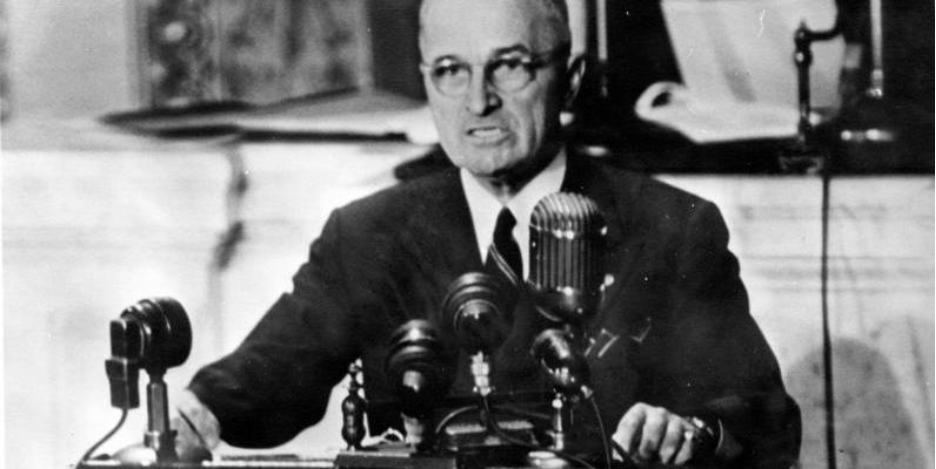
This anti-Soviet and anti-communist ideology formed the foundations of the Truman Doctrine, which would continue to influence subsequent administrations throughout the Cold War. This was formulated on 16 March 1947, in his ‘Truman Doctrine Speech,’ which asked Congress for $400 million in aid to provide economic and military equipment to Turkey and Greece. This attempt to provide help to countries threatened by communism was motivated by a fear later dubbed the ‘domino theory,’ which assumed the fall of one country to communism would result in a series of other countries falling as well. This whipped up a Cold War hysteria, aggravated after China fell to communism in 1949.
Truman’s commitment to preventing the spread of communism reached its peak in 1950. The first sign that the administration was serious about the threat of Soviet expansionism was the creation of NSC-68 in April 1950. This top-secret policy paper, drafted by the Departments of State and Defense, advocated for an increase in American defense spending and a military buildup. In many ways, NSC-68 enforced the militarisation of the Cold War, which began in Korea.
On 25 June 1950, North Korea invaded the South, and less than a week later, US troops arrived in South Korea to support the Southern forces. This decision was partly due to the ongoing hysteria surrounding the expansion of communism, and partly due to the upcoming midterms, during which Truman wanted to remain publicly committed to containment. The errors in America’s military policy came towards the end of 1950, when the overly ambitious General MacArthur began racing towards the 38th parallel despite warnings from China and the Truman administration. The consequences came tumbling down when China invaded in November after American forces came too close to the Chinese border, forcing them back across the 38th parallel.
Nevertheless, NSC-68 and military intervention in Korea signaled a sharp retreat from FDR’s efforts to build a US-Soviet alliance, and Kennan’s original theory of containment, marking the beginning of America’s aggressive Cold War campaign against the Soviet Union.
Truman’s anti-communist fervour and domino theory created an ideology which influenced American foreign policy for forty more years. America’s intense fear and hatred of Soviet-led communist expansion set the stage for Eisenhower to expand America’s anti-communist intervention globally. Whilst more cautious than Truman, preferring covert operations rather than complete military intervention, Eisenhower’s foreign policy approach was a product of his predecessor’s, marking the beginning of Washington’s own domino theory.
Bibliography
Beinart, Peter. The Icarus Syndrome: A History of American Hubris. New York: HarperCollins, 2010.
Office of the Historian, U.S. Department of State. “NSC-68, 1950.” Milestones in the History of U.S. Foreign Relations, 1945–1952. https://history.state.gov/milestones/1945-1952/NSC68
Zoellick, Robert B. America in the World: A Definitive History of U.S. Diplomacy and Foreign Policy. New York: Twelve, 2020.
Featured Image Credit: https://defenceindepth.co/2017/03/13/the-truman-doctrine-seventy-years-on/.
 Retrospect Journal