
Lydia Collier-Wood
The word “artist” today carries a strange ambiguity. It almost refers to anyone working within a creative field; however, when applied to visual art, it tends to imply a kind of originality and creative talent that is inextricably linked to market value. The Renaissance is where we see this image begin to take shape. In fifteenth-century Italy, painting was still technically a craft, dependent on workshop training and patronage, but it was also entering new intellectual terrain. Artists were increasingly seen as more than manual workers: they could be intellectuals, capable of engaging with philosophy, literature, and theology through visual means. Leon Battista Alberti, writing in 1435, described the painter as an “inventor,” one who constructs ideas as well as images. Cennino Cennini, a fourteenth-century Florentine painter, had earlier suggested that artists reveal “things not seen, hiding in the shadow of natural ones.” These ideas marked a gradual elevation of painting from a mechanical pursuit to a liberal art.
This shift is representative of a greater cultural phenomenon. The fifteenth century saw humanist learning, classical revival, and civic ambition converge. Sandro Botticelli (1445–1510) and Luca Signorelli (c.1450–1523) embody this transformation. Botticelli’s Primavera (c.1482) translates the poetic and philosophical ideals of Medicean Florence into visual harmony, while Signorelli’s Resurrection of the Body (1499–1504) asserts painterly intellect through anatomy and theology. Through looking at these works, we can see how artists were negotiating a new identity that would carry through to what we know today.
Before examining Botticelli and Signorelli, it is important to understand the framework within which artists were operating. Painters previously were tied to the guild system which positioned them alongside masons, carpenters, and goldsmiths. Their training was practical and communal; an education in the handling of pigments and plaster rather than in theory or design. Artistic identity was defined by manual skill and by the workshop’s collective output rather than by individual authorship. As aforementioned, this order was loosening in the fifteenth century. Artists began to move between the workshop and the court, negotiating new relationships with humanist scholars and elite patrons. Knowledge of geometry, anatomy, and perspective became not only technical assets but markers of intellectual refinement. It is out of this environment the figure of the pictor doctus, the learned painter, emerged, whose authority rested on study and invention as well as execution.

Fig. 1. Sandro Botticelli, Primavera (c. 1482). Tempera on panel, Uffizi Gallery, Florence.
In Florence, this redefinition of painting found its most poetic expression. Humanist thinkers such as Marsilio Ficino and Angelo Poliziano sought to reconcile classical philosophy with Christian belief, and their ideas filtered into the city’s visual culture. Artists working under Medici patronage were encouraged to create works that demonstrated visual intellect, to translate abstract ideals into image. It is within this climate that Botticelli’s Primavera (c.1482) emerges, a painting that transforms the painter’s craft into a form of visual identity.
Primavera (c.1482) opens in a shaded grove. There are nine mythological figures that move with controlled rhythm. Venus stands at the centre beneath an arch of dark green myrtle. To one side, Zephyrus chases Chloris, who transforms into Flora, scattering flowers, while opposite, the Three Graces dance in light synchrony as Mercury turns away, parting the clouds with his caduceus. The colours are soft and cool, the atmosphere both serene and theatrical. Though its surface appears decorative, the composition is too deliberate to be mere ornament; every gesture is choreographed.
This arrangement of figures mirrors the philosophical order of its time. Venus mediates between earthly desire and divine contemplation, embodying the Neoplatonic belief that beauty could guide the soul away from the material. Zephyrus and Chloris convey instinct and transformation, and Mercury’s detachment on the far-left signals reason. Botticelli turns the language of philosophy into a visual landscape, fitting with Alberti’s new ideas of the artist.
Yet what makes Primavera remarkable is not only its intellectual imagery, but the style through which Botticelli asserts authorship. He represents his figures as elongated and weightless rather than anatomical as we will see with Signorelli. The skin glows with a pale, sculptural light, unlike his contemporaries, who pursued muscular realism and perspectival depth, Botticelli privileged line over volume. This emphasis on contour and poise gave his paintings a distinctive, almost musical grace, combining the classical with the contemporary. It reflected a conscious rejection of pure naturalism in favour of a more poetic ideal, beauty as a form of thought.
These qualities would have been instantly recognisable in Florence, signalling a painter whose hand was distinctive. Botticelli’s style becomes his signature, a mark of intellect as much as of craft. Working within the Medici circle, Primavera also functioned as an emblem of cultural sophistication, a painting that demonstrated a certain level of learning to be understood. As Aby Warburg later observed, Botticelli didn’t copy antiquity but reimagined it, giving myth a new poetic charge.
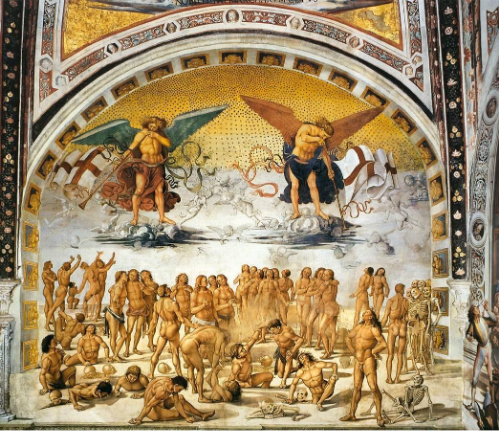
Fig. 2. Luca Signorelli, The Resurrection of the Body (c. 1499–1502). Chapel of San Brizio, Orvieto Cathedral, Italy.
In doing so, Botticelli helped define a new model of the artist with a desire for recognisability, an authorial fingerprint, which still shapes art today. Whether in fashion, design, or contemporary painting, originality remains a currency of intellect. Botticelli’s distinct visual identity foreshadows the modern artist’s pursuit of ingenuity.
By the turn of the sixteenth century, the atmosphere around painting had shifted again. The poetic style of Medici Florence gave way to a more speculative spirit, shaped by growing interest in anatomy, perspective, and theological inquiry. If Botticelli intellectualised beauty through rhythm and line, Signorelli did so through anatomy and force. In The Resurrection of the Body (c.1499–1502), bodies erupt from the earth in a frenzy of movement: sinews tense, torsos twist, and limbs reach toward heaven. Each figure is rendered with startling accuracy. Signorelli’s vision feels more corporeal; here is a demonstration of intellect through anatomical study.
Signorelli’s preoccupation with anatomy mirrored the Renaissance conviction that divine truth could be approached by empirical knowledge. To depict a resurrection convincingly he needed to understand not only how flesh lived but how it might live again. His foreshortened bodies and audacious perspectives stage a dialogue between science and faith, encapsulating the zeitgeist of the time. Similarly to Leonardo, he sought to fuse observation with speculation, to use art as an experiment in testing the limits of representation. The Resurrection of the Body in this sense is less a devotional image than an exploration of the human body in art.
Inscribing Dante’s verses along the chapel walls and placing his own likeness within the fresco, Signorelli aligns himself with the poet and the prophet. The grotesques and antique grisaille recall Nero’s Golden House, layering Christian eschatology with classical revival. As Alison Wright notes, his self-portrait acts as an assertion of authorship, casting the artist not merely as craftsman but as theologian and thinker. In this way, Botticelli and Signorelli, despite stylistic differences, hold a similar vision for their works: both anticipate the modern artist’s impulse to think through making and cement authorship over one’s creation.
When taking Botticelli and Signorelli as a lens, we can reveal how the Renaissance reshaped the role of the painter. Their work demonstrates that art could be more than decoration or devotion: it could be a site of knowledge and individuality. Botticelli’s lyrical precision and Signorelli’s anatomical intensity show two paths toward the same goal of proving that painting was a language of intellect, capable of philosophical depth.
The legacy of this shift continues to shape how we understand the artist. Style still carries the weight of intellect and originality remains tied to authenticity, with artistic identity now almost inseparable from public visibility. What began in the Renaissance as an argument for painting’s intellectual dignity has evolved into a culture where the artist’s image is part of the work itself. Yet beneath that commercial surface, the same concern – that of art making thought and feeling visible – persists. Perhaps the continuity lies not in style or subject, but in the artist’s enduring desire to be seen as an intellectual, to be understood and remembered.
Bibliography
Alberti, L. B. (1991). On painting (C. Grayson, Trans.). Penguin Classics.
Baxandall, M. (1972). Painting and experience in fifteenth-century Italy: A primer in the social history of pictorial style. Oxford University Press.
Cennini, C. (1954). The craftsman’s handbook (Il libro dell’arte) (D. V. Thompson, Trans.). Dover Publications.
Ficino, M. (2003). Selected writings (M. J. B. Allen, Ed. & Trans.). Harvard University Press.
Gombrich, E. H. (1972). Symbolic images: Studies in the art of the Renaissance. Phaidon.
Warburg, A. (1999). The renewal of pagan antiquity: Contributions to the cultural history of the European Renaissance (D. Britt, Trans.). Getty Research Institute.
Wright, A. (2005). The Pollaiuolo brothers: The arts of Florence and Rome. Yale University Press.

