
Written By: Freia Nilsson
Before you set out on your journey it is important to take a moment to step back and observe the map itself. Questioning who made it? What route you will take? Why are you going? It is in this line I will begin by introducing the Millennium clock tower.
The Map
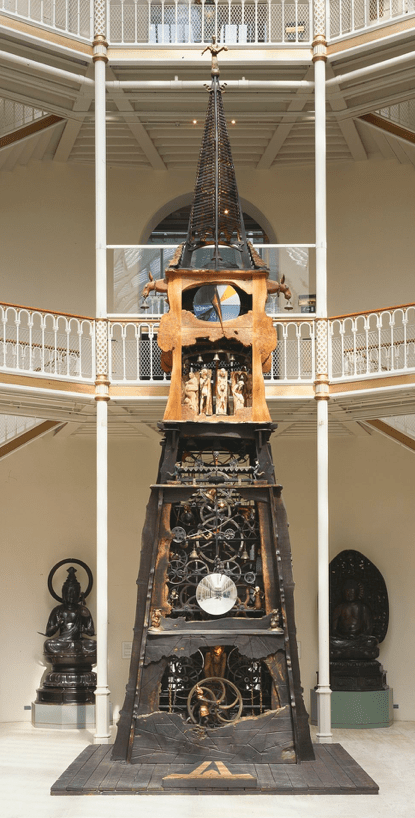
Towering at ten metres tall, the Millennium Clock Tower stands in the entrance hall of the National Museum of Scotland. Since its debut on 1 January 2000, it has served as a time capsule of the past millennium, as with each passing hour, the tower comes to life in a grand performance. Through a series of kinetic sculptures, lights and Bach’s concerto in A minor BMW 593, the past millennium is performed for your entertainment.
Cartographers:
It is the masterpiece of four individuals:
Eduard Bersudsky, renowned for his kinetic artworks, served as the inceptor of the project. Having grown up in Leningrad during the 1940s and remaining in Russia until 1993, at which point he moved to Scotland, Bersudsky had direct experience of the exploitation and deprivation which plagued Soviet Russia. Elements of his individual history are reflected in the clock tower.
Tim Stead was the architect of the project and responsible for the framework of the structure for which he largely used dark burnt timber. He took it to reflect the destruction and exploitation of natural resources.
Annica Sandström, a Swedish clock maker, created the clock’s dials and the side panels.
Finally, Jürgen Tübbecke, a watchmaker, restored an 1880s pendulum to be used for the clock tower.
It is due to the combined efforts of these four artists that the structure still stands in the entrance hall of the National Museum of Scotland. Originally commissioned by Julian Spalding, the then-director of Glasgow Museums, the construction of the clock faced financial challenges from the beginning. However, fortunately, the National Museum of Scotland agreed to finance the project and thus it still stands to this day.
Setting your route:
The Tower is divided into four sections:
The Crypt:
The crypt is the base of the tower, acting as a kind of engine room. It contains a collection of wheels, cogs, and chains, as well as two figures. The first is an Egyptian monkey, which, when the hand strikes the hour, begins to turn its own wheel. The second is an ancient spirit in chains, suggestive of restrained human nature. During the performance, the juxtaposition of the moving monkey with the restrained spirit comments on the primitive aspects of humankind, despite our present conception of modernity. The ambiguous nature of the figures allows you to choose your own avenue of interpretation. Whether it represents the dehumanising effects of industrial society, the mechanisation of war, or the cycle of life, death, and rebirth, the crypt serves as an arena for human sin and secrets. By positioning it as the first scene of the performance, the makers suggest that only by acknowledging these aspects can we proceed to the next stage.
The Nave:
The nave sits above the crypt and paints an image of humanity swept up in the wheels of time, through technology, revolution, war. It consists of allusions to totalitarian regimes with the trio of dictators (Hitler, Stalin, Lenin), all fitted with reptilian tails, a reminder of the extent of abuses of power. However, alongside these figures are those of Albert Einstein and Charlie Chaplin, contrasting the condemnation of the past years with a recognition of the good which emerged. Finally, dominating and obstructing your view is the pendulum on which sits a skeleton. A constant reminder of our own mortality as we see ourselves distorted in the convex mirror.
The Belfry:
The Belfry features a circle of twelve carved figures standing on a rotating platform that completes its cycle every hour. The figures are illuminated by light streaming through the stained-glass windows, bathing the sculptures in shades of purple and green. The figurines themselves are named: Hunger, Madness, Grief, Forced Labor, The Martyr, The Old Clown, Pandora’s Box, The Holocaust, The Intellectual, The War Invalid, War Camps, and The Hermit. This serves as a call to acknowledge and remember the tragedies and human sacrifices that have underpinned humanity’s progression to the modern day.
The Spire:
The Spire is designed to look burnt, like the bones of an old cathedral. At the very top of the structure stands a celestial figure of a woman carrying a dead man in her arms. The messages of the crypt, nave, and belfry all appear to culminate at this pinnacle. Faced with this simple yet powerful image of human loss, we are called to acknowledge our past and strive toward a higher level of moral consciousness as we move into the twenty-first century.
Now you have analysed your map and charted the course, it is important to understand why you are undertaking this 1,000-year journey:
The clock does not seek to simply serve as a timeline for the past millennium but is a call to recognise both our successes and failures. Designed to set you at the centre, navigating your own way through the past millennium, it invites you to build a personal understanding of history in the hopes you will carry the messages spoken to you along the way as you travel through the twenty-first century.
The Journey:
The distant echo of bells rings around the entrance hall; the low rumble of a forming crowd, gathering afront the 10 metre-structure. The dark, oak wood trunk hollowed out, exposing the belly, revealing the organs which have fuelled the millennium long play.
Murmurs are interrupted as music meets metal, the initial cascading notes of Bach’s concerto trickle down…the Egyptian monkey lurches forward.
Crimson lights lick the underside of the structure, illuminating the wheels and cogs and chains. A haunting silhouette of an ancient spirit, hidden amongst these mechanisms. Itself bound in chains. It stands uncomfortably, unlike you, forced to watch the performance.’
We begin the journey here, in the crypt.
Note: This is part one of a five-part series on the Millennium Clock Tower. It will serve as a guide through the four sections in which I will attempt to convey my experience by employing images and descriptions from renowned texts and artworks which come to mind. It is therefore important to note that the interpretations I make are unique to me, but hopefully I will inspire readers to visit the structure and form their own opinions.
Bibliography
Doerr, Elizabeth. “Absolutely Crazy Millennium Clock Tower In Edinburgh Commemorating 1,000 Years Of Rich History.” Quill and Pad.
Lenart, Maggy. “The Millennium Clock Tower”. NMSE – Publishing Ltd. (11 April 2012).
Featured image credit: “Millennium Clock Tower.” Sharmanka Kinetic Theatre. Millennium Clock Tower – Sharmanka Kinetic Theatre

