
Written by: Emily Borg
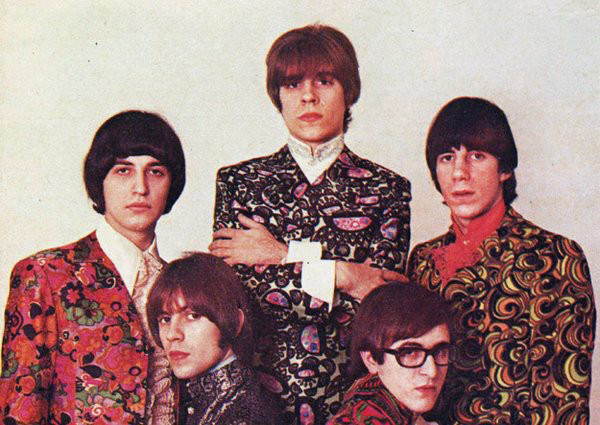
Originating in London, the Peacock Revolution of the late 1950s to mid-1970s centered around a counterculture and mod movement, focusing on the creation of flamboyant and sensual clothes for men. As the decade progressed, it became conflated with the nonconformist movements of the 1960s and 1970s. This culminated in an androgynous and “dandy” style, coined the ‘Peacock Revolution,’ as men paraded themselves with bright and extravagant colours.
During the 1980s, however, fashion saw a return of hyper-masculine and -feminine silhouettes, and the championing of conservative dress, the complete contrary to that of the Peacock Revolution. Therefore, it would be ill-advised to view the Peacock Revolution as one continuous and consistent movement, given the movement’s inconsequential impact after the mid-1970s.
In the late 1950s, the common fashion choice for men was a suit jacket and tie, a mirror to their fathers. The importance of pop icons in the entertainment industry challenged this image, specifically The Beatles, who popularised casual collarless jackets. Along with the bumfreezer jackets and beatnik looks, influenced by the Parisian left bank, men’s fashion slowly became more informal, and became not only a mode of dress but also a political statement. Importantly, the slow change to a more casual look was headed by the young modernists, reflecting a youth desire for change and radical upheaval, typical of the 1970s.
The turning point in men’s fashion came with the introduction and popularisation of Lycra and synthetic blends. The sensuality of the material allowed fashion designers to create more skin-tight and vibrant silhouettes, while also subtly showing off the contours of the waist and crotch. The popularisation of the designs was further aided by a shift in the public’s more liberal views of sexuality, especially after the sexual revolution of the 1950s and 1960s.
The culmination of the Peacock Revolution’s principles is presented in its championing of an androgynous and effeminate style. As it had become more conventional for women to wear trousers and jeans, and there was a shift towards a more unisex approach with women and men both sporting flowery shirts and bell bottoms. Arguably, by the mid-1960s they had broken free from the gender constraints of the 1950s. The use of openly flamboyant colours, frills, and velvet, previously judged as too feminine for men, were clear signs of change in the cultural zeitgeist. For example, Mick Jagger sported a white dress with a short skirt at Hyde Park in 1969, designed by Mr Fish, a 1960s fashion label that helped usher in this movement. Mr Fish also provided Bowie the “man-dress” that he wears on the album cover of “The Man Who Sold the World.” This demonstrates a direct challenge to conformity: by going against the strict gender binary and creating a more feminine sense of dress for men, expectations of gender and masculinity were subverted.
The Peacock Revolution was further subversive through its shared social and economic contexts with other sub-culture movements, such as the Anti-War movement and the Hippie movement. Many of these subcultures overlapped, and had similar core principles and beliefs such as grassroots youth support and a rejection of traditional values. While it is important to recognise that the Peacock Revolution did not have a specific political agenda, it can be acknowledged as a clear symbol of rebellion and a deliberate act of resistance.
The significance of these overlapping subcultures became evident at the movement’s downfall and the re-establishment of socially conservative values in the 1980s. After America withdrew from the Vietnam War in 1973, general support, attendance, and investment for these counter-culture movements died down, specifically the Anti-War Movement. Troop deployment dropped from 540,000 in 1968 to less than 25,000 in 1972. Thus, the youth revolt dissipated, and both the Anti-War movement and the Peacock Revolution started to decline in popularity. The lack of support for the youth revolts, which coincided with a growing support of conservatism, ultimately marks the failure, not only of the peacock revolution, but of the popular liberalism of the decade.
The decline of the Peacock Revolution is epitomised in the best-selling novel Dressing for Success by John Molloys, published in 1975. The book put forward a new masculine identity which became mainstream by the mid-1970s, featuring a revival of the dress conventions of the pre-1960s era. Dressing for Success by citing the importance of a suit and tie, with no facial hair and a short smart hairstyle, and a revival of conservative dress, marked the end of the flamboyant styles of the Peacock Revolution. This desire to return to a 1930s dress style was dramatically influenced by the global economic crisis of the late 1970s, ending the post-war glory years, whereupon the corporate world became a symbol of status and importance. The legacy of the Peacock Revolution became overshadowed by the re-establishment of social conservatism in both the political and cultural spheres.
As the Peacock Revolution became sidelined, there was a continuing emphasis placed on ultra masculine clothes, especially approaching the 1980s. After the AIDS crisis, there was a shortage of young gay fashion designers specifically in the New York Fashion scene. The fear mongering and misinformation surrounding AIDS (referred to as GRID until 1982: Gay Related Immunodeficiency Disease) excluded young men from the work force, sidelining queer styles and voices. This undeniably had an impact on men’s fashion, mirroring a desire to step away from the feminine styles of the 1960s and 1970s, thus returning to heteronormativity and traditional roles. This shift is clearly showcased in New York Fashion Week’s Spring/Summer collection 1990, where the silhouettes were smooth and uber-masculine, in contrast to the flashy and dandy clothes of times before. This collection followed a pink-washing and homogenisation of iconic queer spaces by the Mayor of New York at the time, Rudy Guiliani. These political decisions to “sanitise” LGBTQ areas reflected the reversal of liberal ideas at the highest level of governance. It is therefore arguable that the Peacock Revolution’s legacy was not one of subversion but rather of a return to “normalcy” which, instead of paving the way for more mainstream counter-culture movements, signalled in its fall a return to the more conservative beliefs that overpowered the 1980s.
Ultimately, while the Peacock Revolution did challenge conformity, in terms of the gender binary and bringing queer styles to the centre of the sub-culture movement, its flawed legacy and lack of persistence demonstrate the fallibility of a movement based solely on present contexts with no desire to further the movement.
Bibliography
Daniel Delis Hill. 2018. Peacock Revolution: American Masculine Identity and Dress in the Sixties and Seventies. London, England: Bloomsbury Visual Arts.
Haye, Amy de la. 2020. “Essay: Homophobia and the Impact of AIDS on the Fashion Industry | SHOWstudio.” Www.showstudio.com. June 7, 2020. https://www.showstudio.com/projects/fashion-in-a-time-of-crisis/homophobia-aids-and-fashion.
Lee Blaszczyk, Regina. 2006. “Styling Synthetics: DuPont’s Marketing of Fabrics and Fashions in Postwar America.” Business History Review 80 (3): 485–528. https://doi.org/10.1017/s000768050003587x.
Lehman, Katherine J. 2018. “After Aquarius Dawned: How the Revolutions of the Sixties Became the Popular Culture of the Seventies.” The Sixties 11 (1): 128–30. https://doi.org/10.1080/17541328.2018.1452378.
“The Peacock Revolution: 1960s UK Menswear · V&A.” 2017. Victoria and Albert Museum. V&A. 2017. https://www.vam.ac.uk/articles/the-peacock-revolution-1960s-menswear?srsltid=AfmBOorxjmkRSmqaiMdq2Fv3Nlywg7QENE2IryqUSa-AnCN63eyHtndQ.
Featured Image Credit: https://upload.wikimedia.org/wikipedia/commons/a/ab/Los_Gatos_estamapados.jpeg


