
Written by Millie Oliver
When talking about the history of world literature, who’s the first author that comes to mind? I would imagine it’s most likely the elusive Homer, author of two of the most infamous epics of all time. Or perhaps even Sappho, the famed poet from Lesbos. Whoever first comes to mind I would imagine it’s certainly not Enheduanna of Akkadia. This article focuses on one of the most influential women in ancient history and her story, but also the tragedy so many women befall in all periods of history. Erasure.
So, join me in exploring the dynamic and effervescent figure of Enheduanna: princess, priestess, poet. A woman whose impact on literature is so profound you will not be able to help yourself thinking how come I have never even heard of her? And even better, what would the history of western literature look like if it began, not with a man from Greece, but with a woman from Ancient Iraq?
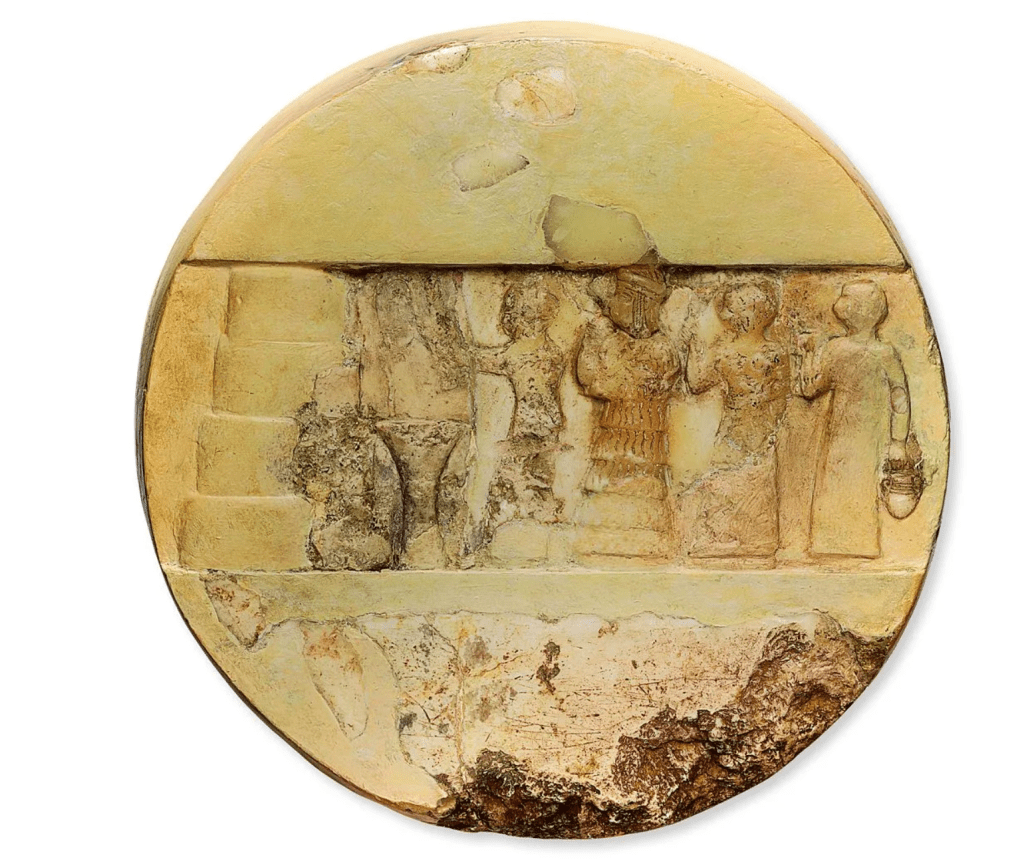
Enheduanna was born centuries before Homer in the period 2000 to 3000 BC in Mesopotamia which is located in modern day Iraq between the Euphrates and Tigris rivers. Her birth was significant, as the daughter of King Sargon the Great founder of the world’s first empire. However, conquering empires didn’t come without its challenges. The people of Ancient Sumer viewed Sargon as an outsider and constantly revolted against his presence in their kingdom. To unify the territories of Akkad and Sumer once and for all therefore he nominated his daughter, Enheduanna, as high priestess of the Sumerian moon goddess Inanna, the patron deity of Ur (an important Sumerian city state).
And so, Enheduanna’s role in history began. In Mesopotamia noble women typically took up religious roles in society, so it was normal for her to be educated in reading and writing as Mesopotamian temples were not just places of worship, but scholarship and learning, evidenced by the libraries they contained. Additionally, temples were also of great socio-economic importance and so Enheduanna’s role was not limited to worship. She also managed grain storage, oversaw temple workers and organised the monthly festivals dedicated to various deities, illustrating the importance her role would have had in Sumerian society.
However, the princess turned high priestess would become better known for the role her literacy skills played in worship. Before Enheduanna’s time, writing started as a form of accounting; lists of grain stores and important figures would be written down in an early form of script known as cuneiform which would be pressed into clay tablets. Writing at this time had a strictly record keeping purpose, making Enheduanna’s literary work even more pioneering for the period as she is most well-known for composing hymns dedicated to different deities worshipped in Mesopotamian temples. She wrote forty-two hymns and three epic poems throughout her lifetime all signed off with:
The complier of the tablets (is) Enheduanna.
My lord, that which has been created (here) no one has created (before).
Most texts in this period were written by scribes, showing how she really stepped out of her given role as a poet by using writing creatively, as a form of art. Unlike all forms of writing that had come before, these hymns changed the world by invoking the Gods and asking for their help, humanising them, giving them human emotions and weaknesses in a time when these hymns were a way for ancient people to connect to their deities. Her most famous work is the exaltation of Inanna which survives in over one hundred copies from cities around Mesopotamia and marked the first time the first-person pronoun ‘I’ was ever used in writing.
Overall, it is incredibly clear that Enheduanna was principle in bridging the cultural divide between Akkad and Sumer and unifying the two nations. She wrote in Sumerian in the Sumerian city of Ur and even used the Sumerian name for their queen of heaven; Innana. Simultaneously, she gave her the attributes of the Akkadian goddess of war Ishtar, evidencing how she used elements from both cultures to create a common foundation for her people. However, as with most women in positions of power in history, not everyone appreciated her influence. After King Sargon’s death, a powerful general staged a coup, and she was exiled, forced to wander the desert. Luckily, her nephew King Naram-Sin of Akkad soon crushed the uprising and restored her to her position of high priestess which she served as for a total of forty years.
Enheduanna’s role in shaping literary history is indisputable. From a world where writing’s only function was as a recording tool, Enheduanna became the first person to infuse emotion, storytelling, and human experience into the written word. This then begs the question: how can a woman who achieved such an incredible feat in the ancient world, who left such a mark that her work would be read, taught, and performed for over five hundred years, be so easily forgotten?
The Babylonian empire fell in 539BC after it was conquered by the Persians and, as a result, Enheduanna’s hymns were no longer copied or studied, allowing them to fade from cultural memory. It wasn’t until a chance discovery in 1927 by archaeologist Sir Leonard Woolley that her work finally resurfaced. However, just because her work had re-entered the spotlight, does not mean she was really seen by the modern world. Scholars were still largely dismissive of women’s roles, particularly towards female contribution to Mesopotamian society. This then led to an academic bias for the following decades in which the male dominated view of history persistently prevented her legacy from being recognised, evidenced by the fact that many people today have not largely heard of her existence. In fact, her authorship has been debated even though evidence strongly points towards her as the first named author.
Luckily for Enheduanna, a large part of the twenty-first century has been dedicated to restoring the importance women had in the past, and specifically to restoring her erased stories. No one agrees with this more than Sydney Babcock, expert in the art of ancient Mesopotamia, who gave Enheduanna’s legacy a new home in the She Who Wrote: Enheduanna and Women of Mesopotamia ca. 3400 –2000 BC.
It is exhibitions such as this that are finally turning the tide and giving women of the ancient world the platform they deserve so that we, the people in the modern era, can remember them. There is no one more deserving of such praise than Enheduanna, the princess, priestess, poet who transformed the way we approached writing and taught us the strength and power of the feminine divine.
Bibliography
BBC Culture, ‘Enheduanna: The world’s first named author’: https://www.bbc.com/culture/article/20221025-enheduanna-the-worlds-first-named-author
Elizabeth Winkler, ‘The Struggle to Unearth the World’s First Author’ in New Yorker: https://www.newyorker.com/books/page-turner/the-struggle-to-unearth-the-worlds-first-author
Minerva, ‘I, Enheduanna’: https://minervamagazine.com/i-enheduanna
Classical Wisdom, ‘Enheduanna’: https://classicalwisdom.substack.com/p/enheduanna
Featured Image Credit: https://www.bbc.co.uk/culture/article/20221025-enheduanna-the-worlds-first-named-author

