
Written By Lydia Illingworth
12/10/2025
The dates used in this article will align with the Julian Calendar as Russia continued to use this calendar system until early 1918
Over the course of 1917, Billington (1966) describes that Russia had witnessed, “a fascinating kaleidoscope,” as the year started with autocracy and ended with Bolshevik control manifested through revolution. When talking about Russia during a political revolution, images may arise of violence and devastation through mass desperation in the face of corruption; similar to the 1789 French revolution and the 1871 Paris Commune. In February, half of Petrograd’s working population went on strike showing symbols from revolutionary groups and from the French revolution. By the 27 February, the army had got involved via 66,000 mutinied soldiers and 40,000 rifles which later led to the death of forty people. If you were asked to describe a social uprising, this might be what you picture compared to the October Revolution, where only 5% of the workforce was involved with a maximum death count of five people. However, this is only a consideration of the actions of the revolution because compared to the periodic strikes in 1905, 1913 and January 1917, both the events in February and October were politically radical in their achievements. By considering the events in February, it brings to light that revolution was within the public consciousness, but does it mean that Bolshevik control was?
The reason Russia in 1917 experienced a political, “kaleidoscope,” was because this was the turning point of the war as Tsar Nicholas II became Commander-In-Chief of the navy and army in September 1915. With the growing decrease in morale, the deaths of up to 2.2 million added pressures through reduced equipment, reduced labourers within factories and reduced soldiers through the 1.5 million deserters. Despite promises from the Provisional Government in March 1917 to end the war, War Minister Milyukov went back on his promise by April, thus in the eyes of the people, the Provisional Government was failing to adapt to the needs of the people similarly to the Tsar. It is here, that the argument for a social uprising becomes justified because public force through the February revolution appeared to be futile.
In addition, these inherited problems spread socially leading to John Reed’s rather hyperbolic description of an, “unrolling pageant of the Russian masses,” during the October Revolution. The Provisional Government’s lack of confidence (as described by Suny (1983)) manifested into the socioeconomic situation: by June, 586 factories closed leading to one hundred-thousand people being unemployed. By October, prices had risen by 755% pre-1917 alongside increasing struggles regarding working conditions. Plus, factory workers could dismiss workers who went on strike and meetings of factory soviets, during working hours, were forbidden, increasing struggles within the workplace. Even prior to 1917, naval blockades and increases in taxes led to a 300% rise in the cost of living, with meat, for example, inflating in price by 232%. Combined with the ongoing First World War, social development for the lives of the Russian people was essentially stagnant. Ergo, it is interesting that Melgunov (1953) noted that, “the uprising had become an obsession with Lenin.” It allowed Lenin to realise that revolution was a necessary action, because of the fundamental issues of society, to achieve Marxist reform.
Faulkner raised an interesting criticism of right-wing historians who described, “the Bolshevik coup,” as a type of “anarchy” because instead it was an expression of desperation for millions of workers, soldiers, sailors, and peasants. This valuably explains the timing of the October Revolution, through the eyes of Lenin, as his ideas were not new but instead idealised by the population. Lenin confronted the idea of revolution from his 1902 pamphlet What is to be done? up until his 1917 factory visits dressed as a worker to promote The April Thesis. However, what had changed Lenin’s power was the size of the Bolshevik party. Membership at the beginning of 1917 had been around 24,000 and by July, it had increased ten times in size. Whilst Kingston-Mann (1972) describes this shift as “an expression of the ‘formless dissatisfaction’ of the people,” Lenin is the one who will gain from this shift as Marxist framework has been adopted into the public consciousness.
By Lenin realising the needs and desperation of the public through “worsening economic conditions and the unpopular policies of the government,” (Suny 1983), it ignited the actions of the revolution. It catalyses Lenin’s attempts to convince the party because the description of the October revolution as a calculated Bolshevik operation is almost too generous in September, rather it is labelled as unrealistic by the party. Lenin’s letters, on the 12 September 1917, claiming that, “History will not forgive us if we do not assume power now,” were criticised and even burned by the committee. This does somewhat reflect a consensus because whilst there were motivations for revolution, it is juxtaposed by personal confidence after the failure of the Kornilov coup in August 1917. Reiman (2016) discusses that Bolsheviks believed that “Russia was underdeveloped,” and could not achieve Marxist stage theory. Figes (2014) however explains how the short-term actions of the revolution were a calculated Bolshevik operation through the 10:2 vote for the revolution in the Central Committee on the 12 October. The vote does prove the sense of calculation involved in the October Revolution because if the analogy of a battle were to be used, the vote can be compared to battle planning. But what juxtaposes this analogy is its long-term causation. Lenin’s ambitions allowed, “the revolution [to be] continuing,” (Kolonitskii and Cohen (2009)) because these ambitions reflected the public desperation that previously motivated the February revolution.
Even the actions on the 25 October prove the extent of the public confidence the Bolsheviks needed: there was a bike battalion, car battalion, artillery from the Peter and Paul fortress, in addition to the support from the Aurora battleship. In this sense, logistically, their calculated operation still relied on the Russian population because Lenin’s plan relied on public frustration against long-term social issues. Whilst this evidence does provide a mirage of cooperation between the people and the Bolsheviks, the reality was that during the height of the revolution, it was merely anti-climactic. On the 24 October, Trotsky’s five thousand soldiers, sailors and Military revolutionary committee commissioner members seized the Electric Power Station, the Main Post Office, the Nikolaevsky Bridge, the State Bank, and the Warsaw Station in St Petersburg. By having this control, there was no fight for the Winter Palace to the extremity that members of the Provisional Government could leave out of the backdoor. Faulkner further speaks of the extent of the anti-climax as, “there was no looting or rioting. Theatres, cinemas, and shops remained open. Normal life continued on the Nevsky, within sight and sound of the desultory siege underway at the Winter Palace.” There was no need for the violent conventions of a revolution as Lenin’s aims had already been established and largely achieved. This does also demonstrate the extent of public and government desperation as Bolshevik military efforts were unnecessary. There was no opposition for the Bolsheviks as Lenin took initiative to solve both the inherited social issues and those brought on by the Provisional Government. Service (1997) summaries this point by proclaiming, “that Russia was heading towards a Socialist takeover, so Lenin merely ensured it was Bolshevik.”
Although, whilst the scale of the October Revolution highlights the extent of calculation, even from the 25 October 1917, there is an attempt to socially reconstruct the narrative of the revolution. Trotsky claimed to the Petrograd Soviet that “the Provisional Government has ceased to exist,” before the last shot was fired on the Winter palace. Kolonitskii and Cohen (2009) speak to this myth that the 25 October became, “central for the identity of the Russians,” celebrated through military parades, particularly during the Second World War, to promote national identity. This is further identifiable in propaganda films such as Eisenstein’s 1928 film October: Ten Days That Shook the World revealing a hyperbolic struggle for the Russian people. However, this myth becomes problematic as the October Revolution did not bring the consolidation of Bolshevik control as, “the image of a monolithic party,” (Kolonitskii and Cohen (2009)) which Russian historiography of the revolution tried to promote, crumbled at the sign of initial struggle ultimately becoming the Civil War. Therefore, short-term success is overshadowed by the steps needed to solve the long-term causes of the revolution as Lenin’s security relied on alleviating public desperation because the October Revolution was largely a consequence of social issues rather than Bolshevik ambitions.
Bibliography
- Basil, J. D. (1968). ‘Russia and the Bolshevik Revolution,’ The Russian Review, 27(1), 42–53. Available at: https://doi.org/10.2307/127227
- Billington, J.H. (1966) ‘Six Views of the Russian Revolution’, World Politics, 18(3), pp. 452–473. Available at: https://www.cambridge.org/core/journals/world-politics/article/abs/six-views-of-the-russian-revolution/F41844384239517497C9A8AC94A70E4C
- Carr, E. H. (1953). The Bolshevik revolution 1917–1923 (Vol. III). London: Macmillan.
- Faulkner, N. (2017). A People’s History of the Russian Revolution. Pluto Press. Available at: http://www.jstor.org/stable/j.ctt1k85dnw
- Figes, O. (1996). A People’s Tragedy: The Russian Revolution, 1891-1924. New York, N.Y.: Penguin Books.
- Figes, O. (2014). Revolutionary Russia, 1891-1991. New York: Metropolitan Books/Henry Holt And Company.
- Kingston-Mann, E. (1972). ‘Lenin and the Beginnings of Marxist Peasant Revolution: The Burden of Political Opportunity, July-October 1917.’ The Slavonic and East European Review, 50(121), 570–588. Available at: http://www.jstor.org/stable/4206621
- Kolonitskii, B., & Cohen, Y. E. (2009). ‘Russian Historiography of the 1917 Revolution: New Challenges to Old Paradigms?’ History and Memory, 21(2), 34–59. Available at: https://doi.org/10.2979/his.2009.21.2.34
- Patnaik, P. (2017). ‘Marxist theory and the October Revolution.’ Agrarian South: Journal of Political Economy, 6(2), 175-187. Available at: https://doi.org/10.1177/2277976017731843
- Reiman, M. (2016). ‘About the Russian Revolution of 1917.’ In About Russia, Its Revolutions, Its Development, and Its Present (pp. 13–24). Peter Lang AG. Available at: http://www.jstor.org/stable/j.ctv2t4dn7.4
- Rendle, M. (2017).’ Making Sense of 1917: Towards a Global History of the Russian Revolution’. Slavic Review, 76(3), 610–618. Available at: https://www.jstor.org/stable/26565166
- Suny, R. G. (1983). ‘Toward a Social History of the October Revolution.’ The American Historical Review, 88(1), 31–52. Available at: https://doi.org/10.2307/1869344
- Service, R. (1997). A History of Twentieth-Century Russia. London: Penguin Books.
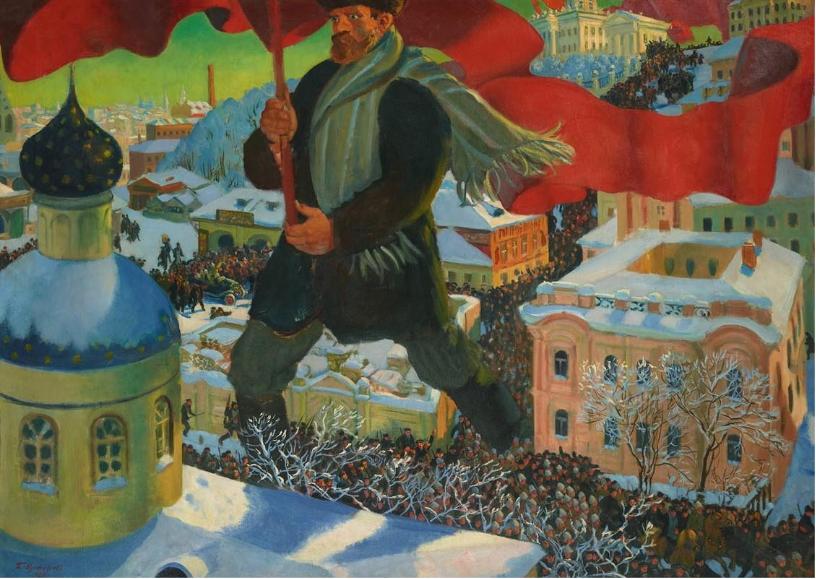
Featured Image Credit: Kustodiyev, Boris Mikhailovich (1920) The Bolshevik Moscow: The State Tretyakov Gallery

