
Written by Seanryan Lai
12/10/2025
On the night of 25 August 1830, a special performance of Daniel Auber’s opera La Muette de Portici was held at the 1830 at the Théâtre Royale de la Monnaie in downtown Brussels, in honour of William I’s 59th birthday and his fifteenth year as King of the Netherlands. The opera – based on the story of a humble fisherman, Masaniello, who bravely led the Neapolitan Revolt against the tyranny of the Spanish King Philip IV in 1647 – featured a rousing highlight in Act II: the Amour Sacré de la Patrie. In this scene Masaniello gives the signal for revolt with the lines: “sacred love of my country, give us courage and pride, my country gave me life, I will give it freedom.” This moment stirred the audience and helped spark a revolution that ultimately led to the birth of a new nation: Belgium. The uprising that began in the Southern provinces was part of a broader Romantic revolutionary wave that struck Europe in 1830, beginning with the July Revolution in France.
From 1815 to 1830, the Southern Netherlands, or “Belgium,” formed part of a union-state called the United Kingdom of the Netherlands. This entity was created by the Great Powers in the aftermath of the Napoleonic Wars and the Congress of Vienna, in accordance with the London Protocol of 21 June 1814, in which Britain, Prussia, Austria and Russia awarded the territory to William I of the House of Orange-Nassau. However, the union was uneasy from its inception. Tensions between the South and North grew rapidly due to deep political, linguistic, economic, cultural and religious divides. The Southern provinces had a unique demographic composition, as the population was predominantly Catholic, and although the region was divided between the Flemish and Walloons, the majority of the upper classes – whether from Flanders or Wallonia – spoke French. William’s attempts to establish Protestantism as the state religion in 1821 and to impose the Dutch language in the South were met with fierce resistance. Moreover, Southern provinces were also heavily under-represented in the General Assembly, with major institutions based in Amsterdam and The Hague. Economic grievances and restrictions on press freedom further fuelled discontent. In 1828, Belgian journalist Louis de Potter was brought to trial for publishing articles in the Courrier des Pays-Bas that criticised the Dutch government and advocated ing unity between Catholics and liberals.
The first half of the nineteenth century was a period of profound transformation in Europe, as the framework of the nation-state emerged under the influence of two complementary movements: Romanticism and nationalism. At the forefront of these movements stood the liberal bourgeoisie. Romanticism – an artistic and intellectual movement born in the late eighteenth century – emphasised subjectivity, imagination and a deep appreciation for nature. It played a prominent role in formulating a Belgian national consciousness through society and culture. Belgian Romanticists looked to their medieval past for inspiration, viewing it as an era marked by chivalry, heroism, and a more organic relationship between humanity and nature. This idealisation led to the creation of a Belgian national history – one that distinguished the people of Flanders and Wallonia from their Dutch rulers. The outbreak of the Belgian revolution in 1830 was seen as an awakening of the Belgian people to assert their identity within Europe and to legitimise the creation of a Belgian state in the eyes of the Great Powers. The Belgian lawyer, Étienne-Constantin de Gerlache argued that “Belgium lying in the centre of Western Europe amid all the propaganda of the philosophes and the Protestants, had been the keeper of the old Catholic civilisation and could still serve that purpose.” To represent the continuous development of Belgian history, de Gerlache adopted Johann Gottfried Herder’s concept of Volksgeist – the spirit of a Volk or people – which, in its organic evolution, could serve as the immutable foundation of national history. For de Gerlache, Catholicism was the heart of this spirit and the nation: “it was this faith which brought together the Flemish and Walloons in a common cause and, together with the new monarchy of Leopold I of Saxe-Coburg and Gotha secured the unity of the fatherland.”
To portray the Belgians as an oppressed people ready to throw off the yoke of Dutch rule, nationalist intellectuals framed Belgian history as a long succession of foreign domination. For centuries, they argued, the population had suffered under a series of tyrannical regimes: first under the Spanish and the Austrians, then the French and the Dutch. An anonymous commentator in Le Mémorial Belge summarised this sentiment: “Spain has exploited us with fanaticism and cruelty, Austria with indifference and calculating gentleness, the French Empire with contempt and Holland with greed and stupidity.” The 1830 revolution was seen as the culmination of a historical struggle against foreign oppression: from the Nervians resisting the Romans, to the Flemish against the French, the “Dutch” revolt against the Spanish, and the Brabantines against the Austrians. The ascension of Leopold I as King of the Belgians in 1831 was portrayed as the fulfilment of earlier periods of national greatness, from the rule of the Burgundians, Charles V, Albrecht and Isabella, to that of Maria Theresa. Belgian historian, Théodore Juste in his Histoire de Belgique, identified key turning points in the nation’s past to highlight its heroic legacy. In particular, he elevated the status of the Flemish Godfrey of Bouillon, the first ruler of the Kingdom of Jerusalem, as a national hero for his contribution in the Crusades. Moreover, medieval battles such as Worringen (1288) and Courtrai (1302) were celebrated as demonstrations of Brabantines’ and the Flemish’ bravery in resisting foreign oppressors. The Brabant Revolution (1789-1790) in the Austrian Netherlands was positioned as a direct precursor of the Belgian Revolution of 1830 since, since it led to the creation of the short-lived United Belgian States in opposition to Emperor Joseph II of the Habsburgs.
The concept of nationalism also played a prominent role during the Belgian Revolution of 1830. To prevent the uprising from being perceived merely as an extension of the July Revolution in France – and to affirm a distinct Belgian identity – the liberal bourgeoisie, led by Charles Rogier and Emmanuel Vanderlinden d’Hoogvorst quickly seized control of the situation. The civil guard was instructed to replace the French tricolour flying above Brussels city hall with the black-yellow-red flag, which had been the historic banner of the 1789 Brabant Revolution and the United Belgian States. Daniel Auber’s opera, La Muette de Portici, used as a symbolic catalyst for the revolt, also carried strong nationalistic connotations. Its tragic ending and emotional power were harnessed to rouse patriotic sentiment and mobilise the population against Dutch rule. In Act V, Masaniello dies in battle during a volcanic eruption of Mount Vesuvius while, while fighting against the Spanish. Upon hearing of his death, his sister Fenella commits suicide. This dramatic sequence deeply resonated with the Belgian audiences and stirred revolutionary and patriotic fervour in cities such as Brussels, Liège and Leuven against King William I. In the days that followed, mobs attacked the offices of the pro-government journal, Le National, and the homes of prominent Dutch politicians, including Cornelis Felix Van Maanen, the Dutch Minister of Justice.
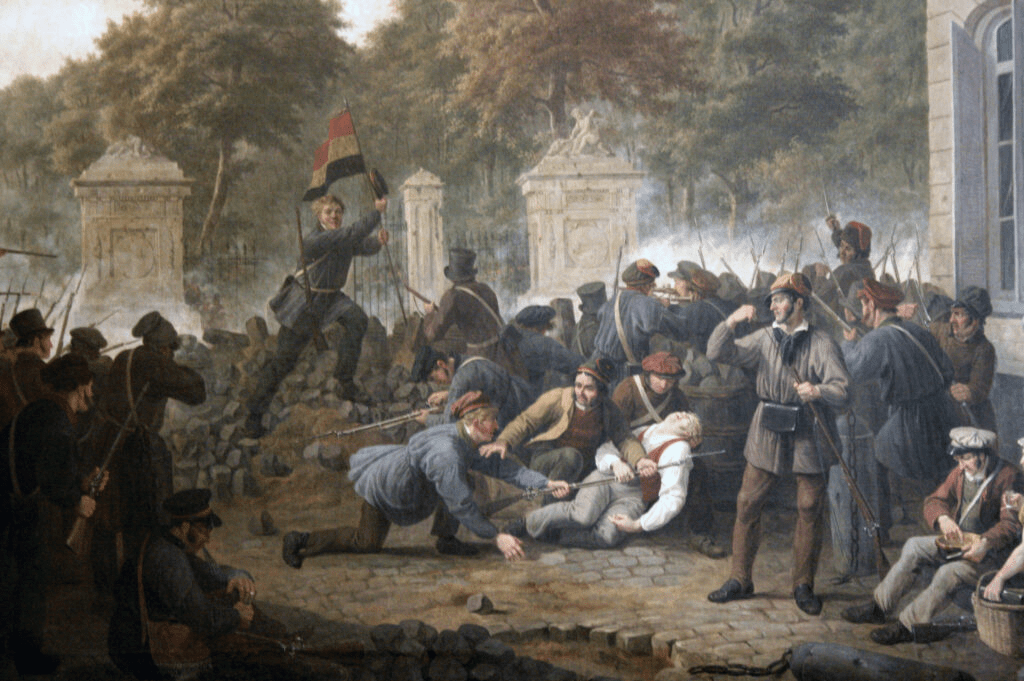
The use of art to depict the Belgian independence struggle reveals the central role Romantic nationalism played in the revolution. Belgians of all social classes – whether Flemish, Walloon, Catholic or liberal – stood together against the Dutch rule. This spirit of unity is powerfully captured in Episode of the Belgian Revolution of 1830 (1835), an oil painting by Belgian artist Gustaaf Wappers. The work prominently features the black-yellow-red tricolour in the background and heroically portrays the revolutionary fervour of the people. It has since become an icon of Romanticism and is now displayed in the Royal Museum of Fine Arts in Brussels.
Romantic nationalism was instrumental to the revolution’s success. By fostering a distinctly Belgian national consciousness, it helped unify the population in struggle against the Dutch. This unity had diplomatic consequences: in 1831, at Britain’s urging, the Great Powers agreed to Belgian independence from the Netherlands. In defiance, King William I, launched a Ten-Day Campaign to reassert Dutch control over the southern provinces. However, following condemnation from the Great Powers and French military intervention at Antwerp in 1832, the Dutch were forced to back down. They reluctantly recognised the ‘Basis of Separation,’ and in 1839, the Treaty of London formally recognised Belgium as a new sovereign nation.
Bibliography:
Humes, Samuel. Belgium: Long United, Long Divided. London: Hurst & Company; 2014.
Marteel, Stefaan. The Intellectual Origins of the Belgian Revolution: Political Thought and Disunity in the Kingdom of the Netherlands, 1815-1830. Cham, Switzerland: Springer International Publishing; 2018.
Moggach, Douglas. ‘’Romantic Political Thought’’. In Oxford Handbook of European Romanticism, edited by Paul Hamilton, 660-683. Oxford: Oxford University Press; 2016.
Slatin, Sonia. ‘’Opera and Revolution: La Muette de Portici and the Belgian Revolution of 1830 Revisited’’. The Journal of Musicological Research 3, no. 1-2 (January 1979): 45-62.
Tollebeek, Jo. ‘’Historical Representation and the Nation-State in Romantic Belgium (1830-1850)’’. Journal of the History of Ideas 59, no. 2 (April 1998): 329-353.
image credit: https://www.brusselstimes.com/1660044/from-opera-to-independence-revisiting-the-belgian-revolution

