
Written by Daisy Yip
A fictional reimagining of the first two days of Chopin’s visit to Edinburgh.
29 July 1848
A steam train travelled across the west coast of England into Scotland, embarking on a twelve-hour journey from London Euston, Birmingham, Carlisle to its final destination—Edinburgh. One of its first-class carriages housed three passengers: Daniel the servant, Muir Wood the Scottish pianist and Mr Fryderyk Chopin, who was invited by his good friend and pupil, Lady Jane Stirling, to visit her homeland. Seated at the corner, wrapped in a hand-tailored black redingote, the wooden panels and wide leathered couch accentuated his slender figure. Between the black brim of his hat and white collar was a pale, gaunt face tilted towards the window, watching the passing silhouettes of English fields and trees with detachment through his pine-coloured eyes.
As the train departed from Lancaster, it dived into the heartlands of Cumbria, travelling along the lake districts, arriving in Carlisle by mid-afternoon. From Lockerbie, the train headed straight towards Edinburgh. Its engines rumbled, accompanied with multiple sharp blows, the wheels, animated by the mechanical rod, began to spin frantically, making a rhythmic marching sound while the chimney emitted plumes of white smoke. The steamed vehicle, huffing and puffing like an awakened animal, raced across the Scottish Lowlands, leaving a long trail of white clouds in the verdant summer green. The thick smoke concealed the scenic view, yet the roaring humps of the engine filled the silent carriage with an air of anticipation, and its acceleration swayed its poised passenger like eggs in a basket. Uplifted by the motion, Mr Wood introduced the Caledonian Railway to Chopin light-heartedly: “the route from London to Edinburgh was only half-a-year old, and constructions of New Town in Edinburgh has come near to its completion! The freshly built city awaits your arrival.” Chopin gave a cordial response but was muted by a sharp whistle as the smoke thickened. Dashing through the smoke, the view cleared up, revealing an illustrious landscape of afternoon rays shining on the boundless plains in grids of greens and yellow. To Mr Wood’s excitement, he cheered, “as the French said, ‘Viva la France!’, today I say, ‘Long live Scotland!’,” and then, in a solemn tone, “and ‘Long live’ to Poland.”
At nightfall, the train arrived at Edinburgh Lothian Road station. Mr Chopin was sent to Douglas Hotel, St Andrews Square. After an exhausting journey, old and weary, feeling like he had reached the ends of the earth—all the way from Paris to London then to Scotland in a span of three months—driving through the cobbled streets of Edinburgh in the peace of the night created an eerie sense of isolation for the Polish composer. The array of warmly lit streetlamps illuminated its proximity, revealing the earthy tones of the city, the pillars, the doorways, the staircases, the pavements, which reminded him of a distant memory. Perhaps, it was like the first night when he resided in Paris, green and timorous, not knowing a single soul. Or like an evening vigil, accompanied with the midnight bells, where he remembered his mother, veiled in an intricately laced black mantilla, holding a candle between her hands that illuminated a tranquil expression, the wrinkles around her loving eyes, gleaming in the dark…
30 July 1848
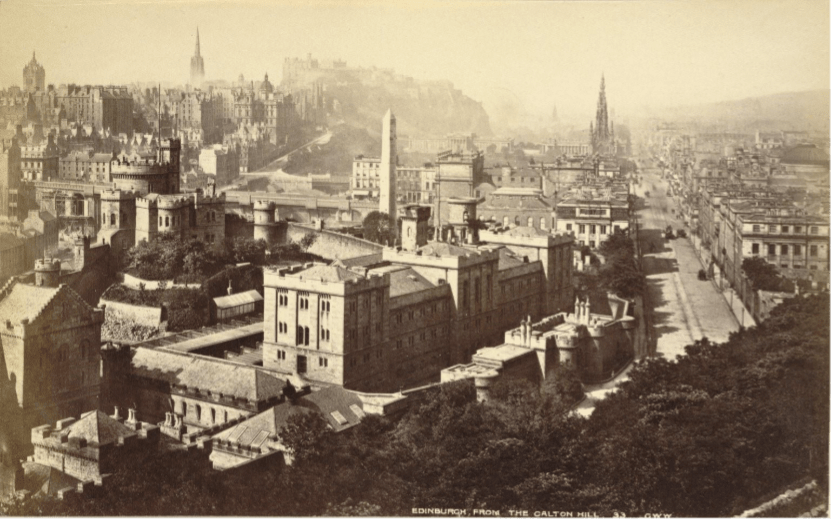
In the morning, after a light breakfast at Douglas Hotel and a short meeting with Mr Wood on the arrangements of his concerts in Scotland at 12 Waterloo Place, Chopin, lightened by the lively mood of the city, took to travel around Edinburgh. Turning into Princes Street, he was met with the towering Scottish Monument; he deduced that the statue and the grand gothic style of this peculiar tower erected at the city centre was a memorial of someone with great importance. ‘Walter Scott…ardent patriot…romantic poet’—Chopin had a vague idea of its implication after reading the English inscriptions synonymous to French. Despite his alienation towards this foreign city, he shared similar sentiments with the people of this land.
The azure sky, the summer warmth and the interesting, geometric arrangements of the buildings along its hilly urban landscape had prolonged the pianist’s exploration. Occasionally he would step off to take a stroll on foot. In Princes Street Gardens, beneath the elm trees, Chopin observed the city: a medieval castle on a large rock, a very memorable neogothic twin-towered college, and compact buildings built along the hill that formed a block-on-block illusion, with an elegant silhouette of a hollowed gothic curved roof, topped with a golden rooster protruding from the vertical roofs. That magnificent copper dome added grandeur to the otherwise quite formidable sight of compact city buildings, layered in squares and rectangles like a wall built on a singular foundation. Indeed, it was an impressive city, yet the sense of surrealness and detachment never quite left him. Deep in thought, he wandered into one of the alleys aside of Princes Street, when he heard a sound, a tune, the piano, so familiar…
I was passing by a music shop when I heard a blind man playing one of my mazurkas…
(Fryderyk Chopin, Letter to Grzymala, 1848)
Once upon a time in Edinburgh, outside a music shop, stood a lonely Polish composer. The pristine shop window framed the sight of a blind man, seasoned in age, humbly dressed, seated before a wooden piano. Mild in movement, his fingers touched the keys in deep affection. Each note, discordant and muffled at times, was nevertheless limpid in sentiment. Unbothered by his surroundings, the man immersed himself in pure musical resonance, transcended into a sacred invisible realm solely guided by touch and the auditory, enriched by his spirit. Little did he realise, the pianist who has composed this melody that brings life to the void, stood a mere few feet away from him, listening. And little did he know, his humble practice, has touched the heart of the composer, and offered sanctuary to his wandering soul.
Which mazurka is it? The upbeat, lustrous ones likened to that of the Polish folk dance, or those introspective, ever-expansive tunes that invigorated the listless intervals of life? Did Chopin, in rudimentary French-accented English, reveal his identity to the blind man? Or played a piece for him? Did they converse? The intimate moment when the esteemed composer became the audience of his piece, and the amateur the performer, was left blank and mystified between the pages of his letter.
Bibliography
Alan Walker, Fryderyk Chopin: A Life and Times. London, Faber & Faber Ltd, 2021.
Bone, Audrey Evelyn. Jane Wilhelmina Stirling, 1804-1859: The First Study of the Life of Chopin’s Pupil and Friend. England, Starrock Services, Chipstead, 1960.
PIANO PRACTICAL EDITIONS. “Chopin,” August 9, 2023. https://pianopracticaleditions.com/chopin/.
Wikipedia contributors. “Caledonian Main Line.” Wikipedia, September 6, 2025. https://en.wikipedia.org/wiki/Caledonian_Main_Line.
Featured Image Credit: Cornell University Library – originally posted to Flickr as Edinburgh from Calton Hill, CC BY 2.0, https://commons.wikimedia.org/w/index.php?curid=7295173

