
Written by Edie Christian
13/04/25
In 2017, Chinese President Xi Jinping spoke at the twentieth anniversary of the handover of Hong Kong, claiming the move had ended the century of “humiliation and sorrow” that permeated Chinese cultural memory; following their defeat in the First Opium War (1839-42), the Qing dynasty ceded Hong Kong to the British Empire. Ostensibly separate from the British government, the East India Company (EIC) — a joint-stock company — became the most defining symbol of British imperialism on the Indian subcontinent. Their insistence on selling profitable opium — grown in the Indian colony — created widespread addiction in China, destabilising its economic and social foundations. The legacies of the Opium Wars and the politics of memory continue to resonate through China today, affecting attitudes towards — and international relations with — the West.
Founded in 1600, the East India Company (EIC) was initially used to gain an English foothold in the East Indian spice trade, eventually trading in many commodities including cotton, silk, and opium. As they became increasingly profitable, they became emblematic of British imperialism in India from the early 1700s to the mid-1800s. The transformation of the EIC from a conventional trading company into an almost autonomous colonial power can be attributed to the defeat of Mughal emperor Shah Alam by EIC troops in 1765. By rendering local revenue officials obsolete, the collection of Mughal taxes was subcontracted to the EIC. Despite relatively few company clerks, the company was able to seize and hold onto power through rapidly expanding security forces, with its army growing to two hundred and sixty thousand by 1803. Forty-seven years later, almost all of India south of Delhi was “effectively ruled from a boardroom in the City of London”. The EIC is often seen as synonymous with the British government; although they both had insatiable colonial and expansionist greed, the power held by the EIC was virtually concentrated into the hands of one ‘unstable sociopath’, Robert Clive (1725-74). After the EIC’s trade monopoly was broken in 1813, it became desperate to hold onto its power by any means possible.
The British had discovered the value of the established opium trade from India to China; the EIC subsequently established a monopoly on growing opium in Bengal, motivated to do so by an imbalance of trade between Europe and China that benefited the latter. The trade of heavily addictive opium has long been justified by British officials as supplying a demand. However, Britain created this opium demand in order to generate profit; the EIC sold two hundred chests of opium to China in 1729, with this number increasing to thirty thousand by 1830. China became beset by various economic and social disruptions as a result of widespread addiction; the Qing dynasty’s attempts to prevent the trade led to the Opium Wars. Both wars were lost by China, with Britain able to force opium upon them and increase their monopoly under the guise of free trade. The first Opium War (1839-42) expanded trading privileges and forced the concession of Hong Kong to the British, with the opium trade not becoming officially legalised until the second Opium War (1856-60). Opium addiction devastated China, as well as its institutions, values, and personal relationships. The common British descriptor of China as the “sick man of Asia” eschewed all responsibility for essentially forcing a crippling opioid addiction onto the population. Not only did the opium trade have a detrimental impact on the Chinese population, but those forced to grow it in India suffered under a ‘brutal system of control’ and poverty. It was not until the 1857 Indian Mutiny that control of India was officially transferred from the EIC to the Crown in the 1858 Government of India Act; this, along with recurring financial issues, had rendered the company obsolete, and it was officially dissolved in 1874. The legacies of the opium trade in both countries continue to fuel domestic and foreign policies, as well as continuing hostility between the two.
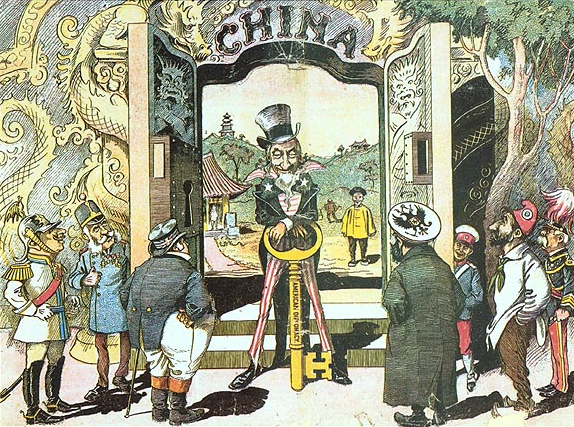
Particularly in China, the legacy of the Opium wars can be drawn directly to modern society, especially the dominance of the Chinese Communist Party (CCP) under Mao Zedong (1893-1976). Following their defeat after the second Opium War, China was subsequently opened to other powers such as France and the United States (US), greatly increasing Western influence; China’s continuing aversion to the West and their policies is undoubtedly due to “China’s formerly degraded position”. The Opium Wars led to the collapse of the Qing dynasty and made China vulnerable to colonisation by both Russia and Japan. Mao’s dominance can be attributed to his ideological commitment of breaking with history, traditions, and symbols. Today, the legacies of the Opium Wars are most apparent in the Chinese distrust of Western powers regarding trade. This is particularly true of the trade relationship between the US and China, which has been worsening during Donald Trump’s second presidential term in the form of increasing tariffs. The importance of memory to Chinese foreign relations is inherently opposed to the tendency of colonial powers to ignore historical exploitation for their own benefit.
“From the 1850s, opium consumption was destroying the fabric of [Chinese] society”, argues Yang-Wen Zheng, professor of Chinese history at the University of Manchester. By introducing opium en masse and manufacturing widespread addiction to bolster profits, the EIC’s involvement in the opium trade can be viewed as a watershed moment in Chinese history. The influence of British colonialism, exemplified by the EIC’s control over India, has reverberated throughout the following centuries, and has particularly manifested within Chinese Communist ideology and foreign policies. This physical British imperialism may have ceased with the handover of Hong Kong from the United Kingdom to China in 1997; beyond this, continued distrust of Western powers into the twenty-first century indicates a continuing psychological impact that will undoubtedly affect relations with China for the foreseeable future.
Bibliography
Biswas, Soutik. 2019. “How Britain’s Opium Trade Impoverished Indians.” BBC News, September 5, 2019, sec. India. https://www.bbc.co.uk/news/world-asia-india-49404024.
Dalrymple, William. 2015. “The East India Company: The Original Corporate Raiders | William Dalrymple.” The Guardian. The Guardian. March 4, 2015. https://www.theguardian.com/world/2015/mar/04/east-india-company-original-corporate-raiders.
Dembowski, Hans. 2024. “How Opium Became a Pillar of the British Empire | D+c – Development + Cooperation.” Dandc.eu. October 29, 2024. https://www.dandc.eu/en/article/britains-east-india-company-ran-highly-profitable-brutally-exploitative-narco-state.
Kapur, Devesh. 2017. “Asia’s Hierarchies of Humiliation.” @Ips_journal. IPS Journal. August 4, 2017. https://www.ips-journal.eu/in-focus/the-politics-of-memory/asias-hierarchies-of-humiliation-2170/.
Ross, Monique, and Annabelle Quince. 2018. “Why China’s Humiliating Defeat in the Opium Wars Still Matters Today.” ABC News, September 1, 2018. https://www.abc.net.au/news/2018-09-02/modern-china-and-the-legacy-of-the-opium-wars/10172386.
Shapiro, Jacob. n.d. “The Third Opium War? – Understanding China through History.” CIRSD. https://www.cirsd.org/en/horizons/horizons-winter-2019-issue-no-13/the-third-opium-war.
Featured Image Credit: American political cartoon depicting China’s “Open Door,” 1900, https://medium.com/@PeterBreton/how-the-opium-wars-and-century-of-humiliation-have-been-reinvented-a02f8ed208e5.

