
Written by Emilio Luppino
The search for an external enemy, the attribution of domestic struggles to foreign forces, and the promise of a single, transformative solution to a nation’s deepest problems have been recurring themes throughout history. Empires and states alike have risen and fallen by embracing these narratives. But what happens when such tactics are employed by a state that is barely a state at all?
In the late-nineteenth century, as European powers were portioning out African land between them, Italy was barely more than a spectator at the negotiating table. A young nation with a fragmented population and a mixture of cultural identities, it lacked the foundations for a vast colonial empire, and, in reality, never built one. Nearly a decade had passed since Rome itself had been annexed into the Kingdom, leaving Italy far behind its European counterparts in both power and prestige. Yet for a section of the Italian ruling class, empire was not just an aspiration but a necessity. Italy, they believed, was entitled to its own weltpolitik, its own place in the sun. After all, how could it stand aside while the great European powers pursued their so-called “civilizing mission”? Abstaining would have meant destined to irrelevance.
With the annexation of Rome in 1870 and the ensuing conflict with the Papacy, the newly unified Italian state lost one of its most effective footholds in Africa: Catholic missionaries. For years, these religious henchmen had served as Italy’s primary channel of influence on the continent. In Ethiopia, Menelik II – a regional king competing for power against Emperor Yohannes IV – had indeed eagerly welcomed foreign support, including weapons, adventurers, and Christian missionaries from France and Italy, to strengthen his position. However, as tensions between the Italian state and the Church escalated, missionaries could no longer be counted on as a reliable medium. Italy would need a new strategy.
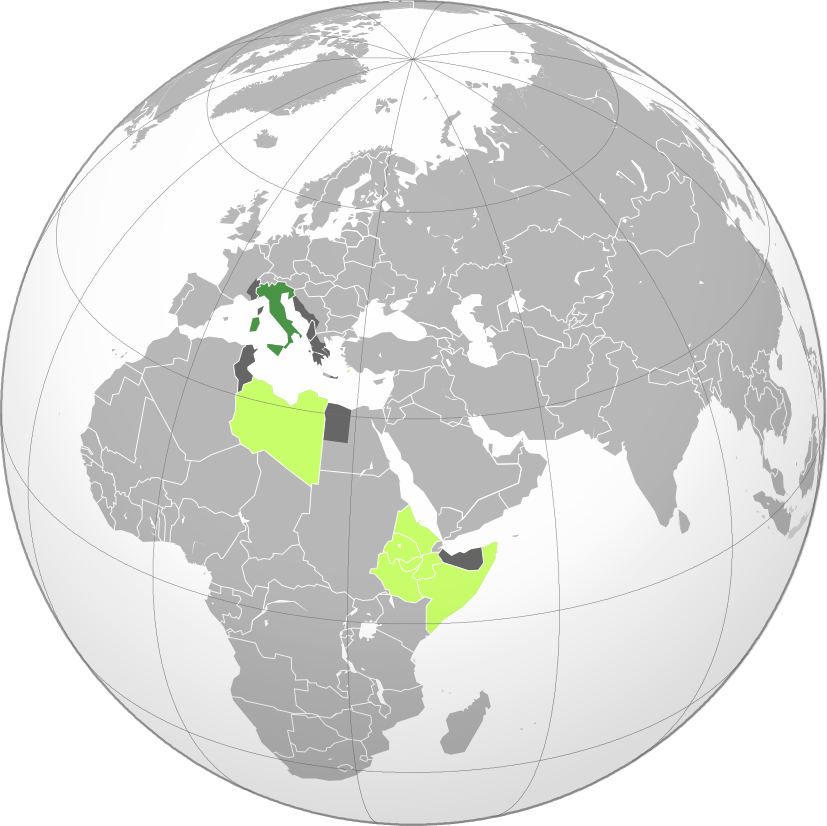
In the following decade, Italy’s colonial ambitions had to accelerate. The first Italian foothold in the Horn of Africa, Assab – originally purchased by the Rubattino Shipping Company in 1869 -, was brought under direct government control in 1882. Just a few years later, in 1885, Italy, with British approval, occupied the strategic port of Massawa. Though formally under Ottoman sovereignty, and despite assurances that its presence was temporary, the Italian army steadily tightened its grip. By 1890 the Ottoman presence was eradicated, and Assab and Massawa had been merged, giving birth to the Italian colony of Eritrea—a small but symbolic step toward Italy’s imperial aspirations.
Yet, Italy was still far from being recognized as a serious player on the world stage. At home, colonial ambitions sparked fierce debate. For some within the elite, an empire was the missing piece in Italy’s national development—a necessity to cement its status among great powers. For others, it was little more than a reckless drain on resources. With unemployment soaring, the economy struggling, and waves of Italians migrating to the Americas in search of a better life, annexing what would later be dismissed as a mere “box of sand” seemed an absurd distraction from Italy’s real problems.
This deep divide was reflected in the way Africa was reported and discussed. Explorers, geographers, and politicians clashed over the feasibility, objectives, and methods of Italy’s colonial venture, producing contradictory reports and erratic policies. Even one of the key justifications for expansion—the idea that colonization would provide land for Italian emigrants—quickly became entangled in political controversy, further undermining Italy’s imperial project before it had truly begun.
But it wasn’t just politicians and intellectuals who decried the disarray of Italy’s colonial ambitions. Officers and soldiers feared uprisings, convinced that rebellion could start at any moment. The very people they unjustifiably tried to subjugate were portrayed not only as barbarians, but as an unpredictable threat, fuelling both violence and agitation. Ill-equipped, unaccustomed to the harsh African climate, and lacking any real military tradition, the Italian national army had barely managed to scrape through the wars of unification, exposing its weaknesses. Now it once again found itself unprepared. Colonial campaigns, initially thought of as a training ground for the army, quickly transformed into something far more brutal: not a military gymnasium, but an arena where the empire’s frailties would be exposed for the world to see.
In 1889, after trying to expand its influence in the Horn of Africa, Italy found itself at the centre of a diplomatic crisis. The cause? A mistranslation of the Treaty of Wuchale. In the Amharic version, Ethiopia’s Emperor was given the option to use Italy as an intermediary in foreign affairs; in the Italian version, it was a requirement, effectively reducing Ethiopia to a protectorate. But while Menelik II rejected this interpretation, Italy unilaterally declared to European powers that Ethiopia was under its control. Five years later, the illusion crumbled, and war erupted.
On 1 March 1896, the Battle of Adwa took place.
Around 16.000 Italian soldiers, expecting to face 25,000 Ethiopian men, found themselves outnumbered by nearly 100,000. A toxic mix of arrogance, racism, and blind confidence in victory led to one of the most clamorous defeats in military history. Meanwhile, Menelik II had turned a crisis into an opportunity—using the devastation of a cattle plague, generated by the Italians’ introduction of panzootic, to unite Ethiopians. The result was a death blow (at least temporary) for Italy’s colonial ambitions, exposing the fatal combination of desperation and ignorance that had driven its imperial project.
That mortification haunted Italy’s ruling class for decades, a scar that marked the nation’s pride. The colonial expansion that should have transformed the Kingdom into an Empire never fully materialized, but the shame of that debacle—which had humiliated Italy in the eyes of other European colonial powers—persisted. And, in 1936, after the cruel and horrifying conquest of Ethiopia, it was this very shame that drove Mussolini to exclaim, “Italy finally has its empire.”
Bibliography
Caglioti, Angelo Matteo. “‘Natural’ Disasters, Ignorance, and the Mirage of Italian Settler Colonialism in Late Nineteenth-Century Africa.” Past & Present 266, no. 1 (August 3, 2024). https://doi.org/10.1093/pastj/gtae004.
Scovazzi, Tullio. “The Italian Approach to Colonialism.” A History of International Law in Italy, April 2, 2020, 334–58. https://doi.org/10.1093/oso/9780198842934.003.0014.
Wilcox, Vanda. “Imperial Thinking and Colonial Combat in the Early Twentieth-Century Italian Army.” The Historical Journal65, no. 5 (October 27, 2021): 1–21. https://doi.org/10.1017/s0018246x21000741.
Featured image credit: “Italian Colonial Empire (orthographic projection)” by TownDown, F l a n k e r is licensed under CC BY-SA 3.0.

