
Written by Olivia Hiskett
Britain hovers near the top of the national tables in terms of alcohol consumption, with almost half of UK adults drinking at least one day a week in 2022. Although now it is perfectly normal to enjoy a drink or two, the moral politics of alcohol have not always been so straightforward. The national panic induced by alcohol can be traced to the eighteenth century, when the relationship between profit and consumption turned sour. However, this did not stop the British from taking their produce elsewhere, as alcohol is woven into the history of imperialism. While deeply engrained in national self-conception and military culture, alcohol is an often-forgotten story in British history.
Alcohol in Britain has long been associated with morality. In 1742, the Gin Craze overtook London, as a cheap and readily accessible spirit. Unlike many chosen liquors of the eighteenth century, it was possible to both grow the raw materials and produce gin domestically. This meant that gin was initially supported by Parliament as a method of reducing imports (especially from contemporary enemy France) and raising funds through the duties applied to its sale. The number of distilleries grew as the market was liberalised, until as many as one point three million gallons of Gin was consumed in 1720. By 1729, almost five million gallons were drunk in England alone. This equated to almost a pint a week for every resident of London.
Gin was a drink culturally tied to Englishness, as it was emblematic of the trade war with France. But soon, the social impact of this free market could not be ignored. By 1750, the consumption of gin represented a form of social decay and civilisational collapse. This was, in part, due to the lack of regulation on gin distilling, meaning that ingredients such as sulphuric acid could be added to the batch with no repercussions. Hogarth’s well-known etching Gin Lane reveals the perceived degeneracy of the Londoners who indulged in intoxication. Hogarth depicts a child falling into a gin cellar as its mother is preoccupied, and another woman sharing a bone with a dog. Women were especially targeted for their consumption of alcohol, with gin dubbed ‘Mother’s ruin’. Anxieties over the detriment to children owing to alcoholic mothers played to concerns over the social body of Britain. The female body in Hogarth’s etching engages in the shameless and selfish act of consumption, rather than the labour expected of her. She is seen as morally monstrous.
As gin brought death and desperation to the slum districts of London, the upper classes soon became afraid that the working classes would drink the nation into ruin. In attempts to control the supply of alcohol, a 1757 Act implemented prohibition, banning the production of any kind of spirit.
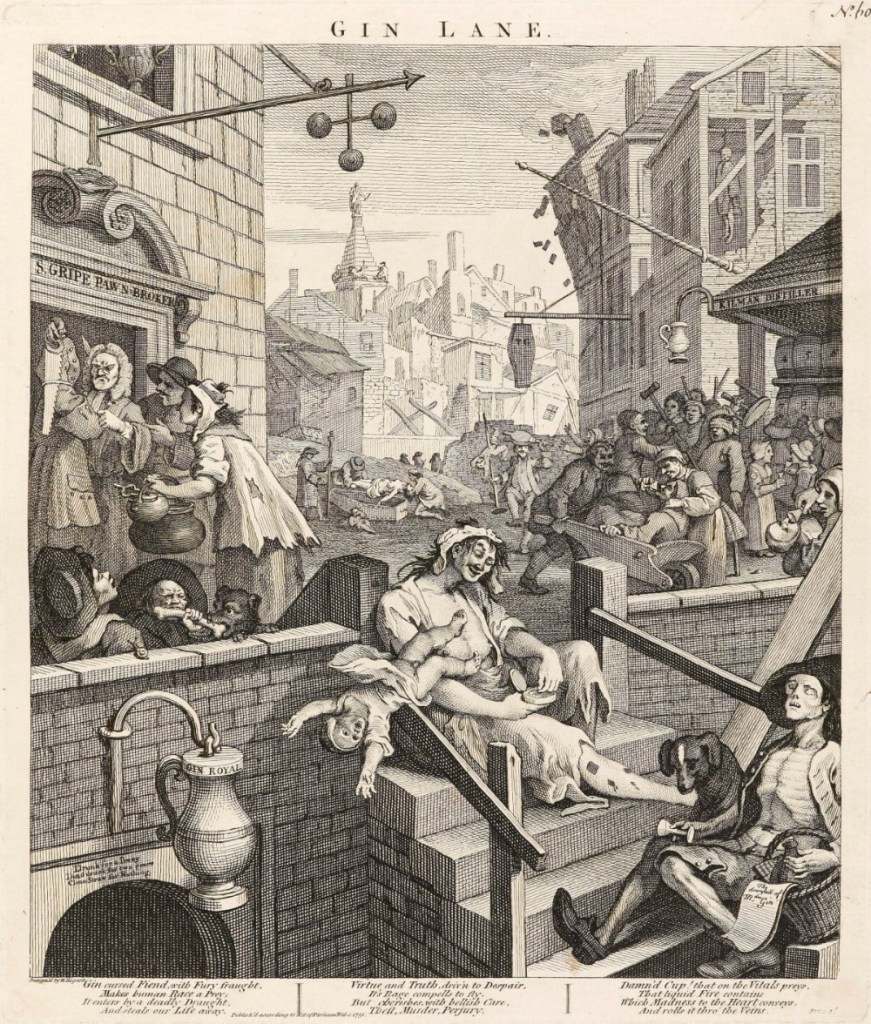
Gin Lane, 1 February 1751, William Hogarth (1697-1764), RA Collections.
However, many campaigned against governmental controls, claiming that gin armed the soldier with the ‘Dutch courage’ needed to defend their nation, and relief after a hard day’s work. Where Gin was domestically morally ruinous, for the armed forces it was a necessity. The relationship between hard alcohol and the military did not end with prohibition in the 1750s. Instead, in the 1760s a British solider could expect a ration of rum of half a pint a day when in the American colonies. Alcohol became indispensable to military, and increasingly colonial, operations. For example, the introduction of alcohol to India through the East India Company provided a huge source of revenue. As Britain forced itself into the territory in the eighteenth and nineteenth centuries, its monopoly over the trade and regulation of alcohol empowered its sovereignty.
However, in colonial India, the elites of the British empire desperately wanted to curtail the levels of drinking among their infantry. They lamented that: “The drinking habits of our countrymen of all classes, are making a very injurious impression on the natives of India”. Their drunken antics were exposing the fallacy of the British ‘civilising mission’. The control of alcohol was seen as essential to the maintenance of colonial power, both in terms of who was drinking it, and who was profiting from its consumption.
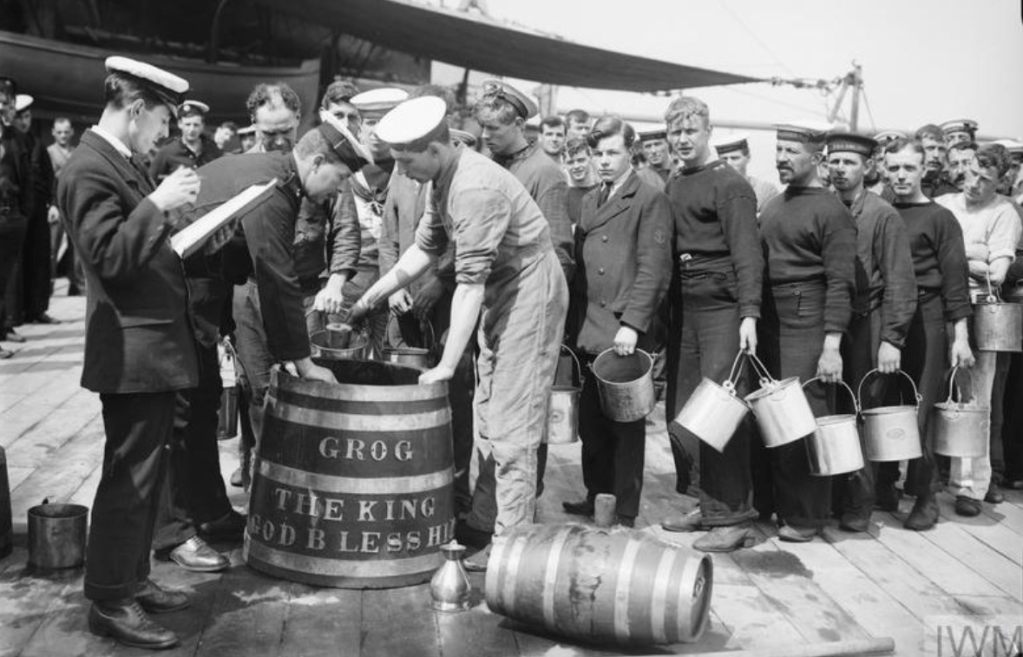
The association of alcohol with the Royal Navy only concluded in 1970, when the final rum ration was dispensed. The end of the ration was marked with a mock funeral, with some sailors tipping their old friend into the waves to meet its watery grave. As the navy modernised, drunkenness and nuclear warheads were not considered a good cocktail. In modern Britain, the hard spirits that once defined a British identity have been replaced with the image of the lager drinking football fan. Moreover, moral panic was seen once again with the arrival of women into the pub; until 1982 a woman could still be refused service. A woman drinking a pint defied the standard conception of femininity and middle-class respectability. In some ways, the image of the eighteenth-century working-class mother ruined by drink prevailed.
However, gin is making a comeback as a trendy spirit. Nigel Farage even has his own label now – versions come in red, white, and blue. The moral politics of this venture is up to history to decide.
Bibliography
Nicholls, James. The politics of alcohol: A history of the drink question in England, Manchester University Press, 2013.
Pedeliento, G., Andreini, D., & Dalli, D. “From Mother’s Ruin to Ginaissance: Emergence, settlement and resettlement of the gin category.” Organization Studies, 41(7), 969-992. 2020
Colls, Tom. “What did they do with the drunken sailor?” BBC Today Programme. 2010 http://news.bbc.co.uk/today/hi/today/newsid_8859000/8859506.stm
Bossart, Celine. “The complete and slightly insane history of Gin in England, Vinepair https://vinepair.com/articles/england-gin-history/
Fischer Tine, Harald. “’The drinking habits of our countrymen’: European Alcohol Consumption and Colonial Power in British India”. The Journal of Imperial and Commonwealth History. 2012
Drink Aware. “Alcohol consumption in the UK” https://www.drinkaware.co.uk/research/alcohol-facts-and-data/alcohol-consumption-uk
Morris, Steven. “Nigel Farage gin sparks Cornish controversy” The Guardian. 2022. https://www.theguardian.com/politics/2022/sep/05/nigel-farage-gin-sparks-cornish-controversy

