
Written by Eva Beere
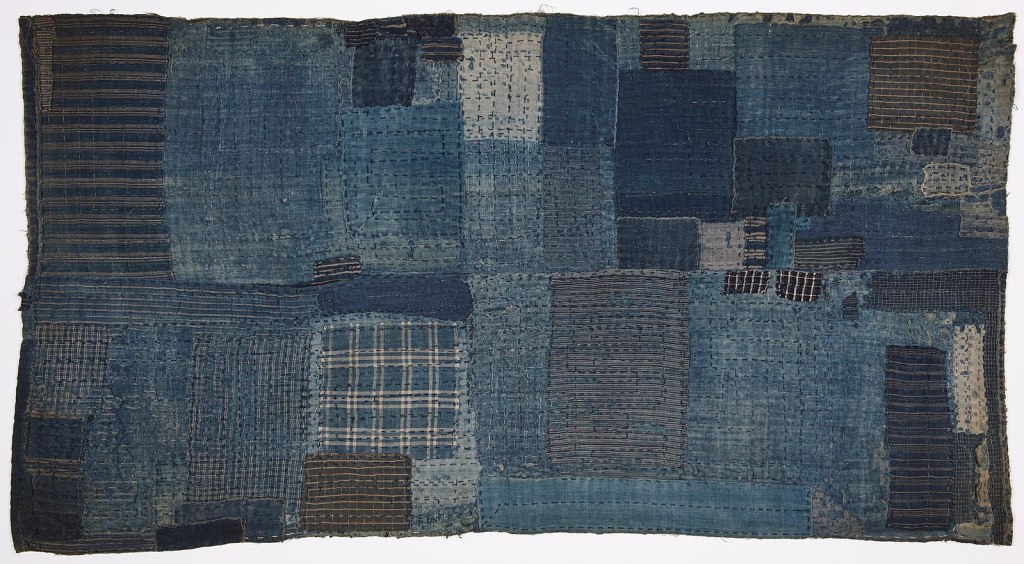
Torn, ripped, repaired and mended. Boro (literally meaning ‘rags’ or ‘tatters’) is a traditional patchwork style which involves repairing textiles by combining layers of old and used fabric together. Emerging in the nineteenth century, boro reveals the struggle of many nineteenth-century Japanese peasants, who through necessity, reworked and mended articles of clothing over several generations, to survive the harsh winters.
The emergence of boro dates to the Edo period (1600-1868), when fashion offered a window into one’s societal and marital status. Married women would often wear robes with short sleeves and minimalist patterns, whilst unmarried women, who were attempting to attract a suitor, would wear robes with vibrant colours, bold patterns and long sleeves. Furthermore, the material and colour of garments were crucial indicators of financial status and social ranking; the imperial family and upper classes wore expensive silk and cotton fabrics, often coloured with an expensive red dye, whilst the lower classes were prevented from wearing such garments and instead wove their own clothing. Before the introduction of cotton from China, this clothing was often made from common hemp, a locally grown fibre which was the only material available for general use in Japan. Thus, when Japan adopted Chinese cotton cultivation techniques, cotton became an important commodity in the rural North, where the climate was too cold to grow cotton plants. Due to cotton’s desired status in Northern regions, a cotton trade was established throughout Japan, where used cotton in the West would be sold to poorer rural villages in the North. As economic hardship increased, fewer families could afford to buy cheap fabrics, meaning the garments they made would have to be durable, lasting through long workdays and unpredictable climates. Families would have to endlessly re-use and recycle work clothing, whereby the women in the family patched worn clothes with small bits of fabric using sashiko stitching. Wives would unstitch old futon covers and other garments, dye them to refresh their appearance and sew them into the word clothes. These garments would then be passed down through generations, over time accumulating more patches.
From boro emerged several other methods of Japanese stitching. The Zanshi technique, meaning ‘leftovers,’ is when remnant threads from spare woven fabrics are tied together and rewoven into a longer thread, and then used to make new textiles. The Sakiori technique also emerged from boro, coming from the Japanese words saku (to tear) and oru (to weave.) Similar to rag rug weaving, sakiori involved ripping apart textiles, shredding them into string and weaving them with hemp threads to produce new fabric. In fact, sakiori was often used to revive boro garments that could no longer be repaired.
A striking feature of boro garments is their indigo colouring. In rural Japan, people preferred to dye their textiles with indigo blue dye, particularly because this was cheaper, and indigo plants grew in abundance in these areas. Besides indigo’s economic benefits, Japanese farmers believed the dye contained healing properties, which were effective for curing skin problems, and antibacterial properties to remove unpleasant odours. Over time, the indigo colour would fade, and along with the newly stitched fabrics, would create a beautiful patchwork of lighter and darker shades.
Although boro, zanshi and sakiori were born out of a need to survive, they reflect a deeper Japanese philosophy concerning waste. Boro reflects the Japanese principle of ‘mottainai,’ which is similar to the English phrase ‘Waste not, want not.’ ‘Mottainai’ embraces reducing waste and repurposing objects, suggesting that an object is not merely suited for one purpose. However, boro garments are often seen by Japanese people as a reminder of the economic struggles they faced. After the Japanese attempted to recover from the defeat in World War II, boro clothing became a source of shame for the Japanese, who connoted these textiles with poverty and struggle. As Japanese society shifted towards mass modernization and urbanization in the twentieth century, boro textiles were largely forgotten.
As Western society continues to embrace the art of thrifting or buying second-hand clothes, boro has become a symbol of high fashion. The influence of boro can be seen in several designer brands, such as Kapital, Koromo, Dior, and Loewe. The Japanese patchwork phenomenon has also been the centre of many global art exhibitions. In 2008, the Amuse Museum, which specialises in boro prints, opened in Tokyo, containing a collection of over 30,000 pieces of Japanese folk art. Japan Society’s “Boro Textiles: Sustainable Aesthetics,” showcased Chuzaburo Tanaka’s collection of boro garments, dating back to the early nineteenth century. His collection included a wide range of garments, from donja to tanzen, offering an insight into the untold stories of many Japanese peasants in rural nineteenth-century Japan. Furthermore, Stephen Szczephanek, who runs the New York-based textile gallery Sri, organised the travelling exhibition Boro: The Fabric of Life, which toured Portugal, Germany and France between 2013 and 2015.
The Amuse exhibition in Tokyo contained a quote that read: “There is life dwelling in it; the endless will and wishes of humans are delicately woven into each fiber.” In a modern society which is bridged between excessive fast fashion consumption and a newfound love for second-hand clothing, there is an opportunity to adopt the Japanese ‘mottaini’ philosophy and allow each object to gracefully reach the end of its life.
Bibliography:
Baker-Brown, Duncan. “Traditional Boro Clothing, Japan.” The Re-Use Atlas. 1st ed. RIBA Publishing, 2017. 66–67.
Reed, David. “All About Boro: The Story of Japanese Patchwork.” Heddels. August 17, 2015. https://www.heddels.com/2015/08/all-about-boro-story-japanese-patchwork/.
“Threadbare, Torn and Tattered: Boro Textiles from Japan.” Selvedge. Accessed February 10, 2025. https://www.selvedge.org/blogs/selvedge/threadbare-torn-and-tattered-boro-textiles-from-japan.
“Sakiori: Another Form of Boro.” Kuon. Accessed February 11, 2025. https://kuon.tokyo/blogs/blog/sakiori-another-form-of-boro?srsltid=AfmBOopBEbQuaRQF7DZWyGxLRnClLU8JUqG5YZKq5L3H-mzseXjwcPf9.
Victoria and Albert Museum. “Make Your Own Japanese Boro Bag.” Victoria and Albert Museum. Accessed February 11, 2025. https://www.vam.ac.uk/articles/make-your-own-japanese-boro-bag?srsltid=AfmBOor2YNoW0pSAEFuQPkJYPfnJ8PN_5bWtbIDwkQKg8mF4ffydQrxH.
Featured Image Credit: Child’s Sleeping Mat (boro Shikimono), late 19th century via Wiki Commons.


,_late_19th_century_(CH_1108827543).jpg)