
Written by Olivia Norbury
Sara Baartman, a Khoisan woman from Cape Colony, was displayed in England and France in the early-nineteenth century as a curiosity: she was one of the most famous human ethnological exhibits. Advertised as the ‘Hottentot Venus’, Baartman was taken from her homeland in 1810 and brought over to Europe as an imperial commodity to be displayed. The fascination she inspired was part of a broader contemporary trend in which imperial collections appropriated and exhibited people, flora, and fauna as evidence of colonial expansion and the supposed success of the imperial civilising mission.
In 1810, Baartman was brought to Europe by Alexander Dunlop, a ship’s surgeon and an exporter of museum specimens from the Cape. Historian Sadiah Qureshi describes her as a ‘rare live specimen of the exotic’, commodified by men like Dunlop and Hendrick Cezar, who purchased her upon her arrival. Their economic and commercial ambitions depended on profiting from so-called exotic investments, reducing Baartman to little more than a commodity, and a means of financial gain.
Ethnological shows in London were among museums, theatres, circuses, and gardens, constituting another of the many entertainment options available at the time. These exhibits were particularly disturbing as they blurred the line between humans and animals, displaying people as if they were animals held in captivity at a zoo. Baartman was subjected to relentless scrutiny, prodded and poked by onlookers who gawked at her as a spectacle of difference. In the nineteenth century, such exhibitions were both accessible and highly profitable, offering the average person a glimpse of the empire’s reach while reinforcing colonial ideologies and maintaining a distance from the perceived Other.
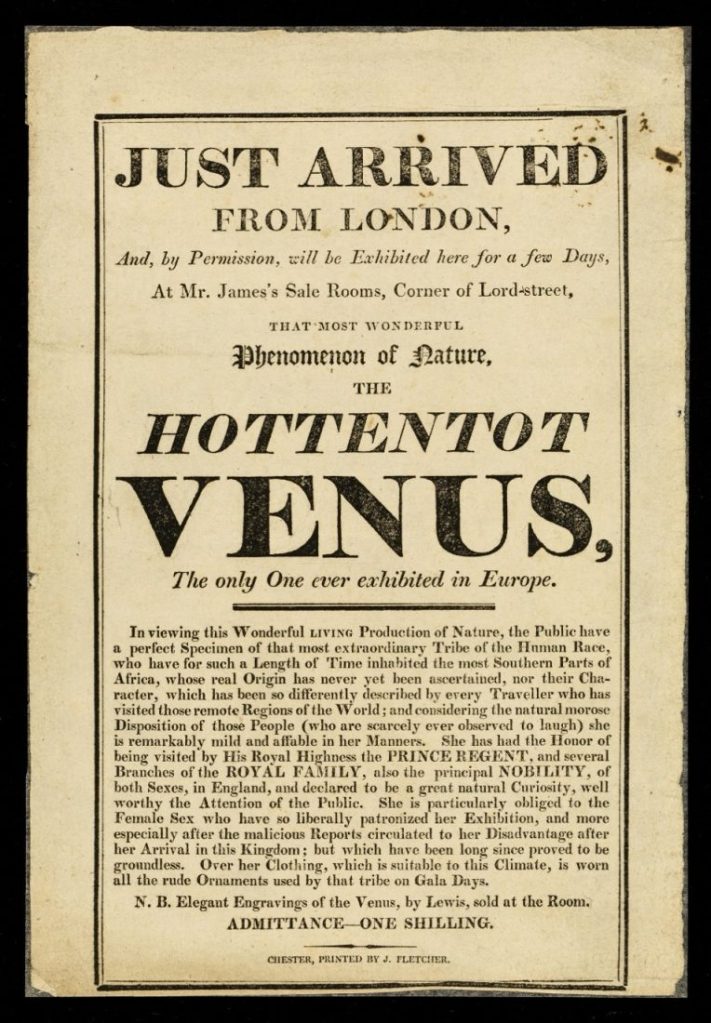
Figure 1. Poster advertising the exhibition of the ‘Hottentot Venus’, Sara Baartman.
The poster advertising Baartman’s exhibition exposes the ideology used to justify her exploitation and dehumanisation (fig. 1). It claims her display is ‘by permission’, prompting us to challenge whose permission is being granted, constituting an unconvincing attempt to suggest her consent. Her exhibition is further legitimised by the presence of the royal family, and her use in scientific research, reinforcing the illusion of respectability. In reality, the display is an act of the exoticising and commercialising of a human body, marked as the Other to affirm European superiority. The final sentence attempts to reassure the audience of Baartman’s welfare by noting that she has been provided with clothing ‘suitable to this Climate’. However, this gesture is immediately undermined by the deliberate adornment of traditional ‘Ornaments’, staging her as an exotic spectacle for public consumption.
There was some opposition to Baartman’s exhibition, particularly from abolitionists who condemned her display on humanitarian grounds. However, Cezar defended it by arguing that, since the British had acquired her, she belonged to them. This altercation led to a court case that ultimately ruled in Cezar’s favour, based on a contract she had allegedly signed. However, it is widely believed that this contract was fabricated in response to the case, as Baartman was likely coerced and may never have signed any documents consenting to her display. Her politicisation makes Baartman unusual, as she attracted little attention upon her arrival, but within a few months, she became a highly contested figure.
Baartman died in December 1815, but her body was retained by Georges Cuvier, who claimed that she was a unique specimen of humanity and, therefore, of great scientific interest. He conducted a report on her remains, using them to assert the supposed inferiority of her physical form through the lens of physiognomy and racial science. Cuvier classified Baartman as a ‘Boschimanne’ rather than a ‘Hottentote’, suggesting she was close to an ape, representing a further attempt to dehumanise her. By preserving her as a racial type, Cuvier erased her individuality whilst implicitly legitimating his political and anatomical theories. His continuation of the exploitation of Baartman after her death was a profound violation, particularly as she had resisted many invasive examinations while alive. His meticulous descriptions and documentation of her body were not just a scientific endeavour, but also a personal triumph, reinforcing his authority in the field. His so-called findings were repeatedly cited throughout the nineteenth century to compare European and Khoisan anatomy, furthering the pseudoscientific justification of European superiority. The treatment of Baartman after her death was therefore a continuation of the imperialist and colonialist project that commodified, humiliated, and dehumanised her even in her death.
The preservation of Baartman’s body perpetuated her exploitation. Cuvier created body casts and wax moulds of her form, and her skeleton remained on display at the Natural History Museum until the 1970s. Her body was exhibited uncovered, as though she were naked, emphasising her sexuality as the primary focus of interest and further reducing her to an object of spectacle rather than a human being. Baartman was exhibited alongside photographs believed to depict a Khoikhoi man and woman, reinforcing her role as a symbolic and universal representation of a perceived foreign anatomical type. This presentation erased any acknowledgement of the violation and humiliation she endured in her life. Her display highlights the dangers posed by museums, which often strip objects of their historical and ethical context.
In 1994, Baartman was exhibited once again, this time alongside nude lithographs of her that exaggerated the proportions of nude Black women, further perpetuating racialised objectification. The privileged status of museums as supposedly neutral spaces enables them to subtly encode racist ideologies under the guise of scientific objectivity, contributing to the ongoing degradation of Baartman’s legacy.
To restore her dignity, Baartman must be remembered within her historical context, rather than reduced to a symbol of subjugation or a reframed curiosity disguised as a cultural icon. Her life should be properly historicised, recognising that her story was not an isolated tragedy but part of a broader system of colonial exploitation.
Bibliography
Crais, Clifton and Scully, Pamela. Sara Baartman and the Hottentot Venus: A Ghost Story and a Biography. Princeton: Princeton University Press, 2008.
Mitchell, Robin. Vénus Noire: Black Women and Colonial Fantasies in Nineteenth-Century France. Georgia: The University of Georgia Press, 2020.
Qureshi, Sadiah. ‘Displaying Sara Baartman, the ‘Hottentot Venus’.’ History of Science 42, no.2 (2004): 233-257.
Image Credit: Hottentot Venus Wellcome Loo48076. https://commons.wikimedia.org/wiki/File:Hottentot_Venus_Wellcome_L0048076.jpg


