

Written by Sam Mackenzie
Your ears are filled with the crack of rifle fire and pistol shot. The smell of smoke from the hundreds of discharged rounds burns its way up your nostrils as you ride your horse up your line.
Your boys have been at it hard for three hours. Meade told you to hold the flank, and you promised yourself no man but god himself would move you off your position.
Old Jeb Stuart’s men had been holding at the treeline for long enough, a distance safe enough for your men to keep lossess low. You have already received reports of Pickett’s advance toward the centre, this is Lee’s big finish. Smash through our centre while the strongest flank collapses on itself and leaves the rear of the army open to cavalry attack. It is clever, you have to give the rebels that.
The thunder of hooves pulls your thoughts away from the larger battlefield. A piercing shriek goes up into the air, one of their deplorable ‘Rebel yells’.
Stuart has made his move.
Thousands of horsemen come charging up toward your position. They look to be not far off twice your own number. You know this will require grit and a damn sight of luck. But oh the glory…
You grin, and twirl your horse.
The bugle sounds out at your signal, and your men form their horses up into lines of attack. Their banners snap and dance in the wind, next to the stars and stripes of the union.
You ride up the length of your line, drawing your sabre from its scabbard as you reach the centre. You twirl your hat and sabre around in the air while riding back and forth. Your men cheer you, and fill you with determination, courage and certainty.
You turn, point your sabre, and spurr your steed forward with a glad cry to your men; “COME ON YOU WOLVERINES!”
You are Brigadier General George Armstrong Custer, and you lead the Michigan Cavalry Brigade, The Wolverines, forward at the Battle of Gettysburg.
Custer, the American Leonidas? A butcher? Both?
General George Armstrong Custer is inarguably one of the most romantisiced figures in American History.
It is, however, unavoidable that the most iconic part of Custer’s mystique and legend, is derived from the manner and circumstances in which he died.
We are given this romantic image, of the long haired Custer, standing with his men on the hill, swarms of the savage redskins circling them and butchering any man they can get their hands on. We imagine Custer going down fighting, taking a score of Indians with him before succumbing to his many wounds, and falling among his loyal soldiers.
This is the view of Custer’s death often portrayed in media, in many history books, and in essentially every piece of artwork ever made depicting the Battle of the Little Big Horn. The noble American Cavarlyman, the knight of the American West, the shining symbol of what the old world gave America, and what the new world can offer her.
Custer’s ‘last stand’ is held in mythically high regard. Counted among the last stands at Rorke’s drift and Thermopelae, so much so that some have coined Custer as ‘The American Leonidas’.
It is undeniable that Custer has a certain appeal. He presents much of what we would imagine, or more accurately hope, a man of the American frontier would be like! A dashing cavalry officer, who buts heads with his superiors telling him to follow the rules, preferring to fight his way through the savage frontier, pistol in hand and loyal men at his back.
His character as an individual also brings with it much intrigue, from his failed business ventures, short lived forays into politics and his marital happenings, Custer is the kind of eccentric character that seems right at home in the centre of a daring Wild West story, and out of place almost anywhere else.
Part of Custer’s appeal is of course tied to the widespread misunderstanding of Native American tribes and customs. Popular imagination would have you believe that these people were savages, and Custer had no choice but to ride in as the protector of the American settler, bringing down the might of the burgeoning United States onto the savage red menace.
This image of custer as the Cavalier Crusader, galavanting across the untamed American frontier was, and to a certain extent still is, no doubt boulstered in the minds of the modern populous by the popularity of Cowboys and Indians movies. These films of course do little to help the image of Native Americans, while making rooting tooting, all American boys like John Wayne look like Custer’s ghost come to live again.
But the age of cowboys and roaming Indians, is at an end. With Custer’s death, the image of the cavalier cavalryman was torn down, the knight of the American West butchered and the idea of the Indian tribes being feeble savages swept away. In the years since the death of the ‘Noble Hero’ that Custer was his image has undergone vast changes. In some ways he is still seen as a glorius hero, though in others, particulary among Native communities, the view that he was a vicious murderer has made its way to the fore in increasing frequency.
I will tell you the story of the Battle of the Washita, and I will let you decide for yourself, dear reader, what kind of man you want Custer to be.
In the year of 1868, it was decided that there was to be a bold push against the Southern Cheyenne and Arapaho tribes of Natives. The previous year, and generally since the end of the Civil War in 1865, the army had been ineffective in battling the ‘Indian problem’ in the Southern states and territories (Modern day Arkansas, Kansas, Oaklahoma and Texas).
As result of a recent series of raids, more than seventy civilians were dead, fifteen women had been raped and more than one thousand heads of livestock had been taken. The army in the region had had enough of the soft approach to the Indian problem.
The ‘Peace Commissioner’ in charge was General William. T. Sherman, who, despite having a native warrior as his middle name (Tecumsah), was not a fan of the native tribes, and he, along with General Sheridan, decided that the time for peace was over with the Cheyenne and Arapahos.
Sherman said to his friend, Colonel Hazen that he “Proposed to give them enough of war to satisfy them to their heart’s content.” His chosen method of delivering this war, was Sheridan, and Sheridan’s top man was Custer.
Along the Washita River, more than six thousand Natives from the Cheyenne and Arapahos, as well as some Kiowa and Commanche villiages were camped for winter. Most of the Cheyenne and Arapahos were clumped together for safety, but one villiage was solitary and isolated further upstream. Black Kettle’s villiage.
Black Kettle was a ‘Peace Chief’ who advocated for living alongside the White man. He had travelled to Washington DC to meet the ‘Great Father’ – President Abraham Lincoln, where he received a medal and an American Flag, both of which he wore and waved proudly.
Black Kettle’s band had been attacked by the army previously, at Sand Creek, where a huge portion of his followers were massacred and he lost much of his influence over the Southern Cheyenne. On the night of the battle, his band is two hundred and fifty strong. Custer’s forces number more than eight hundred.
Being led by some scouts of a rival native tribe (Osage) and driven by his own enthusiasm for the sport of hunting Indians, the Seventh Cavarly arived near Black Kettle’s villiage on the 26th of November 1869. Custer divided his forces into four groups, and prepared to attack.
At daybreak, Custer ordered the regimental band to play ‘Garyowen’ the marching tune of the Seventh Cavalry, and it was to this tune that Black Kettle’s band were awoken.
Custer’s men fell on the villiage in a surge, with only a few seconds of warning from one of Black Kettle’s outlying scouts, the band was unprepared. Women and children rushed half dressed from their Tipis to find cover as the warriors in the villiage fumbled for their rifles to make some attempt at a stand.
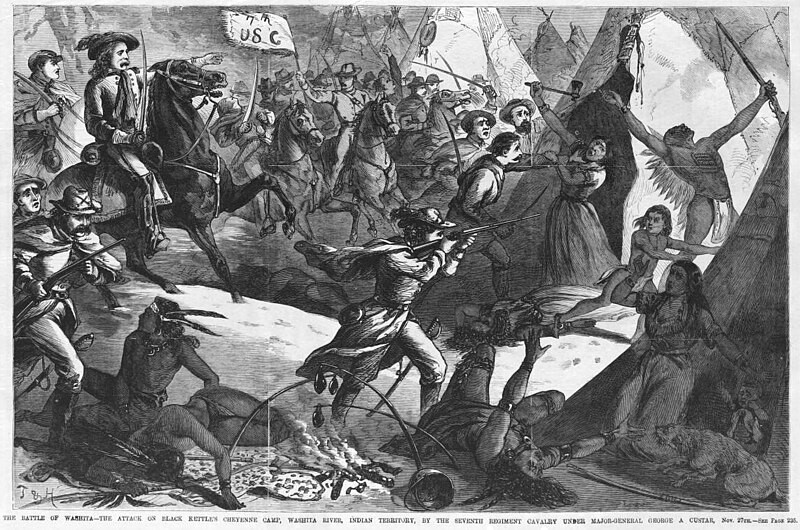
During the fighting, Black Kettle was shot in the back as he attempted to flee with his wife, Medicine Woman. Within minutes, Custer controlled the villiage and was simply mopping up those warriors who had managed to run through the snow to the treeline.
As the morning drew on, warriors from the other bands began to arrive in greater numbers, and Custer quickly realised he could not stand against the force of Indians that seemed to be gathering against him.
He rounded up fifty three women and children, and used them as human shields. Custer knew that the Cheyenne and Arapaho warriors from the other villiage would not risk directly attacking him while he had their non-combatants at his mercy.
Custer slaughtered about six hundred and seventy five of the Villiage’s horses, sparing two hundred to carry prisoners. He proceeded to fake an attack on the other villiages to force them to agree to go to a supply post as a start to their move to the reservation. With all that done, he ordered ‘Garyowen’ played again, and marched home.
With the Battle of the Washita river, Sheridan’s winter campaign was declared over, and a great success. Custer gained yet more noteriety in the press, and this contributed to him gaining command of the later Black Hills expedition against the Lakota Sioux.
There has been widespread debate over whether or not the Battle of the Washita should be called a battle, or a massacre. Once again dear reader, I leave that for you to decide.
The Seventh Cavalry suffered twenty one casualties killed at Washita, with only one being killed in the initial charge, the remainder were a small group under the command of Major Joel Elliot, who broke away on his own with twenty men without Custer’s approval and ran headlong into arriving Native reinforcements.
The amount of Natives killed at the Washita is a matter of some contention as we quite literally don’t know. Custer provides us a battlefield estimate of one hundred and three Indian men killed, with ‘Some’ women and ‘Few’ children being among the dead. Though this number was later changed by custer to have one hundred and forty dead men, so we can likely discard these figures.
The highest Native estimate comes from Red Moon, who estimated that thirty eight were killed at the Washita, with the majority being women and children.
Historian Jerome Greene, by gathering names of those confirmed to be in Black Kettle’s village or the surrounding Cheyenne and Arapaho villiages puts an estimate of forty men, twelve women and six children.
Whatever the case, the Washita did serve to wipe out Black Kettle’s band as a unified roaming force, and helped to break the fighting spirit of the Southern Cheyenne and Arapahos.
On the morning of the Washita, Custer was asked by Captain Thompson, “Suppose we find more Indians than we can handle?” to which Custer replied “All I am afraid of is that we won’t find half enough. There are not Indians enough in the Country to whip the Seventh Cavalry.” Custer would die at the Battle of the Litle Bighorn eight years later, along with more than two hundred and sixty men of the Seventh Cavalry.
They were defeated by Indians of the Lakota Sioux Tribe.
Bibliography
Ambrose, Stephen E. Crazy Horse and Custer : The Parallel Lives of Two American Warriors. Garden City, N.Y: Doubleday, 1975.
Brown, Dee. Bury My Heart at Wounded Knee : An Indian History of the American West. London: Barrie and Jenkins, 1971.
Cozzens, Peter. 2018. EARTH IS WEEPING : The Epic Story of the Indian Wars for the American West .
George Armstrong Custer. 1874. My Life on the Plains Or, Personal Experiences with Indians.
Greene, Jerome A. 2014. Washita. University of Oklahoma Press.
Keegan, J. (2010). The American Civil War : a military history. New York: Vintage.
Featured image credit:
Portrait of Custer – https://www.biography.com/military-figures/george-custer
Battle of the Washita- https://freepages.rootsweb.com/~wynkoop/genealogy/webdocs/12261868a.htm

