
Written by Annika Rasmussen
US President Woodrow Wilson’s Fourteen Points are often interpreted as support for independence movements, sovereignty, autonomy, and colonial reform. But this is largely a misinterpretation which falsely characterizes the president as an advocate for liberation, with instead the reality being far more complicated. This association between Wilson and autonomy stems from a 1918 speech in which he outlined his Fourteen Points program for peace in the aftermath of the First World War: a program which touted self-determination for marginalized ethnicities living under diverse empires. Wilson purportedly further advocated for self-determination in 1919 as calls for independence/autonomy arose in Ireland, India, and Shandong (occupied by Japan). But this view of the president seems to be primarily mythical.
The term self-determination never appeared in Wilson’s official Fourteen Points and despite the proposed program for peace, many argue this call for self-determination lacked a comprehensive program. This caused Victor Mamatey to characterize self-determination as a creed, not policy. Furthermore, Trygve Throntveit claims Wilson did not promote “national right to self-determination” as is commonly understood but instead the “civil right of self-government” of which all people included in a given nation/empire may participate equally within the establishment. Allen Lynch further stipulates that Wilson did not advocate for the dissolution of the Austro-Hungarian Empire after the First World War, exemplifying how the president seemingly did not look to majorly disrupt European geopolitics but merely supported greater representation. However, Wilson did support the creation of an independent state of Poland, therefore he supposedly did encourage self-determination in certain spheres. But how far did the inconsistencies of Wilson’s support for autonomy go?
Throughout Europe, self-determination was implemented with varying degrees of legitimacy. Many points to the creation of Poland as proof that Wilson looked favorably on creating autonomous states based on ethnicity and shared culture, although some historians have countered that American interest in the Polish Question was more closely tied to humanitarian goals. Poland had garnered international sympathy during the war after suffering through a scorched earth campaign during the Russian retreat, and the British blockade during the German and Austrian occupation – further highlighting the paradoxical role of ethnicity in the allocation of territory is the case of Italy. Italy looked to gain significant territory after the war, having not only been on the winning side but also due to promises of land acquisition in the Treaty of London which had allied them with Britain and France in 1915. These land claims were later rejected based, in part, on the ethnic Croat community living in Dalmatia (which would be incorporated into the newly created Yugoslavia). However, Italy gained the Brenner Pass in the north despite that region largely consisting of German-speaking Austrians. This showcases major inconsistencies in how ethnic groups were incorporated, seemingly subjectively, into different nations. Similarly, several German Bohemians were incorporated into the newly created Czechoslovakia. Wilson later admitted these decisions were mistakes caused by his lack of demographic knowledge of the regions, such as his ignorance of the existence of Sudeten Germans (now in Czechoslovakia) and his underestimation of Italian nationalist ambitions. Moreover, Wilson failed to comprehend how the diverse and significantly integrated Austro-Hungarian Empire could not be neatly divided into stark lines of ethnicity/nationality, causing the formation of several unstable countries in Eastern Europe. Notably, Wilson also underestimated how the dissolution of the Austro-Hungarian empire would create a power vacuum which would later encourage German nationalistic ambitions. This was further perpetuated by the limitation of German sovereignty in the Rhineland and Saar regions due to French influence, despite there being a minimal French population in these regions, further undermining the legitimacy of self-determination.
Asia and Africa were almost entirely ignored by the self-determination movement sweeping through Europe. Territorial claims by Armenians, Azerbaijanis, Koreans, Ukrainians, Ruthenians, White Russians, Georgians, Kurds, and Montenegrins were largely overlooked despite all having justifiable self-determination claims to their territory. This indicated how the allocation of territory in Eastern Europe was less centered on identity and instead related to political motivations. France and Britain both moved on the Middle East to establish mandates, despite the Arab populations having an ethnic claim to the land as reflected in national self-determination ideology. This theme of European empires ignoring self-determination in order to expand their spheres of influence and territorial gain was common throughout the Eastern Hemisphere. Interestingly, across India and China many press agencies promoted Wilson and his alleged promise of self-determination as the mode by which they would gain independence from European colonizers. Obviously, this was not the case. In fact, throughout this period the US consolidated control over the Philippines, granting it limited autonomy. This not only exemplifies the paradoxical and inconsistent nature by which self-determination was implemented but also speaks to Wilson’s background as a Southern Confederate sympathizer and bigot. Overall, this trend of denying self-determination to colonies was perpetuated by the fact that most post-war conferences were exclusionary and allowed major European powers to maintain their hold on other continents. Thus, little changed for those living under imperial rule.
Despite Wilson’s seeming (although contested) willingness to break up Empires on the losing side of the war (i.e. Austria-Hungary and Germany), any threat to victorious Empires (such as Indian calls for independence from the British Empire) were ignored and quelled to maintain the Allies’ global standing and strength. Wilson did push rhetoric supporting the disruption of European colonies, although he did not support immediate decolonization. Whether this is due to his own personal beliefs in freedom but lack of power for change, or an attempt to overtly appease his constituents while maintaining the support of the major powers in Europe, is unclear. But his apparent favor of ethnic Poles, Yugoslavs, and Czechs over Germans, Austrians, and Irish is revealing. The myriad of issues concerning self-determination further stem from Wilson’s Anglo-American interpretation of East-Central European politics as well as his unwillingness to commit unequivocally to this ideology.
Although one can argue this ideology of self-determination for nation-building was thrust upon him and not reflective of his initial aspirations for global political representation. Nevertheless, popular understanding of Wilson’s stance has been interpreted as national self-determination based on a shared language, ancestry, and culture. Today, Wilson’s view of self-determination has been characterized as ‘idealistic’ and not ‘realistic.’ But whether this label arose with hindsight as conflict emerged and nations crumpled or is consistent with contemporary views as people were seemingly betrayed by powerful regimes, remains unclear.
Bibliography
Biskupski, M.B. “War and the Diplomacy of Polish Independence, 1914-18.” The Polish
Review 35, no. 1 (1990): 5-17. https://www.jstor.org/stable/25778473
Lynch, Allen. “Woodrow Wilson and the Principle of ‘National Self-Determination:’ a
Reconsideration.” Review of International Studies 28, (2002): 419–436
Manela, Erez. “Imagining Woodrow Wilson in Asia: Dreams of East-West Harmony and the
Revolt Against Empire in 1919.” American Historical Review (2006): 1327-1351
National Archives. “President Woodrow Wilson’s 14 Points (1918).” Accessed February 5,
2025. https://www.archives.gov/milestone-documents/president-woodrow-wilsons-14-points
Pomerance, Michla. “The United States and Self-Determination: Perspectives on the
Wilsonian Conception.” American Journal of International Law 70, no. 1 (1976): 1-27
Throntveit, Trygve. “The Fable of the Fourteen Points: Woodrow Wilson and National Self-
Determination.” Diplomatic History 35, no. 3 (2011): 445-481: https://www.jstor.org/stable/24916429
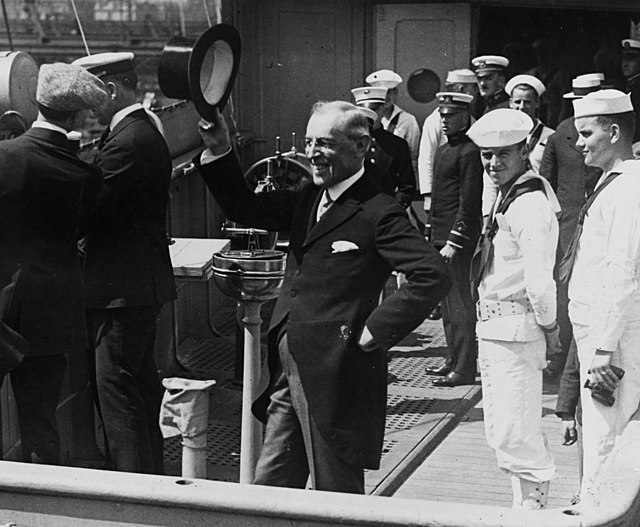
Featured Image Credit: President Woodrow Wilson – NH 18.jpeg via Wiki Commons.


