
Written By Olivia Hiskett
09/02/2025
The feminist slogan “take the toys from the boys” originated as a protest against nuclear weapons in the 1980s. Activists compared state leaders’ treatment of world destroying technology to the fantasies of children with their playthings, suggesting their lack of appreciation for the potentially devastating consequences. The relationship between militarisation and masculine identities is long and complex, as the two concepts are deeply culturally intertwined. By inquiring into the history of the toy soldier, this article will explore the wider debates around masculine identities in the nineteenth and twentieth centuries and the complicated history of nationalism. Where does the childhood fascination with tin guns and plastic canons come from? And who is posited as the enemy?
Although there is evidence of miniature military figures existing in ancient Egypt, the mass production of toy soldiers coincided with the formalisation of the nation state. This is no coincidence. Reserved for the wealthier classes, small metal figurines had been accused of fostering a dangerous romanticism of combat from as early as the late nineteenth century, by associating the act of war with play rather than harm. Boys who would later go on to form the elite military classes of officers had been introduced from childhood to the game of war. Revealingly, toy soldiers became especially popular in Germany after the ascendency of Bismarck, the renowned military leader who unified the state. Therefore, the significance of these figures extends far beyond the toybox, as toys contribute to the larger apparatus of gendered and class education which model appropriate behaviour. They shape fantasies and reflect societal mores, and in late nineteenth-century Germany the emerging ideal was that of the citizen solider.
In 1893, the cost of producing the toy solider dramatically sunk with the invention of hollow casting, only to be made even cheaper again in the 1950s with the widespread commercial use of plastic. In 1914, an estimated eleven million figures were made in Britain, giving greater access to the growing middle classes and even the lower classes, as well as increasingly adult collectors. The figurine was able to exceed its role as a toy and contribute to the idealised masculinities of imperial Britain. The toy soldier was well dressed and stoic, its hollow metal form unturning from the battles it faced, and represented the thick-skinned military hero that defined Victorian and Edwardian masculinity. Their uniforms were often in reference to significant British victories, such as the 21st Lancers who were marketed as ‘the Heroes of Omdurman’, referencing the British conquest of Sudan. The toy soldier normalised from childhood the Imperial regime’s masculine ideals and national pride, with Winston Churchill admitting in his memoirs that “toy soldiers turned the current of my life. Henceforward all my education was directed to passing Sandhurst.” The introduction of military strategy to young boys was central to their self-perceptions and values. However, did they ever outgrow their tin soldiers? Or did a culture of flippancy grow in military circles, as the activists of the 1980s claim, out of the normalisation of conflict and violence from childhood?
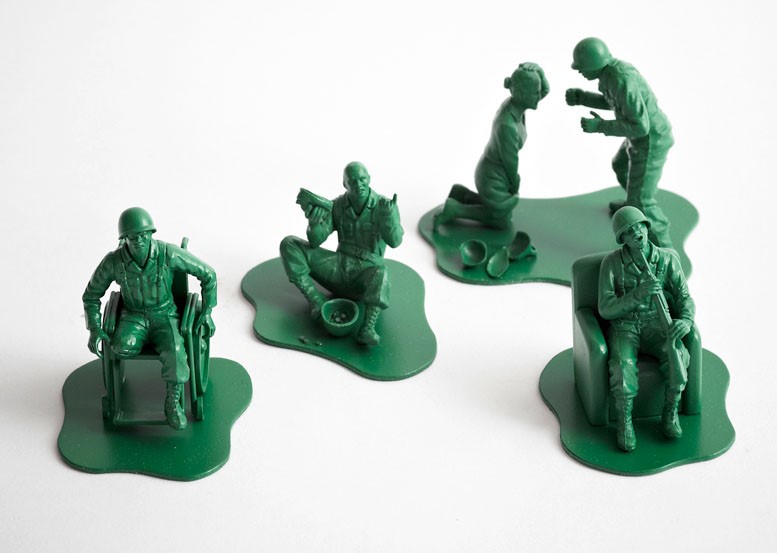
From the 1960s, the style of toy soldiers evolved to match the designs of modern warfare, as well as adopting plastic as the modern medium of choice. Iconic to the era are the little green army men, which are still in mass production and in demand today. However, in 1964, the action figure “G.I. Joe” was introduced to an American market. The toy was not just a toy: he was a celebrity. His muscular physique added a new element to the ideal masculinities promoted by toy soldiers as aesthetics was added to the list of demands. His character was deeply shaped by cold war ideology; G.I. Joe defended “freedom” against an undefined “evil”, reinforcing ideas of American exceptionalism. Shaped by the conflict in Vietnam, Joe began to fall out of favour as public opinion towards the war shifted. As the boys began to return to the US in coffins, the appeal of a plastic serviceman in a box for Christmas waned.
However, modern conflict has not had the same negative impact on military toys and games. Today, the most controversial form of militarised play can be found in video games. The popular franchise Call of Duty has been accused, just as toy soldiers were, of trivialising the realities of war, and representing conflict as a male contest. The games reinforce the military masculinities of the depicted period, that of aggression and dominating behaviour, but posits these characteristics alongside infinite possible killings with no expected emotional toll, only the gratification of beating the assigned mission. Like the static toy soldier, the modern animated serviceman is unable to express anything but a stoic grimace in the face of brutal war. The online element of the game serves to extenuate its competitiveness: which of your friends can inflict the most harm to the enemy? Even in versions of the game set in the future, the unchanging masculine ideal is reiterated. Warfare is reimagined, but the values of the solider remain the same.
The history of toy soldiers and militarised play is embedded in concepts of masculinity and gender performance. As wealthy boys in the 1890s destined to be officers, and the children of the 1960s exposed to the marketing of G.I. Joes grew up, the contemporary masculine ideal was presented to them. The gender roles embedded in their playthings certainly contributed to their fantasies and identities that were taking shape in these formative years. Militarism and violence have undeniably been introduced to children since the birth of the nation state, but whether infantile conceptions of weapons persist into very grown-up decisions (as the campaigners of the 1980s suggest) is open to speculation.
Bibliography
Dawson, Graham. Soldier Heroes: British Adventure, Empire and the Imagining of Masculinities. Routledge, 1994.
Bedford, Gavin. Toy Soldiers… Just child’s play? Egham Museum, https://eghammuseum.org/toy-soldiers-just-childs-play/
Laliberte, Andrew. “Of England’s Soldiers of the Queen”: Toy Soldiers and British Militarism in the Nineteenth and Twentieth Century. The General, Vol. 9, 2024.
Blackburn, G. (2018). Army Men: Military Masculinity in Call of Duty. In: Taylor, N., Voorhees, G. (eds) Masculinities in Play. Palgrave Games in Context. Palgrave Macmillan.
Varney, Wendy. “Playing with ”War Fare”. Peace Review, 12:3, 385-391, 2000.
Ganaway, Bryan “Consuming Masculinity: Toys and Boys in Wilhelmine Germany” in Edinburgh German Yearbook 2: Masculinity and German Culture. Boydell & Brewer; 2008.
Featured Image Credit: Casualties of War, https://www.wearedorothy.com/products/casualties-of-war?srsltid=AfmBOoqjICIP6Rd1EzQRmYtKFXZTxm4llTHK90pOLska_c_6boschUiq

