
Written by Sarah Zhou
The failure of peace in Europe in 1914 led to a conflict of unprecedented scale and consequences. This essay argues that the failure of peace in 1914 was primarily due to Germany’s aggressive pursuit of war, strengthened by Austria-Hungary’s belligerence, not Russia’s actions. This essay will first examine the importance of Austria-Hungary’s declaration of war on Serbia, then explore Germany’s crucial role in encouraging this aggression, including the “blank cheque” and its own reasons for war. Finally, it will refute claims that Germany was forced into war by Austria-Hungary or Russia, revealing how Germany manipulated these events to justify its own war aims. Through this examination, the essay will unravel the complex web of decisions and motivations that ultimately led to the failure of peace in 1914.
Austria-Hungary’s declaration of war on 28 July 1914, following Archduke Franz Ferdinand’s assassination, was a critical factor in the failure of peace in 1914. British contemporaries viewed this as making the situation “very critical”, signalling the imminence of a European conflict. The bombardment of Belgrade by Austrian warships on July 29, despite ongoing mediation efforts, demonstrated Vienna’s determination for war. Preparations for this attack, initiated on July 21, preceded the ultimatum to Belgrade, suggesting Austria’s premeditated intent for conflict. Some historians argue that Austria-Hungary’s response to the assassination was justified, given Serbian and Russian involvement in it. Sean McMeekin argues that Gavrilo Princip, the assassin, was part of Young Bosnia, an organisation influenced by Serbian military intelligence leader Colonel Dragutin Dimitrijević. This suggests possible Serbian leadership awareness of the plot, implying insincerity in their desire for peace. McMeekin also questions Russia’s claimed ignorance, noting the convenient absence of their military attaché in Belgrade on the day of the assassination. However, these arguments lack concrete evidence and have been criticised for oversimplification. Ultimately, Austria’s decision to attack Serbia without conclusive proof of its involvement in the assassination indicates a predisposition towards war, significantly contributing to the breakdown of peace in 1914.
However, it is probable that Austria would not have initiated the war without the full support, “blank cheque”, from Germany; and Germany, hoping for war itself, took advantage of the situation, leading to the failure of peace in 1914. Chancellor von Bethmann Hollweg framing the conflict as Germany “fighting for Austria-Hungary and not Austria-Hungary for [Germany]”, indicates Germany’s intent for war. Germany’s willingness for conflict stemmed from various factors. War was viewed as a solution to conflicts, including the racialist view that war should be used as a means to reorganise Europe, allowing the “rising” German race to claim its “place in the sun”. The German elites also perceived the July Crisis of 1914 as a strategic opportunity for conflict. Under-Secretary Arthur Zimmermann claimed that the situation was “very propitious” for Vienna to strike against Serbia, despite the risk of war with Russia. This perspective is significantly influenced by the German military’s confidence in the Schlieffen Plan, which necessitated a swift attack on France before Russia could fully mobilise, suggesting that Germany had to move fast. Its rigidity compelled Germany to act expeditiously once war seemed inevitable. Therefore, peace failed in 1914.
This interpretation directly contradicts the notion that Germany was forced into the conflict by Austria-Hungary. The metaphorical description of Germans entering the war “screaming as the Austrian noose snapped shut around their necks” appears to be a mischaracterisation of Germany’s role. Germany’s inclination towards war predates the July 1914 crisis, independent of Austria-Hungary’s involvement. This is evidenced by Helmuth von Moltke, Chief of the Great German General Staff, complaining about the peaceful resolution of the 1909 Bosnian annexation crisis: “an opportunity [for war] has passed unused”, indicating a long-standing readiness for conflict within German military leadership. Germany’s own determination for war is further supported by its consistent rejection of mediation efforts. On 26-27 July, Foreign Secretary von Jagow urged Vienna to act against Serbia while dismissing a British proposal for mediation. Bethmann’s proposal of neutrality agreement to British ambassador Sir Edward Goschen suggests that rather than seeking to prevent conflict, Germany aimed to secure British non-intervention to concentrate its efforts against France and Russia, breaking the peace in 1914.
Some historians assert that Germany was forced into a defensive war by Russia, as Russia’s mobilisation indicated a “conquest aim”. This assertion is supported by Russia’s “Large Program for Strengthening the Army”, which aimed to increase its forces by 11,000 officers and 468,000 men by 1917. Russia’s support for Serbia was interpreted as being motivated by its own expansionist ambitions in the Balkans. The argument for Germany’s defensive position is further strengthened by its unpreparedness. Ammunition reserves for artillery were only at 20 to 50 percent of estimated requirements, and Germany’s gold reserves stood at a mere 120 million marks, far short of the estimated 1,800 million marks required for mobilisation. These deficiencies suggest that Germany was not actively planning for immediate warfare, and thus should not be responsible for the failure of peace in 1914.
However, such claim is untenable, as Russia’s mobilisation was not an explicit indication of war. Bethmann and Moltke’s initial cautious response suggests that even within German leadership, Russian mobilisation was not immediately equated with a declaration of war. Germany’s utilisation of Russia’s mobilisation as a propaganda tool further demonstrates how they knew Russia was not responsible. In Admiral Georg Alexander von Müller’s diary entry on 1 August, he noted that by waiting for Russia to mobilise first, the German government had “succeeded very well in making [Germany] appear as the attacked”. The choice of the word “appear” suggests a deliberate construction of Germany as the victim rather than an accurate representation of reality. Sergei Sazonov, the Russian Foreign Minister, pursued a deterrence strategy against Vienna, indicating a more nuanced approach than outright warmongering. Furthermore, the escalation to full-scale conflict required Germany’s decision to attack France: “To prepare to defend oneself is not the same as throwing the first punch”. Ultimately, it was Germany’s intention for war that failed peace in 1914.
Bibliography
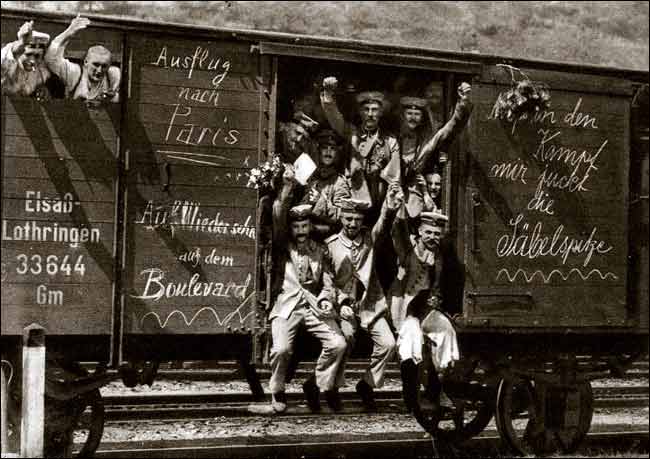
Featured Image Credit: German soldiers, some with flowers others waving or raising their clenched fists, in a railroad car on the way to the front during early World War I (1914) via Wiki Commons.
Balfour, Michael. Review of The Origins of the First World War, by James Joll. International Affairs (Royal Institute of International Affairs 1944-) 61, no. 1 (1984): 152–53. https://doi.org/10.2307/2619808.
Bonnell, Andrew G. “New Histories of the Origins of the First World War: What Happened to the ‘Primacy of Domestic Politics?’” The Australian Journal of Politics and History 61, no. 1 (2015): 121–27. https://doi.org/10.1111/ajph.12090.
Canis, Konrad. Der Weg in den Abgrund. Deutsche Außenpolitik 1902-19Í4. Schöning, 2011.
Clark, Christopher. The Sleepwalkers: How Europe Went to War in 1914. Penguin Books, 2013.
Conrad von Hotzendorff, F. Aus meiner Dienstzeit 1906-1918, 5 vols, Vienna 1921-25, vol.1.
Dutton, David. Review of The Sleepwalkers: How Europe Went to War in 1914, by. Christopher Clark. The International History Review 36, no. 5 (2014): 991–93. http://www.jstor.org/stable/24703275.
Frederick, Maurice. Haldane 1856-1915. Faber & Faber, 1937.
Herwig, Holger H. “Germany.” In The Origins of World War I, edited by Richard F. Hamilton. and Holger H. Herwig. Cambridge University Press, 2003.
Herwig, Holger H. The First World War: Germany and Austria-Hungary 1914-1918. Bloomsbury Academic, 1996.
Joll, James., and Gordon Martel. The Origins of the First World War. Third edition. Harlow: Longman, 2007.
Kaiser, David E. “Germany and the Origins of the First World War.” The Journal of Modern. History 55, no. 3 (1983): 442–74. https://doi.org/10.1086/242517.
Krumeich, Gerd. Juli 1914: Eine Bilanz: Mit Einem Anhang: 50 Schlüsseldokumente Zum Kriegsausbruch. 1st ed. Ferdinand Schöningh, 2014.
Legvold, Robert. Review of The Russian Origins of the First World War, by Sean McMeekin. Foreign Affairs 91, no. 1 (2012): 198–99. http://www.jstor.org/stable/23217190.
Martel, Gordon. Review of The Sleepwalkers: How Europe Went to War in 1914, by. Christopher Clark. The American Historical Review 120, no. 3 (2015): 951–53. https://www.jstor.org/stable/26577266.
McMeekin, Sean. The Russian Origins of the First World War. Belknap Press of Harvard. University Press, 2011.
McMeekin, Sean. July 1914. Countdown to War. Belknap Press, 2013.
Mombauer, Annika. “A Reluctant Military Leader? Helmuth von Moltke and the July Crisis. of 1914.” War in History 6, no. 4 (1999): 417–46. http://www.jstor.org/stable/26013968.
Mombauer, Annika. “Guilt or Responsibility? The Hundred-Year Debate on the Origins of. World War I.” Central European History 48, no. 4 (2015): 541-64. https://doi.org/10.1017/S0008938915001144.
Mombauer, Annika. “Of War Plans and War Guilt: The Debate Surrounding the Schlieffen. Plan.” Journal of Strategic Studies 28 (5): 857–85. doi:10.1080/01402390500394009.
Mombauer, Annika. The Origins of the First World War: Diplomatic and Military Documents. Manchester University Press, 2013.
Neilson, Keith. Review of The Russian Origins of the First World War, by Sean. McMeekin. Canadian-American Slavic Studies 49, no. 2–3 (2015).
Otte, T. G. July Crisis: The World’s Descent into War, Summer 1914. Cambridge University. Press, 2014.
Rauchensteiner, Manfried. The First World War and the End of the Habsburg Monarchy, 1914-1918. Translated by Alex J. Kay, Anna Güttel-Bellert, and Anna Gèuttel-Bellert. Böhlau, 2014.
Robbins, Keith. Review of The Origins of the First World War, by James Joll. The English. Historical Review 102, no. 403 (1987): 529–30. http://www.jstor.org/stable/572382.
Röhl, John. “Admiral von Müller and the Approach of War, 1911-1914.” Historical Journal, 12 (1969): 651-673.
Sanborn, Joshua. Review of The Russian Origins of the First World War, by Sean McMeekin. The American Historical Review, 2012.


