
Written by Helene Chaligne
Language consistently figures in the historical and current public discourse in the Canadian province of Quebec. From the arrival of the French in the province in 1534 to the more recent Pastagate, the province that is today home to half a million people has a rich and multifaceted history with its own use of language. One can easily retrace many important events of Quebec’s history by merely looking at the way they swear.
However, before investigating profanities, one must look at the development of the dichotomous relationship between French and English, as well as Quebec’s equally complicated relationship to the Catholic church.
In brief, the French incorporated Quebec into New France in 1608 and it became a recurring battleground for the English and the French over the next century. The Catholic Church would take up a central role in its society as it was seen as a resistance to English assimilation after the handing over of the colony to the British in 1763. Canada would later become a united nation of four provinces in 1867, and the Catholic Church would become the most powerful political force in the province of Quebec. It would maintain its hold on all aspects of everyday life until the Quiet Revolution of the 1960s, which would usher in a new era of secularism. Before then, religious language would become embedded, just like the church itself, into the everyday lives of Quebecers. By the nineteenth century, the “sacres” had become common usage. “Sacres” refers to the words used when one would “sacrer,” which was to use language related to divine figures or objects in an ordinary context, hence engaging in blasphemy.
When this practice was popularised, it was punishable by law to use it, it being seen as blasphemy to do so. While André Bougaïeff stresses that the repercussions were never as harsh as those of fifteenth century France, when people risked getting their longues chopped off for a similar offence, we see this new language and its use emerging as a symbol of resistance to the oppressive and ubiquitous political monopoly of the church. In order to cover up the blasphemy, the practice evolved into morphological variants. The variants would include the more traditional suffixation and prefixation as well as the crazier substitution, troncation, addition, and agglutination. In the addition morphology, words like Christ and hostie (sacramental bread) could merge together and become “hostiecrif.” In some cases where a substitute is used, the word becomes a “minced oath,” or milder insult. “Bapteme” (baptism) could become “baleine” (whale) or “bateau.” (boat). “Sacrement” could become “Sacramento,” and “Christ” could transform into “Christophe Colomb” or “Crimpuff,” derived from the English “cream puff.” The latter two probably being more recent developments, yet following the principle of substitution in using a stand-in word to refer to a holy element. Troncatition, that is, the curtailing of a word, also featured a multitude of stages; “tabernacle” could become “tabamak, tabam, tabar, taba, tab, t” and hostie could become “stie” or even “sie.”
This linguistic innovation might even take on the poetic function of language observed by linguist Roman Jakobson. This is a function often used to accentuate the intensity of the message. Thus, “tabernacle” was used under the trisyllabic form of “kakarnak,” putting the sacre at the height of its force and intensity. A similar evolution can be observed with “hostie” and its aforementioned truncated form of “stie,” which could morph into the repetition “titi.”
Beyond how remarkable the breadth of its morphology, the sacre and its modified forms are also a unifying symbol of Quebecer society as they were and continue to be used by all social classes. Bougaïeff highlights that this was not the case with similar phenomena in France. Women even found some form of emancipation in adopting the usage of sacres, a practice formerly reserved to men. Akin to other forms of swearing, teenagers would also start employing it alongside other acts of rebellion, such as smoking, the practice thus becoming a marker for the passage into adulthood.
As Timothy Jay remarks, “The ultimate offensiveness of words is determined entirely by pragmatic variables such as speaker-listener relationship and social-physical setting, as well as the words used and tone of voice.” Hence, the sacre poses itself as a fascinating reflection of the political hold the church had on the lives of people in Quebec but also how those people managed to use its own lexicon as a way of subtly subverting that authority. Bougaïeff pushes the exploits of the sacre further, arguing that it poses a degree of intensity that French from the hexagone would not possess. He places the domain of the sacre in its own zone between the non linguistic scream of joy or pain and the perfectly constructed phrase, making it a unique and intimate occurrence. The fact that many sacre phrases would not be written adds to the intimate dimension of it in his view. While it is clear that Bougaïeff is intent on championing the language he passionately uncovers for his readers, one cannot deny the impressive complexity of the linguistic phenomenon and its breadth.
With the Quiet Revolution, a new era of nationalism and political and cultural change took place. The province became secular and French was made the official language of Quebec in 1974 with Bill 22. Later on, Bill 101 would be passed in 1977, aiming to make French the main language in all aspects of life ranging from law to commerce. The latter caused controversy in 2013, as an Italian restaurant was taken up by an inspector of the Office québécois de la langue française (OQLF) about the items on their menu featuring too many Italian words, such as “pasta, antipasti and calamari.” The inspector, in charge of enforcing Bill 101, claimed they should be replaced by their French counterparts. The fiasco would lead to the resignation of the head of the OQLF and for the government to cut funding into the enforcement of Bill 101. A comical example that highlights the continued turmoil and censorship attached to language in the province.
While the sacre no longer fulfils one of its original functions of quiet resistance, it remains a staple of Quebecer culture, “Tabarnak” (tabernacle) still being the height of profanity. Many highly pious people employ certain terms as they ignore the origin of words such as “titi,” having evolved so drastically. As the province’s struggle with language continues in a different vein, the sacre highlights the past use of language to reflect the population’s resistance to censorship.
Bibliography
Bougaïeff, André. “Un Trait Du Français Populaire et Familier Au Québec: Le Système Des ‘Sacres.’” The French Review 53, no. 6 (1980): 839–47.
Jay, Timothy. “The Utility and Ubiquity of Taboo Words.” Perspectives on Psychological Science 4, no. 2 (2009): 153–61.
Ketterer Hobbis, Stephanie. 2017. “‘The Comic and the Rule’ in Pastagate: Food, Humor and the Politics of Language in Quebec.” Food, Culture & Society 20 (4): 709–27.
McWhinney, Edward. “The ‘Language’ Problem in Québec.” The American Journal of Comparative Law 29, no. 3 (1981): 413–27.
Roy A. Prete, G. Eric Jarvis, and Jonathan A. Jarvis. “The Linguistic and Ethnic Transformation of the Church in Quebec since the Mid-1960s.” Journal of Mormon History 43, no. 4 (2017): 155–84.
Tassie, J. S. “The Use of Sacrilege in the Speech of French Canada.” American Speech 36, no. 1 (1961): 34–40.
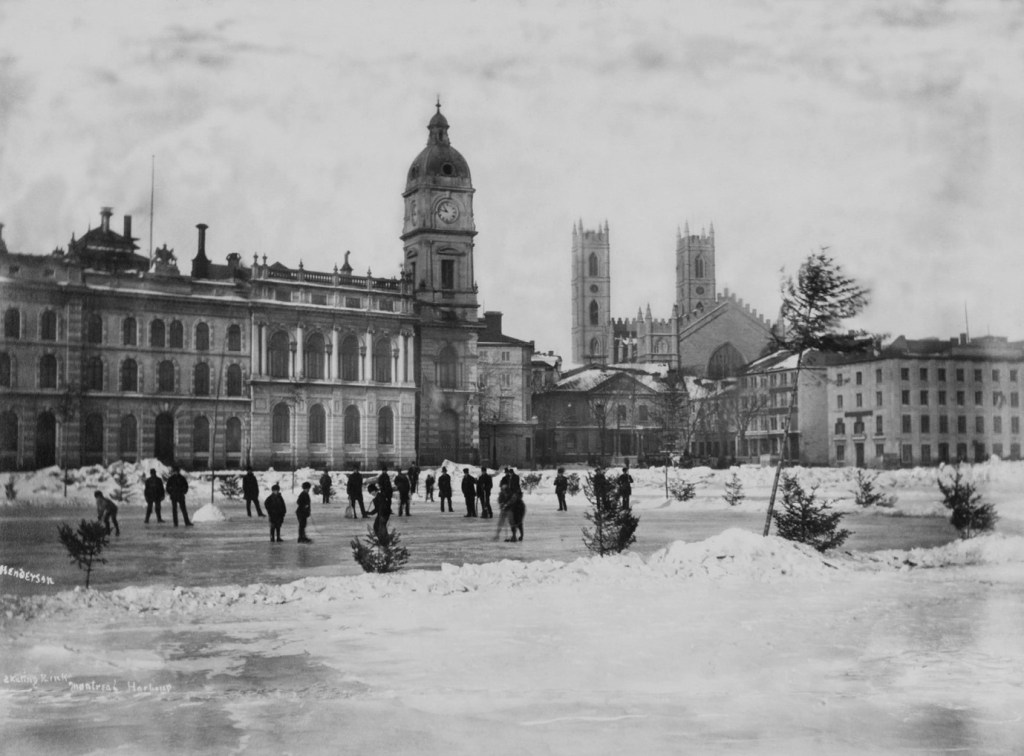
Featured image credit: Skating Rink, Montreal Harbour, C. 1870. https://macleans.ca/culture/arts/quebec-photo-gallery-19th-century-the-explorer-alexander-henderson/

