
Written by Hector Le Luel
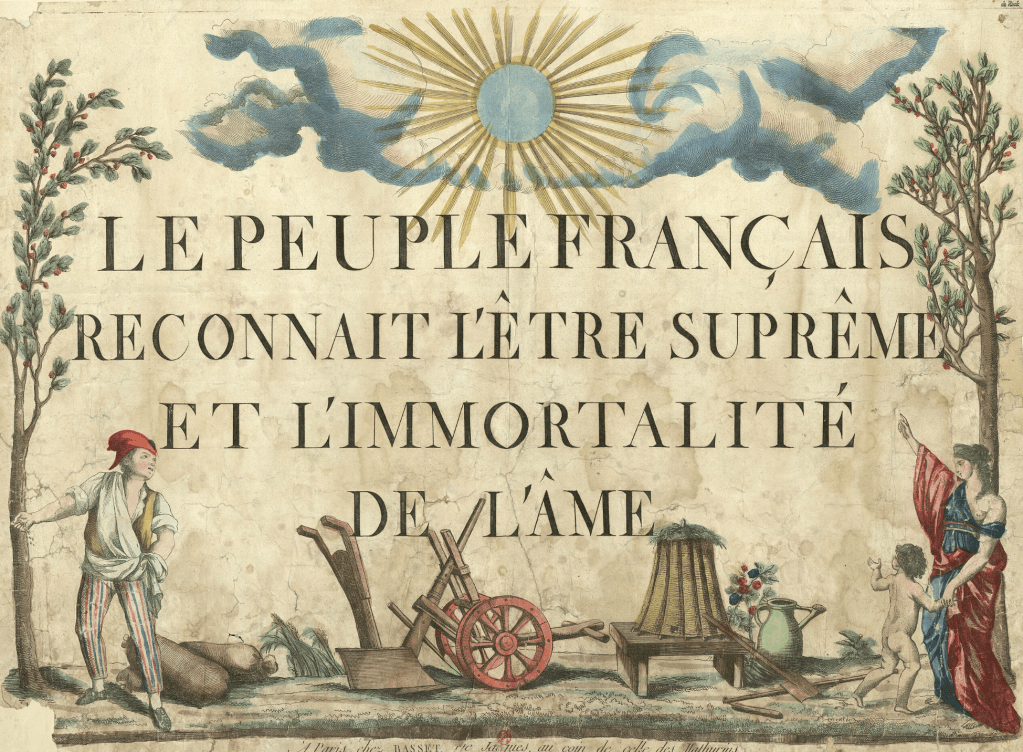
On the morning of 20 Prairial an II (June 8, 1794) in Paris, thousands of people flocked to the Tuileries Gardens in the spring sunshine, waving flowers and tricolour emblems, and singing folk tunes extolling the glory of revolutionary ideals. The object of celebration for the day was the Supreme Being, a deity invoked by Maximilien de Robespierre as the antidote for religious divisions that had pitted atheists, believers, and deists since the start of the Revolutionary period. The festival is often portrayed as a purely political manoeuvre masterminded by a declining Robespierre weeks before his execution, and the religion it put forward seen as another short-lived product of utopian nature. However, observing the Cult, and to a larger extent the Festival of the Supreme Being in the lineage of Revolutionary celebratory practices, uncovers a larger picture of popular participation that bypasses the restrictive political interpretations of the period.
The Cult of the Supreme Being was first introduced by Robespierre in a speech held at the Convention on the 18 Floréal an II (May 7, 1794). Robespierre, at the height of his powers within the Committee of Public Safety, was waging an indiscriminate attack on any suspected anti-revolutionary elements, who were zealously sent to the guillotine after an expeditious trial. It therefore came as a surprise to the audience of deputies when Robespierre’s address focused on issues of a theological nature – the speaker highlighted the need for a common national belief, rejecting both “fanatical” atheism and the artificial God of priests. Such a view echoed larger debates at hand within political and intellectual circles in 1793 and 1794, with proponents of a hardline de-Christianisation gaining ground. 20 Brumaire an II (November 10, 1793) saw the proclamation of a Cult of Reason, where atheist deputies led by Hébert and Chaumette transformed the Cathedral of Notre-Dame into a Temple of Reason that would leave religious practices in the past.
Robespierre’s idea of the Supreme Being therefore embodied a third deistic way. It acknowledged the existence of a higher power, whilst putting aside the sacraments and institutions of the Church for a practice steeped in “natural” humanist revolutionary values. Such a concept was nourished by a long list of eighteenth-century thinkers, such as Rousseau, who advocated for a rethinking of humanity’s relationship with God and its representative canons and institutions. Robespierre was equally indebted to the years of debates and initiatives that had seen the secular Revolution replace idols with abstract concepts of liberty, virtue, and equality that would guide the new nation towards unshackled enlightenment.
Many accounts, both contemporary and retrospective, saw in the Cult and its Festival a façade for Robespierre’s political ambitions. Celebrated historians of the Revolution such as François-Alphonse Aulard and Michel Vovelle evaluated the celebrations for the Supreme Being as nothing more than a sophisticated object of propaganda designed to appeal to the masses. They point to the two lengthy speeches held by Robespierre himself during the ceremony, coronated by his pompous ignition of a symbol of “Hideous Atheism” that revealed an inner statue of Wisdom. Historians have long relied on accounts written after Robespierre’s fall in the Thermidorian reaction of 1794, provided by actors eager to distance themselves from the brutality of the Terror and the theatrics of the Supreme Being. Such readings emphasise the Festival of the Supreme Being, and other celebrations of the kind, as deeply political affairs, led by top-down planners instrumentalising the will of the people and the malleability of nascent French nationhood.
From the 1970s, however, scholars such as Mona Ozouf have stressed the importance of looking at Revolutionary festivals through the non-political, in a field where “events themselves have been over-burdened with rational meanings”. Looking at the sentiments of the participants rather than the organisers and the themes shared by these supposedly uniquely political festivals, Ozouf saw a true continuity that defined Revolutionary celebration. The Festival of the Supreme Being was not, for Ozouf, the celebration of a newfound religion – it shared many characteristics with the Festival of Reason and the Festival of Federation, with actors dressed as allegories of Liberty and the habitual singing of desacralised hymns. Participants celebrated the coming of Spring and the hopeful end to a period of Terror, drawing on folk and Christian understandings of seasonal renewal and the promise of times of plenty. In Ozouf’s account, Robespierre’s speeches and grand ideology are superseded by the familiar codes of celebration firmly entrenched in the national culture. It is therefore not a surprise to find accounts that describe the only disruptions in an otherwise joyous ceremony as the heckling during Robespierre’s speech, that he himself describes in his diaries.
Similarly, Jonathan Smyth’s recent study of the Festival of the Supreme Being underlines the decentralised aspect of the celebrations across France. Far from the Parisian centre of political life, the festival was led in each region following the established codes of Revolutionary carnival atmosphere: banquets were held in honour of fraternity, and children, men and women participated in songs and dances. Festivals were thus more than the object they meant to celebrate: drawing on Ozouf’s hypothesis of an underlying coherence of festivities, Smyth sees a celebration of unity, both locally defined and appealing to a larger concept of nationhood. Observing reactions to the celebrations, both in Paris and throughout the country, Smyth uncovered testimonies that weakened preconceived ideas of the festival as Robespierre’s last attempt at consolidating his crumbling power. Robespierre’s staunchest opponents congratulated the initiative as a moment of federation and solidarity, and a letter from the provinces praised the festival as a time of “brotherhood” with the nation as a “large family coming together in piety”. The specific ideological underpinning of the festival was seldom discussed, with audiences concentrating on broader understandings of a potential end to atheistic zeal and the violence of the Terror.
Both Ozouf’s and Smyth’s works on the Festival of the Supreme Being seem to be further supported by the posterity of the celebrations and the cult it represented. After Robespierre’s fall on 9 Thermidor an II (July 27, 1794), the deist national ideology was abandoned like many other markers of Robespierre’s legacy. The festival, however, was still discussed as one of the grandest public celebrations in a period that saw hundreds of similar events carried out. The shift in understandings of cultural practices such as festivals equally points to a larger revaluation of the French Revolution period, too often characterised by the power struggles between ambitious political figures. A focus on the emotion, popular participation, and larger cultural atmosphere of the period replaces a variety of invisible actors at the heart of this History, both in the capital and across France.
Bibliography
Burcham, Sam. La Morte de la Culture Populaire Française. North Alabama Historical Review (Vol. 2), 2012.
Ozouf, Mona. Festivals and the French Revolution. Harvard University Press, 1991.
Ozouf, Mona. “Space and Time in the Festivals of the French Revolution.” Comparative Studies in Society and History 17, no. 3 (1975): 372–84.
Robespierre, Maximilien, and David, Jacques Louis. 1794. Rapport Fait Au Nom Du Comité de Salut Public Par Maximilien Robespierre : Sur Les Rapports Des Idées Religieuses & Morales Avec Les Principes Républicains, & Sur Les Fêtes Nationales. Séance Du 18 Floréal, L’an Second de La République. Paris: Imprimerie nationale, 1794.
Smyth, Jonathan: Robespierre and the Festival of the Supreme Being: The search for a republican morality. Manchester University Press, 2016.
Voeltzel, René. L’Être suprême pendant la Révolution française (1789-1794). Revue d’Histoire et de Philosophie religieuses (n.3), 1958.

