
Written by Eva Beere
On Monday, July 16, 1945, at 5.30am, the United States entered a new atomic era with the first successful detonation of a nuclear bomb, nicknamed the ‘gadget’. Little did they know that the Soviets were already one step ahead of them.
When the Soviet Union detonated their first atomic bomb just four years later at the Semipalatinsk Test Site in Kazakhstan, the United States marvelled at how they had managed to build such a destructive weapon so quickly. While the United States had succeeded in getting a head start in the Arms Race, they failed at one important task: recognising that they had Soviet spies working at their top-secret laboratory, Los Alamos.
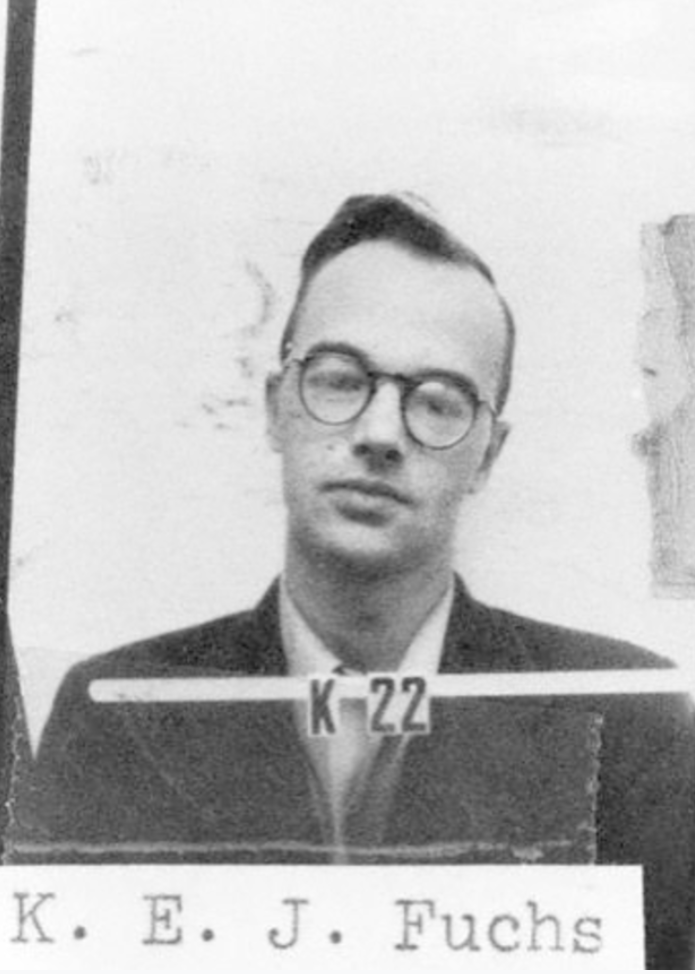
Emil Klaus Julius Fuchs was a German-born physicist whose adolescence was plagued by Nazi persecution. Fuchs had an extremely political upbringing, which motivated him to join the German Communist Party (KPD) whilst a student at the University of Leipzig. Here, along with his siblings, he became an active speaker and expressed clear and public criticism for the rising NSDAP. His father was also an active critic of the Nazi regime, joining the Social Democratic Party in 1921, and, despite spending his years as a Lutheran pastor, became a Quaker after the Lutheran church was taken over by the Nazis. Reminiscing about his childhood, Fuchs said:
“I think the one thing that most stands out is that my father always did what he believed to be the right thing to do, and he always told us that we had to go our own way even if he disagreed.”
His sister and brother-in-law would later risk their lives by helping many Jews escape from Germany amidst Hitler’s rising antisemitic policies. This active resistance made the Fuchs family a key target for the Nazis, with Klaus Fuchs getting his front teeth knocked out by Hitler’s brownshirts in a brutal attack. Thus, it is unsurprising that when Hitler became the Chancellor of Germany in 1933, Fuchs fled to England.
Whilst living in England, Klaus displayed a brilliant academic capacity, earning his PhD at the University of Bristol and then a DSc at the University of Edinburgh. After France unexpectedly fell to the Nazi regime in 1940, Fuchs was briefly interned at a camp in Quebec, due to British fear that any German refugees were involved with the Nazis. After his release, Rudolph Peierls, a German-born British physicist, invited Fuchs to work as an assistant on the British atomic bomb project titled ‘Tube Alloys.’
After the Soviet Union brutally defeated German troops in the infamous Operation Barbarossa, Fuchs volunteered his services to German Communist Jurgen Kuczynski and offered to pass over British Atomic secrets to the Soviets. This was a clear violation of the Official Secrets Act, which Fuchs had signed when he was granted British citizenship in 1942. His motivations were inextricably linked to his communist upbringing; whilst he was awaiting trial, he would later say, “knowledge of atomic research should not be the private property of any one country” but, rather, this knowledge should be shared.
As the war continued, the United States and Britain agreed to combine forces, signing the Quebec Agreement in 1943, which allowed them to collaborate on their respective atomic bomb projects. Thus, in 1943, Fuchs moved to Columbia University in New York City, where he worked on the Manhattan Project, a research development program led by the United States in their effort to produce an atomic bomb. Here, the team of scientists were investigating ways to separate U-235 from U-238, whereby U-235 was considered better for generating an atomic explosion. By the time he reached New York, he had already passed over 570 pages of classified information concerning British atomic bomb developments to his Soviet handler Ursula Kuczynski, codenamed ‘Agent Sonya.’
Fuchs’ espionage activity gained momentum when Britain and America agreed to collaborate on nuclear arms developments, and he was selected as one of the chosen scientists to join Oppenheimer’s atomic bomb project at Los Alamos. Here, he handed over some of the Manhattan Project’s most important data to Soviet contact Harry Gold, a Swiss-born American chemist.
In Los Alamos, Fuchs joined the Theoretical Physics Division, where he worked under Hans Bethe. Fuchs was a highly regarded scientist by the British, with Bethe considering him “one of the most valuable men in my division.” Fuchs’ value to the British in Los Alamos earned him an opportunity to return to the United Kingdom after the war, where he became the head of the Theoretical Division at the Atomic Energy Research Establishment at Harwell. Yet, he was equally valuable to the Soviets, as he supplied two years’ worth of information on the creation of the hydrogen bomb to his London KGB controller, Alexander Feklisov, during his time at Harwell.
By the time the Soviets detonated their first atomic bomb in 1949, MI5 had received information from the Federal Bureau of Investigation (FBI) that there had been a British mole within the Manhattan Project who had been leaking information about the scientific developments of the United States atomic bomb to Moscow. This uncovering project, nicknamed VENONA, was a high-kept United States intelligence secret, which used codebreakers to decipher Soviet intelligence codes. Although they had uncovered espionage involvement in Los Alamos, neither MI5 nor the FBI knew who the mole was.
As the case developed, MI5 and the FBI came closer to identifying Klaus Fuchs. When Fuchs finally confessed to William Skardon, a Special Branch officer, that he had been working with the Soviets since 1942 and provided them with crucial information on the developments of Los Alamos, he was sentenced to fourteen years in prison, nine of which he served. This offered a clear explanation for the rapid speed of the Soviet atomic bomb developments, whereby Fuchs’ involvement is estimated to have shortened the Soviet atomic project by one to two years. Yet, even after Fuchs’ identity was revealed, his case still puzzled many United States and British intelligence experts; the main question on everybody’s minds was: how was it possible that a highly placed scientist of foreign birth could, with impunity, give away secrets of the highest national importance over a period of seven years without being detected?
Despite being one of the most infamous atomic spies in history, Fuchs is not commonly branded a ‘traitor.’ As John Green suggests in his 2019 Guardian article, Fuchs was not motivated by a profound need to betray Britain but rather by his conscience. His experience fleeing from the Nazi regime had made him deeply opposed to war. Thus, he could not understand the West’s unwillingness to share atomic bomb secrets with the Soviet Union. Fuchs understood the danger of one country rising to power too quickly, and he was unwilling to let the United States annihilate the Soviet Union in the same vein. Although he confessed in 1950 that passing information on the design of the plutonium bomb was “the worst I have done”, his involvement in espionage is better explained by his aim to keep peace between the West and Moscow rather than as an attempt to weaken American power.
Bibliography
Gibbs, Timothy. ‘Catching an Atom Spy: MI5 and the Investigation of Klaus Fuchs.’ In The Oxford Handbook of National Security Intelligence, ed. By Loch K. Johnson (Oxford Academic, 2 Sept. 2010), https://doi.org/10.1093/oxfordhb/9780195375886.003.0034
Glazzard, Andrew. “Klaus Fuchs: A Spy for the Atomic Age: How ‘The Most Dangerous Spy in History’ Made His Name.” New Statesman, August 28, 2019. Updated September 6, 2021.
Goodman, Michael S. “The Grandfather of the Hydrogen Bomb?: Anglo-American Intelligence and Klaus Fuchs.” Historical Studies in the Physical and Biological Sciences 34, no. 1 (2003): 1–22. https://doi.org/10.1525/hsps.2003.34.1.1.
Green, John. “Atom Spy Klaus Fuchs Was Motivated by Conscience.” The Guardian, August 20, 2019. https://www.theguardian.com/world/2019/aug/20/atom-spy-klaus-fuchs-was-motivated-by-conscience.
MI5. “Klaus Fuchs.” MI5: The Security Service. Accessed October 16, 2024. https://www.mi5.gov.uk/history/the-cold-war/klaus-fuchs.
The Klaus Fuchs Case (CAB301-108). Abingdon, England: Taylor & Francis, 1950.
PBS. “February 9, 1944: Message from Moscow to Canberra.” NOVA. Accessed October 16, 2024.https://www.pbs.org/wgbh/nova/venona/inte_19440209.html
Szasz, Ferenc Morton. 1992. British Scientists and the Manhattan Project: The Los Alamos Years. New York: St. Martin’s Press.

