
Written by Arianna North Castell
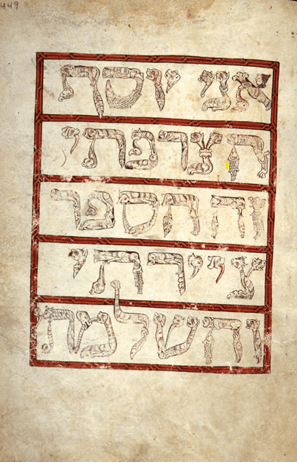
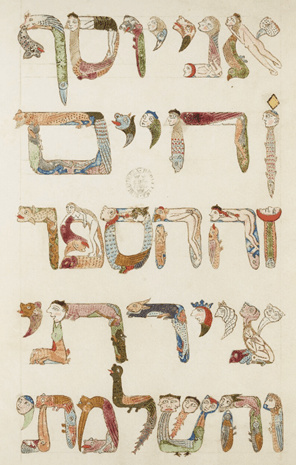
“I, Joseph Ibn Hayyim, illuminated and completed this book.” This phrase, written in colourful, zoomorphic Hebrew letters, concludes the Kennicott Bible—a reflection of the intricate and unpredictable beauty found within all 922 pages of this lavish work. The illustrator did not merely create a breathtaking manuscript for aesthetic purposes, but carefully crafted it to immerse its reader in the sensation of entering a sacred building to worship.
The manuscript was created in Galicia (northern Spain) in 1476, just sixteen years before the expulsion of the Jews was decreed, and many Hebrew texts were subsequently confiscated or destroyed. Luckily, this text was transported from Spain unscathed. Little is known about where the text went or whose hands it passed through, but almost three centuries later it appears in Gibraltar, and is then acquired by Benjamin Kennicott. Now, the manuscript is kept tucked away in the Bodleian Library in Oxford. The pages of its facsimile are scanned and uploaded online, and the original pages seldom see the light of day. So, if we were able to take the heavy tooled box binding and open the cover, what would be illuminated to us? The text not only reveals beautiful and intricate artistry, but deep cultural bonds that cemented Sephardic culture.
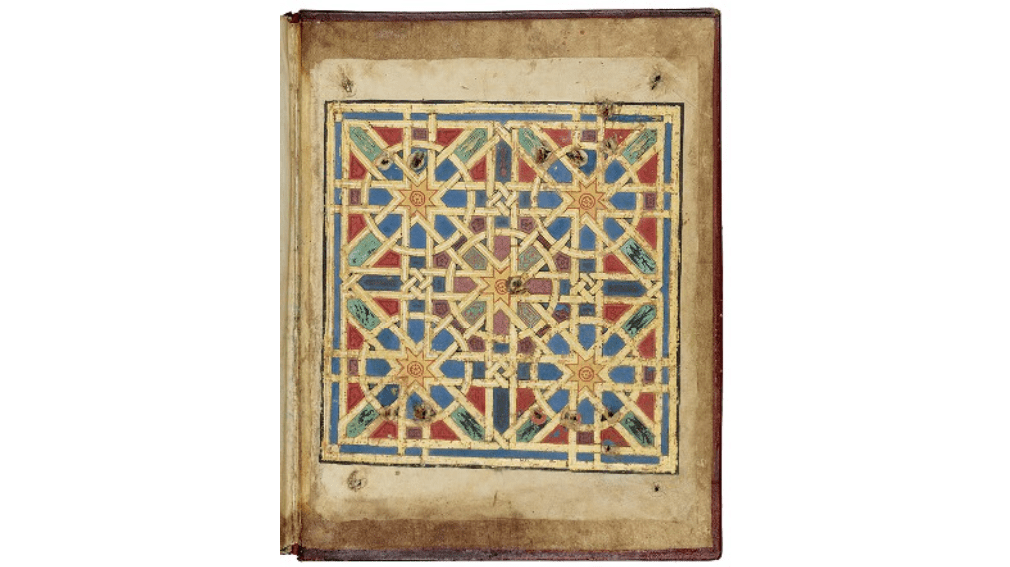
When you open the first page, though you may expect to start at the very beginning with Genesis, first you must ensure that you are able to appreciate the text for all its complexities. The biblical passages are prefaced and concluded with the Sefer Mikhlol, a grammatical treatise that will guide you through the Hebrew. Here, the sacred text is given protection from misinterpretation or incorrect readings. As the opening pages unfold, the superior craftsmanship of the text is made evident. The script itself remains consistent throughout the book—meticulous and perfectly aligned Sephardic cursive. The Sefer Mikhlol is adorned with intricate illustrations that pay homage to the Spanish-Islamic architecture of the time such as the richly decorated bifora which divides the text by a single column. The interlacing pattern shown below is also distinctly arabesque.

After the colourfully encapsulated Sefer Mikhlol, you’ll encounter the opening lines of Genesis. From this point onward, each book of the Bible is marked by an ending illustration. The books are divided by parashah, each featuring its own illustration. These images lend toward the abstract, some being enumerated and others not. As you examine the pages, take note of the intricate enmeshing of text and illumination, solidifying the close relationship between illustrator and scribe. The scribe, Moses ibn Zahara, adds flourishes to passages about Joseph as a homage to the illustrator’s biblical counterpart. In a reciprocal gesture, the illustrator allows for rich illustrations to encircle Psalm 90, the Prayer of Moses, in honour of the scribe. Within the illustration, Moses ibn Zahara has chosen to include his own micrographic details. This is not unusual to Sephardic texts, the Catalan Mahzor renowned for its incredible micrographic images.
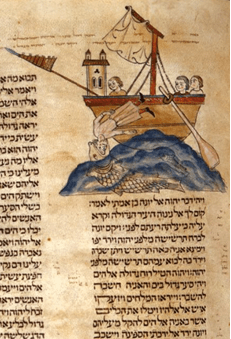
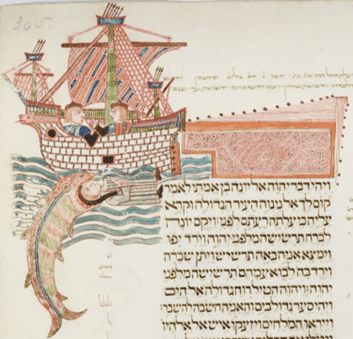
Many of the illustrations you would admire can be sourced from another Sephardic Bible- The Cervera Bible, completed in Catalunya in the year 1300, provided rich inspiration for the illustrations found. Though written in Catalunya, the text made its way to Galicia around the time of the creation of the Kennicott Bible. Below, you’ll see an illustration of Jonah being swallowed by a big fish, a striking visual that appears in both the Cervera and Kennicott Bibles.
The distinctive illustrator’s colophon also finds inspiration in the Cervera Bible. The rich imagination and creativity of Joseph ibn Hayyim is evident in his highly stylized and colourful colophon. Each letter takes on an anthropomorphic or zoomorphic form, with grotesque faces and features- even the form of a naked woman, which is seldom seen in Hebrew biblical manuscripts. These playful and exaggerated figures demonstrate the wide pool of artistic influences that the artist drew from, with specific references from Christian and Islamic art. Illuminators of manuscripts rarely sign the manuscript themselves (this is the only attributed to Joseph ibn Hayyim) and this colophon gives us a rare display of the artist’s unrestricted creativity.
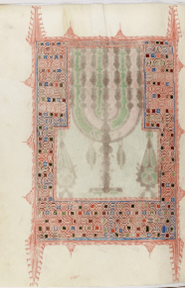
Upon admiring the lettering and illustrations, one might find themselves lost in the spectacular beauty of this Bible and immersed in its study. This is not accidental- the decadence of this text further allows its reader to leave their world and enter another. Profiat Duran, a Catalan grammarian, professed that Bible study was the truest worship of God in the absence of the Temple. Many Sephardic Bibles of this time call themselves mikdash yah (a sanctuary of the Lord) making the text more than a manuscript, but also a sanctuary and physical place of worship. The illustration contains detailed architectural features and includes temple adornments, further solidifying the idea that this Bible is a physical place of worship and should be decorated as such. The manuscript is enclosed in toolbox binding, reinforcing that it is a structure to enter, respect, and venerate.
The illustrations make great efforts to reinforce the idea of the manuscript as a physical temple. Temple implements are illustrated on full pages to adorn the manuscript with the necessary objects for a mikdash yah. The tabernacle and the menorah are shown in tandem on a double page spread, fully allowing the reader to immerse themselves in the image of the interior temple. We can also witness the ingenuity of the illustrator heightening the mirage of a physical sanctuary. The decadent illustrations often bled through the page, meaning faint traces of some illustrations can be seen on the reverse. The menorah page does as such, but instead of leaving the bled through page blank, the illustrator chooses to frame it with an intricate pattern. This page appears before the temple implements, creating a window through which the reader looks in—a shadowy preliminary portal.

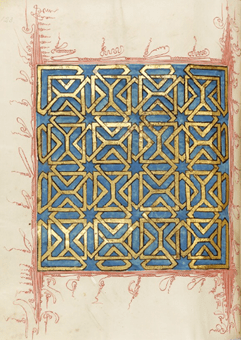
Heavy with gold-embossed detailing, the manuscript also features several intricate ‘carpet’ pages (pages with just illustration). The purpose of these is multifaceted, they serve as markers between biblical books but are also intrinsic to the immersive properties of the manuscript. Some believe they are meant to echo prayer mats used in Islam and Christianity, a device that aids the reader in preparing for worship and transitioning to holy ground. These pages not only create a sense of preparation and facilitation of prayer, but they also evoke the tangible sensation of fabric to be handled. Some mediaeval manuscripts would have even featured fabric sewn over select illustrations. Many scholars theorise that this illusion of fabric being lifted to reveal sacred texts would have invoked the feeling of unrolling Torah scrolls or drawing back the veil that covered the sacred temple.

When the biblical texts conclude, we return to the Sefer Mikhlol, as richly decorated as its appearance in the opening of the manuscript. Here, we return to the sanctity of the word, as well as displays of rich arabesque illustration. Though our journey across the text has now concluded, you must note that whilst this has been short- every page of this manuscript is embedded with rich artistry to be interpreted. Both scribe and artist strived to create a Bible that was also a sanctuary, a place of worship at the time of displacement and persecution. The Kennicott Bible shows us not only the rich cross-cultural bonds that defined Sephardic culture, but the way that the community was able to cement their traditions to create a profound legacy.
Images of the Kennicott Bible are all taken from: https://digital.bodleian.ox.ac.uk/objects/8c264b23-f6cc-4f18-98cf-9d75f7175b54/
Images of the Cervera Bible: https://www.loc.gov/item/2021668000/
Bibliography
Cohen, A. S., & Safran, L. (2023). Abstraction in the Kennicott Bible. In E. Gertsman (Ed. ), Abstraction in Medieval Art: Beyond the Ornament (pp. 1-78). Amsterdam: Amsterdam University Press.
Facsimile Editions. (n.d.). The Catalan Mahzor. Retrieved October 19, 2024, from https://facsimile-editions.com/cm/
Facsimile Editions. (n.d.). The Kennicott Bible. Retrieved October 19, 2024, from https://facsimile-editions.com/kb/
Goldberg, C. (2011, November 6). The Cervera Hebrew Bible at the Met: Not What You Learned in Sunday School. Art Unwashed. Retrieved October 20, 2024, from https://art-unwashed.blogspot.com/2011/11/cervera-hebrew-bible-at-met-not-what.html
Kogman-Appel, K. (2004). Jewish book art between Islam and Christianity: the decoration of Hebrew bibles in medieval Spain (1st ed.). Brill.
Metropolitan Museum of Art. (n.d.). Hebrew Bible (Cervera Bible). Retrieved October 20, 2024, from https://www.metmuseum.org/art/collection/search/656896
Rendsburg, G. (2019, July 4). The Kennicott Bible: A masterpiece of medieval illumination [Video]. YouTube. https://www.youtube.com/watch?v=aMZ4BNyUPUw&t=1348s

