
Written by Hanako Nordborg
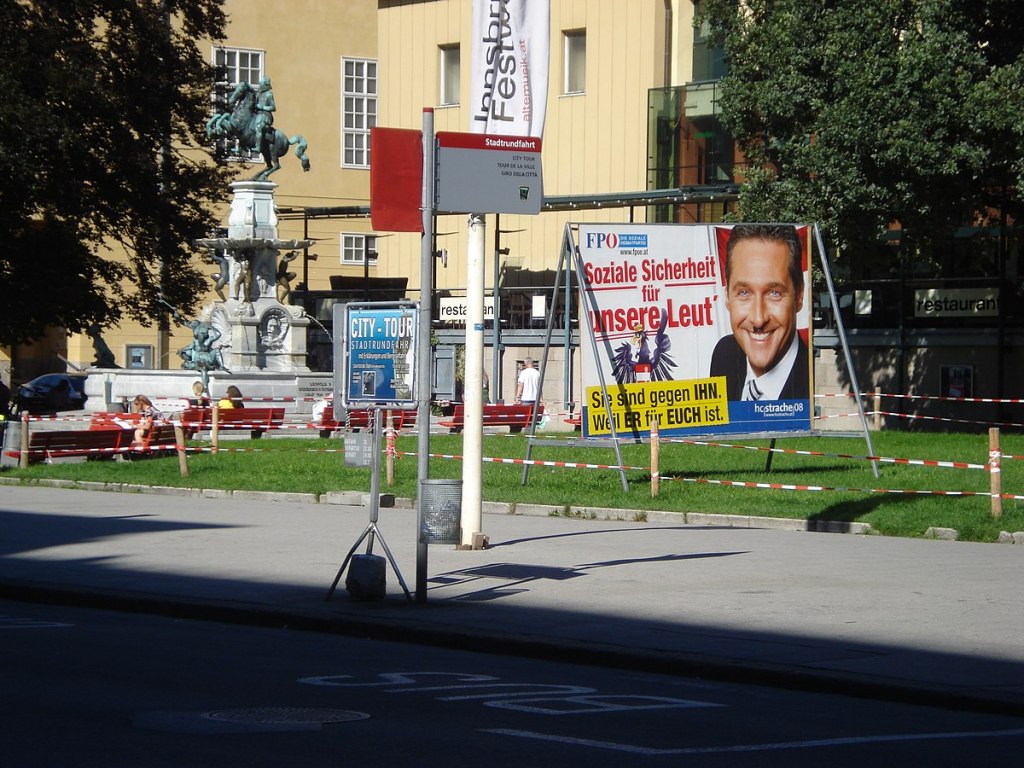
In Austria, the political party that was once the Nazi party has received 28.8 per cent of the votes in the legislative election (Nationalratswahl) this September. Austria is a small country in central Europe, like many European countries, it currently has a far-right party that is popular with roughly a quarter of its population. This party is also a complete unknown. Perhaps its best-known counterpart is the Alternative for Germany (AfD) due to two of its members attending a meeting that discussed the mass deportation of immigrants in January of this year. This sparked immediate outrage; protestors’ chants compared the AfD to the Nazi Party. On Germany’s heels, Austrians took to the streets in the thousands in late January to protest rising right-wing extremism and the country’s very own AfD, the Austrian Freedom Party (FPÖ). The FPÖ may be Austria’s big political break from Germany and most of Europe: its far-right party doesn’t resemble the Nazi party so much as it stems from it. The FPÖ stands out because there is no attempt at hiding its members past ties. Austria hadn’t rediscovered Nazis—they never left.
It might be more accurate to describe the AfD as Germany’s FPÖ. After all, the AfD was founded in 2013 by the conservative, Eurosceptic Bernd Lucke, Alexander Gauland, and Konrad Adam, and has attracted Neo-Nazis and antisemites in recent years. In contrast, the FPÖ was founded in 1956 by Anton Reinthaller (1895–1958), active in the Nazi Party (NSDAP) and a former SS-Brigadeführer. Sentenced to three years in prison, his name was one of three hundred on a list of those involved in serious war crimes. The FPÖ’s campaign website admits to its founder’s past but spends little time on it. Friedrich Peter, Mr. Reinthaller’s successor, chaired the FPÖ from 1958 to 1978 and tried to paint the party as a more liberal coalition partner to larger parties. Mr. Peter was also an active Nazi from 1938 to 1946. As an SS-Obersturmführer, he oversaw the 1st SS-Infantry brigade responsible for the murder of seventeen thousand Jews and twenty-five thousand Soviet prisoners of war. Mr. Peter denied his knowledge and involvement, claims that historian Martin Cüppers dismisses. The FPÖ’s website also brushes over Mr. Peter’s past, writing that he participated in World War II as a soldier on the Eastern and Western front but makes no mention of the mass murders he oversaw. Two former Nazis were allowed to be politically active in postwar Austria.
Confronting Nazism was not relevant to political functionality in postwar Austria because elites saw it as a deviation from the norm. The Third Reich was an aberration and was to be treated as such; former Nazis were easily integrated back into political life. It took until the 1990s for Austria to begin examining the Nazism in its politics. The joke that Austrians “made the world believe that Hitler was a German and Beethoven an Austrian” has historical merit. The country relied on the postwar myth of being “Hitler’s first victim.” This myth was not the creation of the Austrian elite, as historian David Art points out, but an unintended consequence of a meeting between the Allies in 1943. Austria was a footnote in the Allies’ minds, the Moscow Declaration of 1943 describes the country as the first “…to fall victim to Hitlerite aggression…” Conveniently, the second passage of the Declaration, “Austria is reminded, however, that she has a responsibility for participation in the war on the side of Hitlerite Germany and that in the final settlement, account will inevitably be taken of her contribution to her liberation,” has been removed where possible by Foreign Minister Leopold Figl (1902–1965) of the conservative People’s Party (ÖVP). Such behaviour was not restricted to conservatives; the Social Democrats (SPÖ) fully upheld the victim narrative, implying a common, underlying acceptance of Nazism until public backlash made this inconvenient.
Reading in retrospect, many German opinion pieces on the AfD remarked that comparisons between it and the Nazi party were unsurprising and that the Nazi-esque nature of it was well-known. They wrote of Germans shaking themselves from this despondence, and there was a sense of optimism that the AfD’s illicit meeting may be the beginning of its end. This was not the case for Austria, not even ten months ago. The FPÖ doesn’t skirt around Nazism—its ancestry is populated by Nazis. It was also not the first-time protests have struck the FPÖ. In 2019, the German newspapers Der Spiegel and the Süddeutsche Zeitung published a secret recording of Austria’s then vice-chancellor, H.C. Strache, and Johann Gudenus, leader of Austria’s far-right party. The video shows a woman posing as the niece of a Russian oligarch with close ties to Vladimir Putin who exposes the two men’s willingness to engage in political corruption, illegal party financing, and manipulation of unbiased media platforms. Mr. Strache was expelled as Vice-Chancellor within twenty-four hours and Sebastian Kurz, then Chancellor and head of the conservative ÖVP, called an early election after dissolving his coalition with the FPÖ and formed a new government with the Greens. The FPÖ’s support dropped from 25 to 16 per cent Austria-wide, then in the later municipal elections in Vienna, from 30 to 7 per cent.
That was to be the end of the FPÖ, now headed by Herbert Kickl. Yet they recently came first in the 2024 election, winning almost thirty per cent of the votes and beating the People’s Party’s (ÖVP) by 26.3 per cent (an 11.2 per cent drop from the last election) and the Socialists’ (SPÖ) by 21.1 per cent. The reasons for its success lie partly in the mediocre performance and mismanagement of immigration issues and the recent cost-of-living crisis. Mr Kickl is unknown internationally but rose to the top of the FPÖ after the Ibiza affair and was the secret power behind the more prominent Mr Strache and the infamous Jörg Haider, responsible for slogans such as “Home not Islam” (Daham statt Islam). Yet by the time of the election, the openly xenophobic leader of a historically racist party rooted in Nazism had not gathered enough criticism or controversy to stop the FPÖ. Like Germany’s AfD, the protests were nothing but a small speed bump on the FPÖs way to parliament. Please don’t overlook Austria.
Bibliography
Bundesministerium für Inneres. ‘Nationalratswahl.’ <https://www.bundeswahlen.gv.at/2024/nr/> [Accessed 17.10.2024]
Art, David. ‘Introduction.’ In The Politics of the Nazi Past in Germany and Austria by David Art, 101–144. Cambridge: Cambridge University Press, 2009
Art, David. ‘The Victim Culture.’ In The Politics of the Nazi Past in Germany and Austria by David Art, 101–144. Cambridge: Cambridge University Press, 2009 https://www-cambridge-org.ezproxy.is.ed.ac.uk/core/books/politics-of-the-nazi-past-in-germany-and-austria/A452034935B54A880EBDDA2AD7DA94F0
Bailer, Brigitte. ‘Ist die FPÖ eine staatstragende Partei?’ Der Standard, 13 January 2024 <https://www.derstandard.at/story/3000000202931/ist-die-fp214-eine-staatstragende-partei> [Accessed 16.10.2024]
‘Drei Anwälte im Hochverratsprozeß Reinthaller.’ Weltpresse: Abend Ausgabe, 23 October, 1950. <https://anno.onb.ac.at/cgi-content/anno?apm=0&aid=dwp&datum=19501023&seite=9>
Kahn, Michelle Lynn. ‘Antisemitism, Holocaust Denial, and Germany’s Far Right: How the AfD Tiptoes around Nazism,’ The Journal of Holocaust Research 36 (2022):164–185 <https://www-tandfonline-com.ezproxy.is.ed.ac.uk/doi/pdf/10.1080/25785648.2022.2069337?needAccess=true>
Kitschelt, Herbert ; McGann Anthony J. ‘The Radical Right in the Alps : Evolution of Support for the Swiss SVP and Austrian FPÖ,’ SAGE Publications 11, no. 2 (2005): 147–171 https://journals.sagepub.com/doi/epdf/10.1177/1354068805049734
Personen: Dipl.-Ing. Anton Reinthaller (1895–1958) <https://www.fbi-politikschule.at/blauesoesterreich/personen/personen/reinthaller-anton/> [Accessed 29.09.2024]
Personen: Friedrich Peter (1921–2005) <https://www.fbi-politikschule.at/blauesoesterreich/personen/personen/peter-friedrich/> [Accessed 29.09.2024]
Rauscher, Hans. ‘Der ungelöste Fall Friedrich Peter.’ Der Standard, 26 September, 2005 <https://www.derstandard.at/story/2187479/der-ungeloeste-fall-friedrich-peter>[Accessed 30.09.2024]
‘The alarming comeback of Austria’s far-right Freedom Party.’ The Economist, 16 March, 2023 <https://www.economist.com/europe/2023/03/16/the-alarming-comeback-of-austrias-far-right-freedom-party?giftId=a1463b5f-f793-42f1-b585-3afe2d5356af>[Accessed 29.09.2024]
‘What’s behind mass protests against Germany’s far-right AfD party?’ Al Jazeera, 21 January, 2024 <https://www.aljazeera.com/news/2024/1/21/whats-behind-mass-protests-against-germanys-far-right-afd-party>[Accessed 29.09.2024]
‘1956-1958. Die Gründung der FPÖ’ <https://www.fbi-politikschule.at/blauesoesterreich/geschichte/die-fpoe/die-gruendung-der-fpoe/>[Accessed 29.09.2024]
Featured image credit: A billboard promoting the Freedom Party of Austria in Innsbruck. Accessed via Wikimedia Commons: https://commons.wikimedia.org/wiki/File:Freedom_Party_of_Austria_propaganda_billboard.JPG


