
Written by Samantha de Verteuil
Content Warnings: References to political violence and death
“I will answer only to History and to the Greek people,” shouted Military Dictator Giorgos Papadopoulos in the courtroom that July in 1975, where he and his fellow junta stood trial for high treason. The Court President, Ioannis Deyannis, replied, “Do you think that History is absent from this courtroom?” Papadopoulos couldn’t think of a response. Only a few days later, both History and the Greek people sentenced him to death.
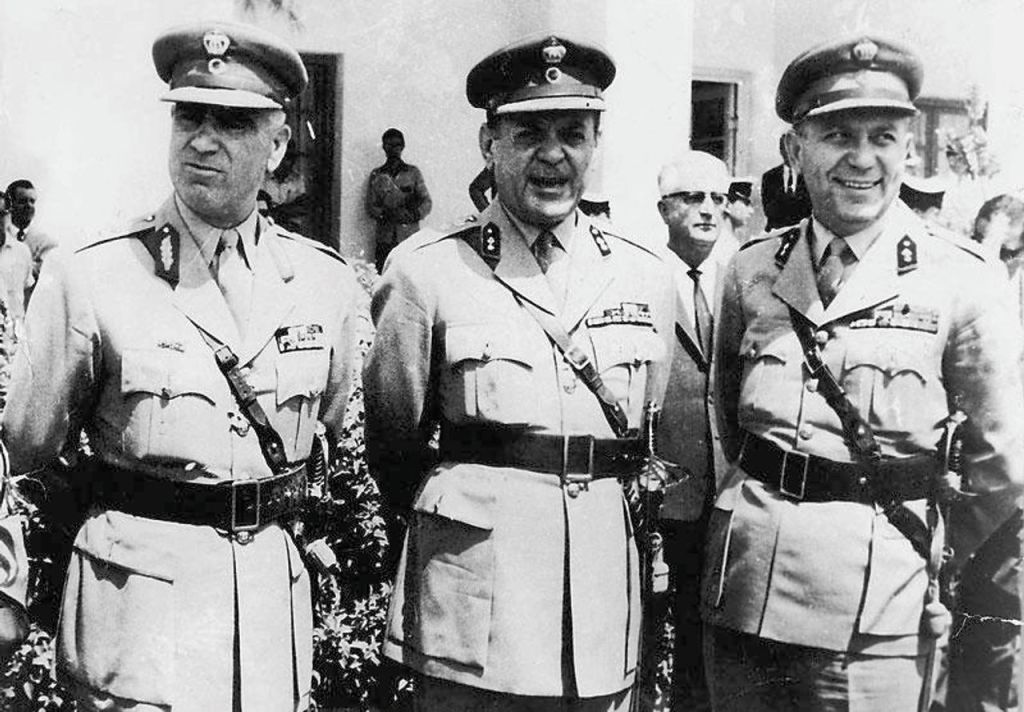
The Regime of the Colonels was instituted in 1967, after the right-wing military junta staged a coup a month before the scheduled democratic elections. In a press conference after the coup d’etat and the strict censorship that followed, General Papadopoulos claimed Greece was “…just like a patient strapped to the operation table, who, unless strapped to the table, cannot be cured of [its] disease.” This analogy prompted BBC journalist John Morgan to reply, “What does he think of the view that the only thing wrong with the patient was that there might have been liberal victory in the elections of May the 28th?” In support of the journalist’s quip, the regime never did seem to find the root of the sickness ‘infecting’ Greece, though it kept the patient strapped tightly, poked, prodded, and tortured. In the first month of the coup, an estimated 8,000 people were arrested, with estimates near 2,000 for the number of victims tortured. Political violence didn’t subside as the regime maintained its footing in the nation; torture became a deliberate practice, with an estimated 3,500 people detained in torture centers run by the Greek Military Police (ESA). After internal divisions began to break down the legitimacy of the regime, the failure to liberalize had spurred general unrest, and the fear of an all-out war with Turkey spread, the fall of the military dictatorship quickly followed.
The subsequent collapse of the seven-year government left the courts with over twenty potential charges of high treason, hundreds of torture victims, and the families of killed student protestors. To address the charges left in the wake of the corroded dictatorship, ‘Greece’s Nuremberg’ was split into three trials: the Trial of the Instigators, the Trial of the Polytechnic, and the Trials of the Torturers.
The Trials of the Torturers
Ioannis Kontos, who had begun his military service in September 1971, stated in court: “I feel ashamed of having served in ESA. When someone asks me in conversation where I served, I say, ‘as a simple infantryman.’ Mr. Chairman, who is going to cleanse us of this stain?” Following the Trial of the Instigators and the Trial of the Polytechnic, six more trials occurred. These were the Trials of the Torturers. The first two of these trials, the ones that dealt with the ESA, are acknowledged by Amnesty International as the first trials since Nuremberg to involve the prosecution of torture.
One unique aspect of the two trials was their structure. Both high-ranking officials and subordinates testified during the same trial; this functionally prevented each group from pushing the blame onto the other without immediate consequences. This doesn’t mean it wasn’t tried. Greek torturer, Major Hajizisis, had claimed that there weren’t reports as to what the officers were doing, so “why should [he] be accused of things done by [the KESA corporals] Kainich and Demertzidis?” This statement provoked a reaction from the solider defendants, with one voice ringing out, “What are you saying?” Kainich stormed out of the courtroom but not before mumbling, “That scum Hajizisis has forgotten when he sent me prisoners to KESA with instructions to beat them to a pulp. Now the coward says he says he didn’t know what went on there.” The day after the altercation, Kainich tried to backtrack his incriminating statements, but the outburst had already proven that Major Hajizisis did, in fact, give the orders of torture.
The uniqueness of structure goes further than who was giving testimony and at what times, to include the quantity of oral testimony. Official documentation, files, and paperwork had been destroyed, meaning the trial was conducted almost solely by oral testimony. 120 torture victims had given statements, but still, the defendants often pointed to the lack of ‘solid’ evidence to support their innocence. Major Theofiloyannakos, usually referred to as the second face of torture (behind Major Hajizisis), denied all victims’ claims.
Chairman: “We had 120 witnesses who testified that they had been beaten there…”
Theofiloyannakos: “It’s all lies. A year hence, when you’ve seen how the system develops, you too will understand. . .”
Chairman: ‘Were all 120 lying?”
Theofiloyannakos: “You ask, you ask again, and again you ask again.”
Chairman: “Have I not got the right to ask?”
The outcome of the trial was significant but limited. While the junta were now incarcerated, their sympathizers pressured the Justice Ministry for special amenities, resulting in their enjoyment of air conditioners, television sets, and tennis courts, luxuries far beyond the imaginations of the many brutally detained and violated under the junta’s fist. Additionally, pressures for a speedy trial to move on from the politically tumultuous past meant that relatively few involved with the torture facilities ever faced the consequences. Most of the soldiers who were directly responsible for the hours and hours of beating and sexual humiliation faced by the victims never saw the inside of a courtroom. Ioannis Kontos had asked the court ‘who [was] going to cleanse [them] of this stain,’ but it seems that the stain has disappeared far faster than the scars of its victims.
Bibliography
Amnesty International, ed. Torture in Greece: The First Torturers’ Trial 1975. London: Amnesty International, 1977.
“Press Conference Following Greek Coup.” BBC, 1967. https://www.youtube.com/watch?v=ib4OS22eX58.
Haralambous, Chloe Howe. “Making History (Disappear): Greece’s Junta Trials and the Staging of Political Legitimation.” Journal of Modern Greek Studies 35, no. 2 (2017): 307–37. https://doi.org/10.1353/mgs.2017.0022.
Time Magazine. “GREECE: Answering to History.” September 1, 1975. https://content.time.com/time/subscriber/article/0,33009,947162,00.html.
Time Magazine. “GREECE: The Colonels on Trial.” August 11, 1975. https://time.com/archive/6851442/greece-the-colonels-on-trial/.
Papaeti, Anna. “Music, Torture, Testimony: Reopening the Case of the Greek Junta (1967–1974).” The World of Music 2, no. 1 (2013): 67–89. http://www.jstor.org/stable/24318197.

