
Written by Arianna North Castell
In 1958, the Catholic Church officially opened the case for Isabel of Castile to be considered for sainthood. To some, this decision may seem easy. She not only ruled in her own right, but also created a long-lasting personal legacy of piety, wisdom, and power at a time where her position was unprecedented for women. But to be made a saint in the modern day, the candidate should not only be a role model for the standards of their own time, but for ours too. In the five hundred years since her death, Isabel has been lauded as a truly remarkable female figure. Though her feats were undeniably extraordinary, such glorification of a historical figure always comes with strings, as the semi-mythological status awarded to her reign largely pushes the widespread suffering she caused to the sidelines. As modern historians now confront this marginalised narrative, the struggle to view her as saint or oppressor has arisen.
Firstly, it is important to understand how Isabel came to be a figure of legendary status. During her lifetime, she was consistently praised for her virtue and piety and was granted the title ‘la Católica’ in 1494. From the perspective of the Catholic Church, she had done more to earn the title by enforcing Catholic hegemony not only within Spain, but within the Americas too. Her unification of Spanish territory, firstly in her union with Ferdinand of Aragon and secondly in the ‘Reconquista’ of Granada, firmly placed her as an almost maternal figure for a united Spain. This perception only grew over the years, as she became a mother of the Spanish ‘Golden Age’ due to her role in the Spanish Empire by financing Columbus’ expedition to the Americas. This character that had been created was then swept up by Romanticism, as her characteristics of piety, patriotism, and motherhood were exactly what the movement sought. The subsequent rise of Francoism triggered a further glorification of Isabel’s character. Her expulsion of the Muslim and Jewish communities was seen as key to the ‘purification’ of Spain that validated the aims of Franco’s regime. Her symbolic nature under the regime meant that her life was stripped of its historical complexities, as she was representative of the religious and cultural hegemony that Franco promoted.
The acts she had once been lauded for were now placed under scrutiny. La Reconquista, the expulsion of the Jews, and Columbus’ expedition to the Americas were not crowning moments of Spanish Catholic supremacy, but stained the history of the country with Islamophobia, anti-Semitism, and colonialism. These notions, although modern, are all too easily applied to Isabel’s deeds. Not only do these labels damage her legacy, but they open the study of her life to many anachronisms. It is crucial to understand that our modern perception of Islamophobia and anti-Semitism are built around fundamentals that did not exist when Isabel was alive. The incorporation of racial elements that shapes these beliefs in the modern age was not a factor in Isabel’s reign — their status as religious outsiders was at the forefront.
However, this does not make these labels defunct when attempting to understand Isabel’s life and actions. Her actions directly targeted Jews and Muslims based on their religious identity and resulted in death, displacement, and long-term discrimination for whole communities. Religious persecution of this kind, in pursuit of religious conformity and hegemony, forms a key part of our modern understanding of anti-Semitism and Islamophobia. It is essential to recognize that terms like anti-Semitism and Islamophobia are modern concepts that have evolved over time. To apply these terms retroactively to historical figures is always challenging, as the motivations and contexts of past actions were often different from the ways we understand prejudice today. Isabel’s policies towards Jews and Muslims were rooted in the mediaeval Christian worldview, where religious uniformity was seen as essential to political and social order. Though these labels are useful in understanding her actions from a modern viewpoint, the importance should be placed on the suffering she caused, regardless of which modern label one may choose to apply to them.
Shifting postcolonial and feminist sentiments have also seen the tide change on the perspective of Isabel’s life. Whereas empire was once lauded, the fragmentation of colonialism in the last century proposed a revisionism of Isabel’s characterisation. Though she refuted the notion that captive Native Americans should be sold into slavery, her evangelising motivations are no longer heroised. Instead, they are recognised as a mission that ultimately stripped the religion, culture, and language of the native people. The atrocities committed under the Spanish Empire are now at the forefront of its study, and Isabel’s role in its creation cannot be ignored. Hand in hand with this shift come the developments brought by the third and fourth waves of feminism, each of which increasingly ask more of female role models. Isabel displayed unprecedented and extraordinary power for a woman, achieved through her own skill and intelligence. However, this does not mean that we need to be permissive of the faults of these figures and celebrate their achievements — they can coexist with their faults. Fourth wave feminism emphasises intersectionality, meaning that the violence and oppression experienced by Native American, Muslim, and Jewish women caused by Isabel should be as important as her achievements. It begs the question: how much should we ask of our feminist role models? Perfection is obviously out of the question, but the harbinger of violent religious persecution is a flaw too large to bypass.
The case for sainthood for Isabel of Castile remains open to this day. The very notion of a ‘saint’ implies a figure of unimpeachable morality and virtue. Though it may seem easy to manipulate any historical figure to align with this standard without complexity, in most cases it would be a dangerous erasure of the truth. In Isabel’s case, this is most certainly accurate. We deserve to celebrate figures that truly align with our values, and it cannot be said that Isabel does. Though history grapples with whether to view Isabel as a paradigm of female power or a hegemonic oppressor, in reality there is no reason why she cannot be viewed as both. Allowing complexity within the lives of historical figures is not a disservice to them, but instead allows for a more realistic understanding, free from the damage of romanticism or glorification. As standards change and develop, so must the ones applied to our history-makers: a title that is undeniably Isabel’s.
Bibliography
Foster, Ann. “Isabella of Castile: Part Two: Catholic Monarch, Warrior Queen.” Ann Foster, 1 May 2019, annfosterwriter.com/2019/05/01/isabella-of-castile-part-two/. Accessed 6 Oct. 2024.
Palos, Joan-Lluís . “Queen Isabella of Castile’s Rise to Power in Spain.” History, 28 Mar. 2019, www.nationalgeographic.com/history/history-magazine/article/queen-isabellas-rise-to-spanish-throne. Accessed 7 Oct. 2024.
Rubin, Nancy . “The Convex Mirror: A Queen, an Heiress and Biographical Blindness on JSTOR.” Jstor.org, 1998, http://www.jstor.org/stable/26304634. Accessed 5 Oct. 2024.
Von Hapsburg , Alexandra . “Cause for Canonization of Servant of God Queen Isabel the Catholic.” Queenisabel.org, 2024, http://www.queenisabel.org/AboutIsabel/FaithfulDaughter.html. Accessed 7 Oct. 2024.
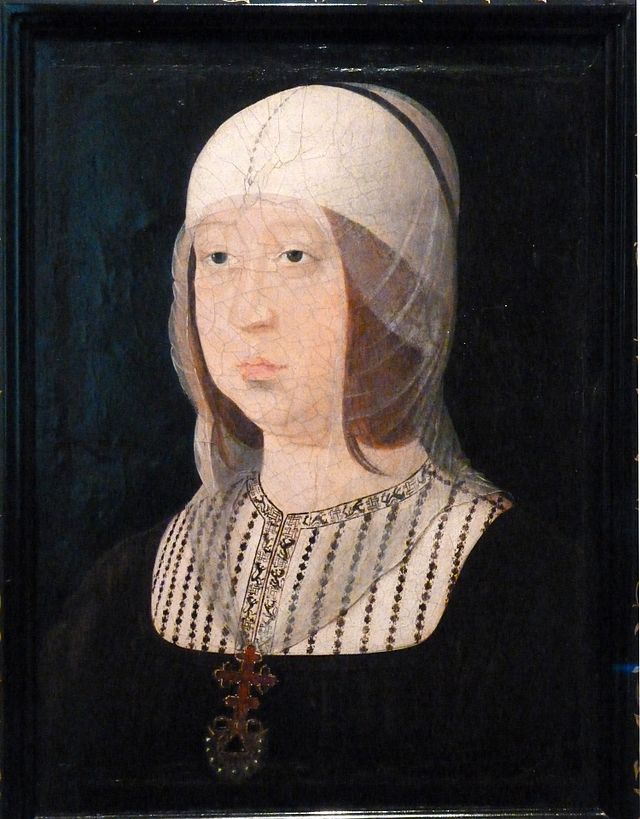
Featured image credit: Isabel the Catholic by Juan de Flandes (c.1500-1504). Accessed via Wikimedia Commons.

